
Project Description
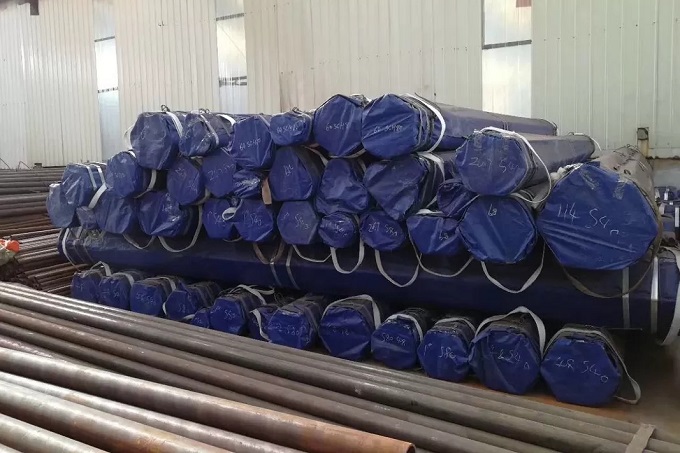
Lead time 15–25 days
Third party SGS / BV / TUV
Quote within 24 hours
Certificate EN 10204 3.1
P235TR2 is the basic non-alloy pressure tube of EN 10216-1, the part of the pressure tube standard written for room-temperature service. The “TR” is the tell: TR2 carries a 27 J Charpy requirement at 0 °C, which is what separates it from TR1 and makes it the grade specified for pipelines, vessels and general pressure equipment that may see a cold start-up. It is not a boiler grade and it is not P235GH. Above about 300 °C the allowable stress falls away because the standard has no elevated-temperature data, and the design has to move to EN 10216-2. Supplying TR2 where GH was specified is one of the quiet errors in this product family: the tube looks the same, the certificate is genuine, and the design basis is gone.
Where TR2 sits in EN 10216
Table 1 — The five parts of EN 10216, and which one applies
| Part | Scope | Typical grades |
|---|---|---|
| EN 10216-1 | Non-alloy tubes for room temperature pressure purposes | P195TR, P235TR, P265TR |
| EN 10216-2 | Non-alloy and alloy tubes for elevated temperature | P235GH, P265GH, 16Mo3, 13CrMo4-5 |
| EN 10216-3 | Alloy fine grain tubes | P355NH, P355NL1 |
| EN 10216-4 | Non-alloy and alloy tubes for low temperature | P215NL, P265NL |
| EN 10216-5 | Stainless tubes | 1.4301, 1.4404, 1.4571 |
TR1, TR2 and TR3
Table 2 — The three quality levels in EN 10216-1
| Designation | Impact requirement | Where it is specified |
|---|---|---|
| P235TR1 | No impact test as standard | General pressure service, mild climate, non-critical |
| P235TR2 | 27 J at 0 °C | Cold climate, outdoor piping, vessels that may see a cold start |
| P235TR1 with impact by agreement | Test temperature stated on the order | Where the code requires toughness but the grade is fixed |
TR2 is not a higher strength grade — the tensile and yield are identical to TR1. The only difference is the impact test, and that difference is the whole reason it is ordered. If the purchase order does not state TR2, the mill may ship TR1 and the certificate will still look correct.
Chemical composition
Table 3 — Chemical requirements, heat analysis (%)
| Element | Requirement |
|---|---|
| Carbon | 0.16 max |
| Silicon | 0.35 max |
| Manganese | 0.40 – 1.20 |
| Phosphorus | 0.025 max |
| Sulphur | 0.020 max |
| Aluminium, total | 0.020 min |
| Chromium | 0.30 max |
| Copper | 0.30 max |
| Nickel | 0.30 max |
| Molybdenum | 0.08 max |
| Niobium | 0.010 max |
| Titanium | 0.040 max |
| Vanadium | 0.02 max |
Mechanical properties
Table 4 — Room-temperature requirements
| Property | Requirement | Note |
|---|---|---|
| Yield, 0.2% | 235 MPa min | Falls with wall thickness above 16 mm |
| Tensile | 360 – 500 MPa | Upper limit applies; over-strong tube is rejected |
| Elongation in 50 mm | 25% min | Longitudinal |
| Impact, Charpy V | 27 J at 0 °C | Transverse where the wall allows |
| Hardness | Not specified | Typically 140–170 HBW |
| Delivery condition | As rolled or normalized | Normalized for wall above 16 mm or after cold finishing |
P235TR2 against P235GH and P265GH
Table 5 — Choosing the pressure tube grade
| P235TR2 | P235GH | P265GH | |
|---|---|---|---|
| Standard | EN 10216-1 | EN 10216-2 | EN 10216-2 |
| Service | Room temperature | Elevated temperature | Elevated temperature |
| Yield | 235 MPa | 235 MPa | 265 MPa |
| Tensile | 360 – 500 MPa | 360 – 500 MPa | 410 – 530 MPa |
| Impact | 27 J at 0 °C | 27 J at 20 °C | 27 J at 20 °C |
| Elevated temperature data | None | Tabulated to 400 °C | Tabulated to 400 °C |
| Delivery condition | As rolled or normalized | Normalized | Normalized |
Sizes and tolerances
Table 6 — Dimensional range
| Parameter | Range / tolerance |
|---|---|
| Outside diameter | 10.2 – 762 mm |
| Wall thickness | 1.6 – 100 mm |
| OD tolerance | ±0.75% or ±0.5 mm, whichever is greater (D2) |
| Wall tolerance | −12.5% / +15% (S2) or ±10% (S1) by agreement |
| Length | 5 – 7 m random, or fixed cut 3 – 12 m |
| Straightness | 0.2% of length |
| Ends | Plain, bevelled, or threaded |
| Surface | As rolled, pickled, or black painted |
Where P235TR2 is used
General pressure piping
Water, air and non-hazardous process lines inside plants, where the design temperature is near ambient.
Pressure vessels
Small receivers and air tanks where the code accepts a room-temperature pressure tube and impact toughness at 0 °C is required.
Outdoor piping
Cold-climate installations where TR1 would be acceptable on stress but not on toughness.
Fire main
Wet and dry fire systems, often with a galvanized or painted finish and a 0 °C impact requirement.
Compressed air
Receiver piping and distribution headers, where the design temperature is set by the compressor outlet and stays below 200 °C.
Structural pressure parts
Jacket tubes and support legs that see pressure but not temperature.
Frequently asked questions
Can P235TR2 be used at elevated temperature?
No. EN 10216-1 has no elevated-temperature proof stress data, so there is no design basis above about 300 °C. If the design temperature is above ambient, P235GH to EN 10216-2 is the correct grade.
What is the difference between P235TR1 and P235TR2?
The impact test. TR1 has no impact requirement as standard; TR2 requires 27 J at 0 °C. The chemistry and the tensile properties are the same, which is why the grade suffix on the purchase order matters more than the grade number.
Is P235TR2 the same as P235GH?
No. Same yield and similar tensile, different standard and different design basis. TR2 is EN 10216-1 for room temperature; GH is EN 10216-2 for elevated temperature, delivered normalized and with proof stress data to 400 °C. They are not interchangeable.
What does the “1.0255” number mean?
It is the EN material number for P235TR2. P235TR1 is 1.0254. The number is what appears on European drawings and in material databases, and it should match the certificate.
Can it be supplied normalized?
Yes, and it is required for wall above 16 mm or after cold finishing. Normalizing at 900–950 °C gives a uniform ferrite-pearlite structure and consistent impact results. State N on the order if the drawing requires it.
Is P235TR2 weldable?
Yes, with standard carbon steel procedures. No preheat is needed below about 25 mm wall; above that, 100–150 °C preheat is good practice. PWHT is not required for its own sake but may be required by the code for wall thickness.
What surface finish is standard?
As rolled, with mill scale. Pickled and oiled, or black painted, are available. For painting or coating, specify pickled and primed rather than as-rolled, because mill scale interferes with adhesion.
What is the minimum order and lead time?
1 tonne per size for standard dimensions. Lead time is 15–25 days; larger diameters and non-standard walls run longer. Third-party inspection adds about a week.
Request a quote
Related products
P265GH (1.0425) TubeHigher strength EN 10216-2 grade
EN 10216-2 Boiler TubeP235GH to 13CrMo4-5
ASTM A106 PipeThe US carbon steel pressure pipe
P355NH (1.0563) TubeEN 10216-3 fine grain pressure tube
DIN 17175 PipeThe legacy German boiler standard
All boiler and pressure tube · Guide: the five parts of EN 10216 and how to read a pressure tube drawing
Also in this range: DIN 17175 boiler pipe · EN 10297-1 E355 mechanical tube · EN 10297-1 E275 mechanical tube · ASTM A335 chrome-moly boiler pipe.
Request a quotation
Give us OD, wall, length, quantity, design temperature and the impact requirement. If the drawing says P235TR2, confirm whether TR1 would be acceptable — the price difference is small but the certificate is different.