
Project Description
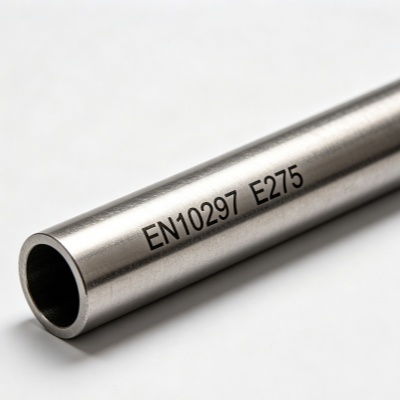
Equivalent Grades of E275 Across International Standards
E275 has recognized equivalents in major national and international standards, enabling specification interchange and cross-regional procurement. The table below lists comparable grades with their governing standards.
| Standard | Grade | Remarks |
|---|---|---|
| DIN | St44-2 (1.0144) | Closest legacy German equivalent |
| ASTM | A570 Gr. 40 / A36 | A570 Gr. 40 is closest; verify for tube form |
| JIS | SS490 | JIS G3101 general structural rolled steel |
| GOST | St4ps | GOST 380 common carbon steel; semi-killed |
| ISO | Fe430B | ISO 630 structural steel; comparable strength |
| BS | S275JR | BS EN 10025-2; replaces BS 4360 Gr 43C |
While these grades share comparable strength and chemistry ranges, material substitution should be validated against the specific application’s mechanical property requirements. FUSHUN METAL provides EN 10204 Type 3.1 mill certificates confirming actual chemical composition and mechanical test results for every supplied lot.
Typical Applications of E275 Seamless Tubes
With 275 MPa minimum yield strength and good toughness, E275 seamless tubes are engineered for medium-duty mechanical applications. FUSHUN METAL supplies E275 tubing to global manufacturers for the following downstream components:
Shock absorber outer tubes, suspension strut housings, steering tie rods, drive shaft sleeves, axle casing tubes
Hydraulic cylinder barrels and piston rods, pneumatic cylinder bodies, hydraulic line pipes, accumulator shells
Spinning frame rollers, loom cylinder tubes, printing press impression cylinders, dyeing machine guide rollers
Precision honed tubes for cylinder liners, guide bushings, machine tool spindles, linear bearing housings, measuring instrument bodies
Structural hollow section columns, crane boom sections, scaffold standards, transmission tower members, bridge railing posts
Shaft sleeves, bearing spacer tubes, telescopic assemblies, cold-formed mechanical parts, conveyor roller bodies
E275 Tube Supply — Dimensions and Manufacturing Methods
FUSHUN METAL supplies EN 10297-1 E275 seamless tubes across three manufacturing routes, covering a wide dimensional envelope to serve diverse engineering requirements. With over 15 years of steel supply experience, the company sources exclusively from ISO 9001 and AS9120B-certified production lines and performs incoming dimensional verification and surface inspection on every batch. The standard available size ranges are:
| Process | Outside Diameter (mm) | Wall Thickness (mm) | Typical Length (m) |
|---|---|---|---|
| Hot-Rolled Seamless | 17.2 – 660.0 | 2.0 – 75.0 | 4.0 – 12.0 |
| Cold-Rolled Seamless | 10.0 – 127.0 | 0.5 – 12.0 | 5.8 – 11.0 |
| Cold-Drawn Seamless | 6.0 – 219.1 | 0.5 – 25.0 | 5.8 – 16.0 |
Dimensional tolerances per EN 10297-1: OD ±1% or ±0.5 mm (whichever is greater); WT tolerance varies by wall-thickness-to-OD ratio (±12.5% for WT/OD ≤2.5%, ±10% for WT/OD >5%). Surface finishes: black (hot-rolled), pickled & oiled, or bright (cold-finished). Custom lengths and precision-cut ends are available on request.
E275 Chemical Composition per EN 10297-1
The ladle analysis limits for E275 (1.0225) are defined in EN 10297-1. The moderately higher carbon and manganese content compared to E235 provides the increased strength while maintaining adequate weldability. FUSHUN METAL verifies each heat through optical emission spectrometry (OES) as part of its incoming quality control protocol, ensuring every delivery lot conforms to the specified chemistry limits before release.
| Element | C | Si | Mn | P | S |
|---|---|---|---|---|---|
| Max (%) | 0.21 | 0.35 | 1.40 | 0.030 | 0.035 |
The carbon content up to 0.21% and manganese up to 1.40% provide the E275 grade with its characteristic 275 MPa yield strength. Weldability remains good, with no preheat required for wall thicknesses up to 20 mm. The controlled phosphorus and sulfur levels ensure consistent surface quality and mechanical integrity.
E275 Mechanical Properties — Normalized (+N) Condition
The standard delivery condition per EN 10297-1 is normalized (+N), achieved by heating to 890–920 °C followed by controlled air cooling to produce a uniform ferrite-pearlite microstructure. E275 delivers a meaningful strength step-up from E235 while preserving sufficient ductility for forming and welding. FUSHUN METAL validates all mechanical properties through routine tensile testing on every test unit, with EN 10204 Type 3.1 certification issued for every shipment.
| Property | t ≤ 16 mm | 16 < t ≤ 40 mm | 40 < t ≤ 65 mm |
|---|---|---|---|
| Yield Strength ReH (MPa, min) | 275 | 265 | 255 |
| Tensile Strength Rm (MPa) | 410 – 550 | 410 – 550 | 410 – 550 |
| Elongation A5 (%, min) | 21 | 21 | 21 |
| Hardness (HBW, approx.) | 120 – 165 | ||
For wall thicknesses over 65 mm up to 100 mm, yield strength decreases to 245 MPa (65–80 mm) and 235 MPa (80–100 mm) with tensile strength of min 380 MPa. In the as-rolled (+AR) condition, E275 achieves 410 MPa tensile and 275 MPa yield (t ≤16 mm), while cold-drawn (+C) condition raises tensile strength to 560 MPa minimum. Optional impact testing (Charpy V-notch) and hardness verification are available per customer specification.
E275 Seamless Tube Additional Product Data
Seamless process exclusively: hot-finished, cold-drawn, or cold-rolled, as mandated by EN 10297-1. Standard delivery condition is normalized (+N); alternative conditions include as-rolled (+AR), cold-drawn/hard (+C), or cold-drawn/soft (+LC) on request. FUSHUN METAL ensures full EN 10297-1 compliance through its ISO 9001 and AS9120B audited supply chain, with every production lot traceable to its originating mill heat number.
Mandatory tests per EN 10297-1: ladle analysis, room-temperature tensile test, flattening test (for OD ≥10 mm and WT ≤40% of OD), dimensional inspection, and visual surface examination. EN 10204 Type 3.1 inspection certificate accompanies every shipment. Optional tests: Charpy V-notch impact test at specified temperatures, Brinell hardness test (HBW), eddy current or ultrasonic NDT per EN 10893 series, and product analysis verification.
Good arc weldability with all standard processes (MIG/MAG, TIG, MMA). No preheat required for wall thickness ≤20 mm; 100–150 °C preheat recommended for thicker sections due to higher carbon equivalent. Good cold formability suitable for bending, flaring, swaging, and expansion operations within the grade’s ductility limits. Post-weld stress relief at 550–650 °C recommended for heavy-wall or restrained assemblies to relieve residual stresses and maintain dimensional accuracy.
Available surface finishes: black (as-rolled/hot-finished), pickled and oiled, or bright (cold-drawn or cold-rolled). Corrosion protection options: shop-applied anti-rust varnish, hot-dip galvanizing to EN ISO 1461, or epoxy/polyurethane paint systems. Standard export packaging: hexagonal bundled stacks secured with steel strapping, plastic end caps for thin-walled and bright-finish tubes, and weatherproof wrapping for sea freight. Custom crating and individual tube wrapping available for precision-finished components.