
Project Description
Lead time 20–30 days
Fine grain Al ≥ 0.020%
Quote within 24 hours
Test category TC1 / TC2
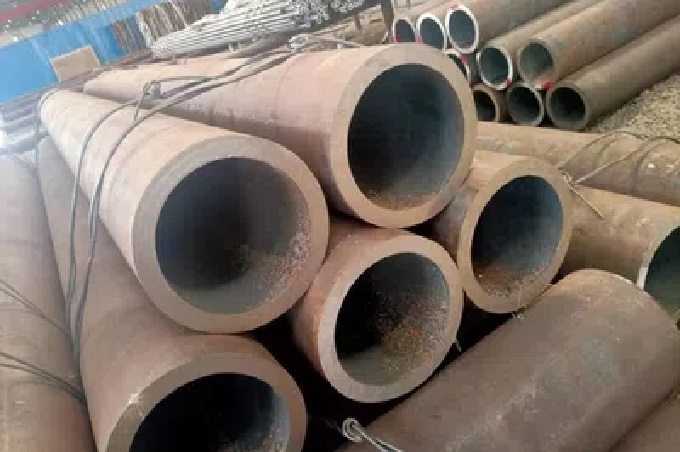
P355NH — EN number 1.0565 — is the 355 MPa normalized fine-grain pressure tube grade. It sits in EN 10216-3, not EN 10216-2, and that distinction is the thing most datasheets get wrong: the NH grades are alloy fine grain steels, with a manganese range of 1.1 to 1.7%, a mandatory aluminium addition and a toughness requirement that the carbon grades do not carry. What that buys is a wall thickness roughly two thirds of what P265GH needs at the same pressure, plus guaranteed impact energy down to −20 °C. It is the grade behind thick-walled steam piping, boiler headers and gas storage vessels where a carbon steel wall would become uneconomically heavy. We supply OD 10 to 600 mm, wall 1 to 80 mm, normalized, TC1 or TC2, with longitudinal and transverse impact values on the certificate.
EN 10216-3, not EN 10216-2
Table 1 — Why the part number matters
| Standard | Steel type | Grades | Toughness requirement |
|---|---|---|---|
| EN 10216-2 | Non-alloy and alloy, elevated temperature | P235GH, P265GH, 16Mo3, 13CrMo4-5 | Impact per test category |
| EN 10216-3 | Alloy fine grain, elevated temperature | P355NH, P355NL1, P460NH | Fine grain with Al minimum, impact to −20 °C or lower |
The practical difference: a P355NH heat must be aluminium-killed to a fine grain size, which is what delivers the 27 J minimum at −20 °C. That is a metallurgical requirement, not a test the mill can add at the end. A quotation offering “P355NH to EN 10216-2” has not understood the grade.
Chemical composition
Table 2 — P355NH / 1.0565 chemistry, cast analysis (%)
| Element | Requirement | Element | Requirement |
|---|---|---|---|
| C | 0.18 max | P | 0.025 max |
| Si | 0.50 max | S | 0.015 max |
| Mn | 1.10 – 1.70 | Cr | 0.30 max |
| Ni | 0.50 max | Mo | 0.08 max |
| Al total | 0.020 min | Nb + Ti + V | 0.15 max total |
Sulphur at 0.015% is the second thing that separates this from a carbon grade — it is half the allowance in P265GH. Combined with the aluminium minimum, that is what makes the impact values at −20 °C achievable rather than hopeful.
Mechanical properties
Table 3 — Tensile and yield by wall thickness, normalized condition
| Wall thickness | Tensile Rm | Yield ReH min | Elongation A min |
|---|---|---|---|
| Up to 16 mm | 490 – 630 MPa | 355 MPa | 22% |
| Over 16 – 40 mm | 490 – 630 MPa | 345 MPa | 22% |
| Over 40 – 60 mm | 490 – 630 MPa | 335 MPa | 22% |
| Over 60 – 100 mm | 470 – 610 MPa | 325 MPa | 22% |
| Over 100 – 150 mm | 460 – 600 MPa | 315 MPa | 22% |
Impact energy
This is the table that justifies the grade. The impact requirement is not a formality — it is what allows the tube to be used in a pressure vessel that must not fracture at low ambient temperature or during a pressure test in winter.
Table 4 — Minimum absorbed energy in the normalized condition
| Test temperature | Transverse | Longitudinal | Note |
|---|---|---|---|
| +20 °C | 39 – 50 J | 55 – 75 J | The normal acceptance point for TC1 / TC2 |
| 0 °C | 35 – 40 J | 47 – 65 J | Standard cold-service requirement |
| −20 °C | 27 – 30 J | 40 – 45 J | The limit of the base NH grade — order it explicitly |
| −40 °C and below | Not covered — specify P355NL1 | The L grades are the low-temperature variant of the same steel | |
Values are quoted as ranges because the standard gives a minimum average plus a rule for individual specimens, and actual results sit above the minimum. If your design needs a specific figure at −20 °C, state it and we will quote against tested results rather than a table.
Standards and equivalents
Table 5 — Cross-reference
| System | Designation | Product form | Note |
|---|---|---|---|
| EN | EN 10216-3 — P355NH / 1.0565 | Seamless tube | The reference specification |
| EN | EN 10217-3 — P355NH | Welded tube | Same grade, welded product |
| ASTM | A662 Grade C | Plate | The vessel plate equivalent — useful when shells and tubes must match |
| DIN | WStE 355 | Tube and plate | Withdrawn predecessor |
| AFNOR | A 510 AP | Tube | French designation |
| BS | 224 Gr. 490 | Tube | British designation |
| UNI | FeE 355-2 | Tube | Italian designation |
Inspection
Table 6 — Test scope
| Test | Status | Note |
|---|---|---|
| Cast analysis | Required | Including Al and the Nb+Ti+V total |
| Product analysis | TC2 required | Confirms fine grain elements in the finished tube |
| Tensile at room temperature | Required | Rm, ReH, elongation |
| Impact test | Required | Longitudinal and transverse, at the ordered temperature |
| Flattening or ring test | Required | Per size and wall |
| Leak tightness | Required | Hydrostatic or NDT |
| NDT of the body | TC2 required | Eddy current or ultrasonic |
| Elevated temperature tensile | Optional | Ordered when the design needs verified data above 400 °C |
Where P355NH earns its price
Thick-walled steam piping
Main steam and hot reheat lines where a P265GH wall would be too heavy to support and too slow to weld.
Boiler headers
Header bodies and stubs where the wall is driven by pressure rather than by corrosion allowance, and toughness at ambient is a construction requirement.
Gas storage vessels
Pressurised gas and air storage where the vessel is tested and stored outdoors, so the impact requirement at −20 °C is real.
Hydropower penstocks
Large diameter pressure tube and pipe, where the combination of strength and toughness at low temperature is the specification driver.
Pressure vessel shells
Shell courses matched to A662 Gr.C plate, so the tube and plate on the same vessel are metallurgically consistent.
Cold climate plants
Any installation commissioned in winter at high latitude, where a carbon steel wall would need impact testing above its specified range.
Frequently asked questions
Is P355NH in EN 10216-2 or EN 10216-3?
EN 10216-3. The NH grades are alloy fine grain steels; EN 10216-2 covers the non-alloy and alloy carbon grades like P265GH and 13CrMo4-5. Many datasheets get this wrong, including some that were written by suppliers of the grade.
What does NH stand for?
Normalized, with specified elevated temperature properties, for pressure purposes. The N is the heat treatment, the H the high-temperature property set. NL is the same steel with a low-temperature impact requirement.
Can P355NH replace P265GH?
Usually yes, and it is the normal upgrade when the wall gets too thick. It needs a design review for the higher allowable stress and for weld procedures, because the fine grain steel has a narrower welding window. It is not a drop-in swap on an existing qualified procedure.
What is the difference between P355NH and P355NL1?
Impact temperature. P355NH is tested to −20 °C, P355NL1 to −40 °C or lower depending on the sub-grade. If the design calls for toughness below −20 °C, the NH grade does not cover it.
Does it need post-weld heat treatment?
Depends on wall and code, not on the grade. Fine grain steels are more sensitive to over-tempering than carbon steel, so PWHT temperature control matters — stay within the WPS range and do not exceed it to “be safe”.
Why is the aluminium content on the certificate?
Because the aluminium addition is what pins the grain size and delivers the impact values. A heat at 0.015% Al can pass the tensile test and fail the specification. Check the figure, not just the impact result.
Can you supply matching plate?
Yes, A662 Gr.C plate to match the tube, from the same mill where possible. Supplying tube and plate as a package removes the mismatch that shows up at the tube-to-tubesheet joint.
What is the minimum order and lead time?
One tonne per size. Lead time is 20–30 days; above 40 mm wall and for TC2 with third-party witness, expect the longer end.
Request a quote
Related products
P235TR1 (1.0254) TubeRoom temperature pressure service
16Mo3 (1.5415) Tube0.3% Mo for service to 500 °C
13CrMo4-5 (1.7335) Tube1.25Cr-0.5Mo for superheater service
ASTM A106 Seamless PipeGr A / B / C, the US carbon route
EN 10216-2 Pressure TubeThe full GH grade range
All boiler and pressure tube — carbon, alloy and stainless · Guide: which standard governs your order
Request a quotation
Give us OD, wall, design temperature, design pressure and quantity. We reply within 24 hours with price, lead time and impact test scope.