
Project Description
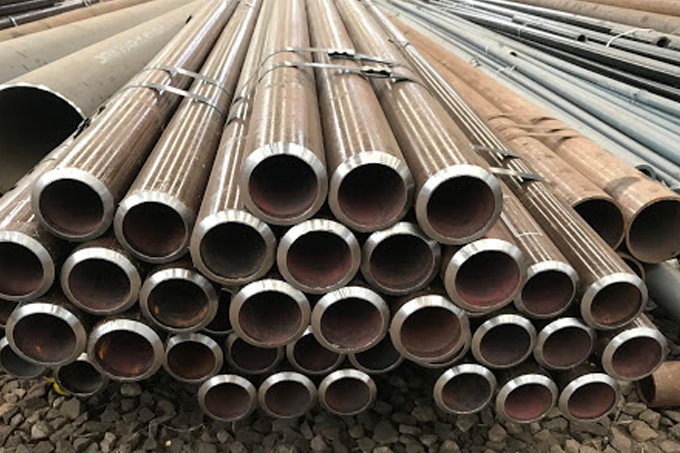
Lead time 20–30 days
Third party SGS / BV / TUV
Quote within 24 hours
Hardness 250 HBW max, every lot
ASTM A335 is the seamless ferritic alloy steel pipe specification for high-temperature service — superheater and reheater tubing, main steam lines, and hot reheat piping in fossil power plants, plus the high-pressure sections of refinery and petrochemical units. Where A106 runs out of allowable stress above roughly 450 °C, A335 takes over: chromium gives oxidation resistance, molybdenum gives creep strength, and the vanadium-niobium addition in P91 lifts the usable ceiling to 649 °C at a wall thickness about half that of P22. The grades are not interchangeable. P11, P22 and P91 all look like black pipe and all carry the same stencil format, but they have different welding procedures, different heat treatment and different design allowables. We supply P5, P9, P11, P22, P91 and P92 in NPS 1/2 to 24, normalized and tempered, with hardness, tensile and impact results on the certificate, and we will say on the quotation which grade your design temperature actually requires.
Six grades, six different jobs
Grade selection in A335 is driven by metal temperature, not by price. The table below is the decision a piping engineer actually makes; the wall thickness follows from the allowable stress in ASME B31.1 Table A-1 or B31.3 Table A-1 at design temperature.
Table 1 — A335 grades, chemistry family and where each is used
| Grade | Family | Typical metal temperature | Where it is specified |
|---|---|---|---|
| P5 | 5Cr–0.5Mo | up to 593 °C, oxidation-limited higher | Refinery heater tubes, catalytic reformer lines, high-sulphur process piping where 2.25Cr is not enough. |
| P9 | 9Cr–1Mo | up to 649 °C | Older superheater tubing and steam lines; largely superseded by P91 for new construction but still the repair and replacement grade. |
| P11 | 1.25Cr–0.5Mo | up to 593 °C | The workhorse. Superheater tubing, steam headers, hot process lines, hydrogen service where P22 is not required. |
| P22 | 2.25Cr–1Mo | up to 593 °C | Higher-pressure steam lines, hydrocracker and hydrotreater piping, ammonia synthesis loops (with the appropriate impact testing). |
| P91 | 9Cr–1Mo–V–Nb | up to 649 °C | Main steam and hot reheat lines in supercritical plants, thick-wall headers. Creep strength roughly twice P22 at 600 °C. |
| P92 | 9Cr–0.5Mo–1.8W–V–Nb–B | up to 620–649 °C | Ultra-supercritical main steam; higher creep rupture than P91, tighter welding and hardness control. |
Chemical composition
Table 2 — ASME SA-335 chemical requirements, heat analysis (%)
| Element | P5 | P9 | P11 | P22 | P91 | P92 |
|---|---|---|---|---|---|---|
| Carbon | 0.15 max | 0.15 max | 0.05–0.15 | 0.05–0.15 | 0.08–0.12 | 0.07–0.13 |
| Manganese | 0.30–0.60 | 0.30–0.60 | 0.30–0.60 | 0.30–0.60 | 0.30–0.60 | 0.30–0.60 |
| Silicon | 0.50 max | 0.50–1.00 | 0.50–1.00 | 0.50 max | 0.20–0.50 | 0.50 max |
| Chromium | 4.00–6.00 | 8.00–10.00 | 1.00–1.50 | 1.90–2.60 | 8.00–9.50 | 8.50–9.50 |
| Molybdenum | 0.45–0.65 | 0.90–1.10 | 0.44–0.65 | 0.87–1.13 | 0.85–1.05 | 0.30–0.60 |
| Vanadium | — | — | — | — | 0.18–0.25 | 0.15–0.25 |
| Niobium | — | — | — | — | 0.06–0.10 | 0.04–0.09 |
| Tungsten | — | — | — | — | — | 1.50–2.00 |
| Nitrogen | — | — | — | — | 0.030–0.070 | 0.030–0.070 |
| Phosphorus, max | 0.025 | 0.025 | 0.025 | 0.025 | 0.020 | 0.020 |
| Sulphur, max | 0.025 | 0.025 | 0.025 | 0.025 | 0.010 | 0.010 |
P91 and P92 are the two grades where residual elements decide whether the pipe passes. Nickel above 0.20%, copper above 0.10% and a nitrogen outside 0.030–0.070% all push the creep rupture strength down, which is why these heats are bought against a restricted analysis rather than the bare specification.
Mechanical properties
Table 3 — Tensile and hardness requirements
| Grade | Tensile, min | Yield, min | Elongation, min | Hardness, max |
|---|---|---|---|---|
| P5 | 415 MPa (60 ksi) | 205 MPa (30 ksi) | 30% | 250 HBW |
| P9 | 415 MPa (60 ksi) | 205 MPa (30 ksi) | 30% | 250 HBW |
| P11 | 415 MPa (60 ksi) | 205 MPa (30 ksi) | 30% | 250 HBW |
| P22 | 415 MPa (60 ksi) | 205 MPa (30 ksi) | 30% | 250 HBW |
| P91 | 585 MPa (85 ksi) | 415 MPa (60 ksi) | 20% | 250 HBW |
| P92 | 620 MPa (90 ksi) | 440 MPa (64 ksi) | 20% | 250 HBW |
Transverse tensile testing is standard for pipe over NPS 8; longitudinal specimens are permitted below that. Impact testing is not a routine A335 requirement — it becomes one when the purchase order invokes a low-temperature service specification, a sour service specification, or ASME construction that requires it. State the test temperature on the order; it changes the heat treatment acceptance, not just the certificate paperwork.
Heat treatment
Table 4 — Delivery condition and typical mill heat treatment
| Grade | Delivery condition | Normalizing / austenitizing | Tempering |
|---|---|---|---|
| P5 | Normalized and tempered, or full anneal | 930–980 °C | 700–760 °C |
| P9 | Normalized and tempered | 870–930 °C | 700–760 °C |
| P11 | Normalized and tempered | 900–960 °C | 650–730 °C |
| P22 | Normalized and tempered | 900–960 °C | 680–750 °C |
| P91 | Normalized and tempered | 1040–1080 °C | 730–800 °C |
| P92 | Normalized and tempered | 1040–1080 °C | 730–780 °C |
P91 that has been cooled too slowly through the 400–700 °C range, or tempered below 730 °C, will pass a room-temperature tensile test and still fail in service. The hardness reading is the cheap check: a P91 heat reading under about 190 HBW usually means over-tempering, and one over 250 HBW means the tempering was skipped.
Temperature capability and design basis
The allowable stress that governs wall thickness is read from ASME B31.1 Table A-1 or B31.3 Table A-1 at the design metal temperature. The values fall steeply above 550 °C for the 1.25Cr and 2.25Cr grades and much less steeply for P91, which is why the 9Cr grades win on wall thickness rather than on price per tonne.
Table 5 — Service limits and what governs above them
| Grade | Practical maximum metal temperature | What limits it |
|---|---|---|
| P11 | 593 °C (1100 °F) | Creep strength; above this the allowable stress falls below what a economic wall can deliver. |
| P22 | 593 °C (1100 °F) | Creep strength and temper resistance; standard ceiling in ASME B31.1. |
| P5 | 593 °C continuous, higher under oxidation-limited duty | Creep at the low-carbon 5Cr composition; oxidation resistance is the stronger property. |
| P9 | 649 °C (1200 °F) | Creep; largely replaced by P91 where the higher strength pays for the welding cost. |
| P91 | 649 °C (1200 °F) | Type IV cracking in the fine-grained heat-affected zone of welds, not the base metal. |
| P92 | 620–649 °C | Creep rupture and weld toughness; boron and tungsten raise the ceiling but narrow the heat treatment window. |
Dimensions and tolerances
Table 6 — Size range and permissible variation (ASME A999/A999M)
| Parameter | Requirement | Practical note |
|---|---|---|
| Outside diameter | NPS 1/2 – 24 standard; larger on inquiry | Hot finished above NPS 2, cold drawn below unless ordered otherwise |
| Wall thickness | −12.5% / +15% of nominal for hot finished | Tighter wall control is available by agreement for thick-wall P91 headers |
| Length | Single random 5.2–7.3 m, double random 11–13.4 m | Fixed cut lengths from 3 m, ±5 mm |
| Straightness | 1 in 500 (0.2%) max | Cold drawn grades hold 1 in 800 in practice |
| Ends | Plain or bevelled 37.5° ±2.5° | Bevelled with 1.6 mm root face for orbital welding |
| Surface | Scale-free, no laps or seams | Pickled and phosphated on request for P11/P22 |
Grade equivalents across systems
Table 7 — A335 grades against EN, JIS and GB designations
| A335 | UNS | EN / DIN | JIS | GB | Not the same as |
|---|---|---|---|---|---|
| P11 | K11597 | 13CrMo4-5 (1.7335) | STPA22 | 15CrMo | 13CrMoSi5-5, which is a different creep family |
| P22 | K21590 | 10CrMo9-10 (1.7380) | STPA24 | 12Cr2Mo | A387 Gr.22 plate — plate is not pipe acceptance |
| P5 | K41545 | 12CrMo9-10 (1.7375) is nearest | STPA25 | 1Cr5Mo | P5b, which has a different carbon range |
| P9 | K90941 | X12CrMo9-1 is nearest | STPA26 | — | P91 — same chromium level, completely different strength |
| P91 | K91560 | X10CrMoVNb9-1 (1.4903) | STPA28 | 10Cr9Mo1VNb | P9; the V and Nb are what make P91 |
| P92 | K92460 | X10CrWMoVNb9-2 (1.4906) | — | — | P91; tungsten and boron change the welding procedure |
Welding and post-weld heat treatment
Table 8 — Welding parameters by grade family
| Grade family | Preheat | Interpass, max | Filler | PWHT |
|---|---|---|---|---|
| P11 | 150–200 °C | 300 °C | ER80S-B2 / E8018-B2 | 650–700 °C, 1 h per 25 mm |
| P22 | 200–250 °C | 300 °C | ER90S-B3 / E9018-B3 | 680–750 °C, 1 h per 25 mm |
| P5 | 200–300 °C | 300 °C | ER80S-B6 / E8015-B6 | 700–760 °C |
| P9 | 200–300 °C | 300 °C | ER80S-B8 / E8015-B8 | 700–760 °C |
| P91 | 200–250 °C | 300 °C | ER90S-B9 / E9015-B9 | 730–780 °C, controlled heating and cooling |
| P92 | 200–250 °C | 300 °C | ER90S-B92 / E9015-B92 | 740–780 °C, tight band |
PWHT on P91 is not optional and not a range you can stretch. Below 730 °C the martensite is not tempered enough and hardness stays high; above 800 °C the creep strength is destroyed and cannot be recovered by re-normalizing a finished weld in the field.
Where A335 is the right answer
Superheater and reheater tubing
P11 and P22 for subcritical boilers, P91 where the steam outlet temperature passes 570 °C and the tube wall has to stay thin enough for the heat flux.
Main steam piping
Thick-wall P91 and P22 headers and hot reheat lines. Wall thickness and PWHT control matter more than the mill certificate here.
Refinery process lines
P5 and P11 in catalytic reforming, hydrotreating and high-sulphur process service where carbon steel would suffer sulphidation.
Hydrogen service
P22 in hydroprocessing loops, bought against API 941 Nelson curve limits and with hardness control on the weld.
Power plant retrofit
P9 and P5 replacement sections in plants built before 1990, where the design allowables were set by the original grade and cannot be upgraded.
Ammonia and syngas
P22 and P11 in synthesis loops, with impact testing at the low-temperature end of the operating envelope.
Frequently asked questions
Can P22 be substituted for P11?
Only with design approval. P22 has higher creep strength, so the substitution is usually conservative on stress, but it changes the welding procedure, the PWHT temperature and the filler metal. A contractor holding a P11 procedure cannot run it on P22 without requalification. In the other direction — P11 for P22 — the substitution is not conservative and should be rejected.
What is the difference between A335 P91 and P9?
Both are 9% chromium. P9 is 9Cr–1Mo with 415 MPa minimum tensile; P91 adds vanadium, niobium and controlled nitrogen, and reaches 585 MPa minimum tensile with roughly double the creep rupture strength at 600 °C. They are not interchangeable at any temperature above 500 °C.
Does A335 need impact testing?
Not by the base specification. Impact testing is invoked by the purchase order — for low-temperature service, for sour service to NACE MR0175, or by the construction code. When it is required, the test temperature is stated on the order and the results go on the 3.1 certificate. Charpy testing at −20 °C or −46 °C on P22 is common in cold-climate projects.
How do I verify P91 after delivery?
Three checks: PMI on every length to confirm 8–9.5% Cr with V and Nb present, hardness survey (190–250 HBW is the window), and a review of the heat treatment chart from the mill. A P91 length that PMIs as 9Cr but shows no vanadium is P9, and it will fail in creep service.
What is the maximum temperature for P22?
593 °C (1100 °F) in ASME B31.1 construction. Above that the allowable stress drops faster than the wall thickness can economically follow, and the design moves to P91 or to a 9Cr grade. European practice with 10CrMo9-10 is similar, with the EN 10216-2 tabulation ending at 600 °C.
Can you supply P91 with a hardness restriction?
Yes. State the window, for example 190–250 HBW or 200–250 HBW, and we will buy the heat against it. Hardness below 185 HBW usually indicates over-tempering and is rejected for creep service; above 250 HBW the weldability and toughness are compromised.
Do you supply cut lengths and bevelled ends?
Yes. Cut from 500 mm upwards with ±3 mm tolerance, plain or bevelled at 37.5° with a 1.6 mm root face. For P91 we recommend bevelling at the mill rather than on site, because field machining without preheat is a common source of cracking.
What is the minimum order and lead time?
One tonne per size for standard schedules. Lead time is 20–30 days depending on grade and size; P91 and P92 thick-wall runs longer because the heat treatment cycle cannot be shortened. Third-party inspection adds about a week.
Request a quote
Related products
ASTM A213 Alloy TubeT5 to T91 for superheater and heat exchanger
EN 10216-2 Pressure TubeP235GH, P265GH, 16Mo3, 13CrMo4-5
13CrMo4-5 (1.7335) Tube1.25Cr-0.5Mo, service to 530 °C
ASTM A192 Boiler TubeSeamless, high pressure, NPS 1/2–7
ASTM A333 Low Temperature PipeGr 1, 3, 6, 8 impact tested to −46 / −101 °C
All boiler and pressure tube — carbon, alloy and stainless · Guide: ASTM vs ASME vs API vs ANSI, and which one governs your order
Also in this range: P235GH (1.0345) boiler tube · P235TR2 (1.0255) pressure tube · DIN 17175 boiler pipe · EN 10297-1 E355 mechanical tube.
Request a quotation
Give us grade, NPS, schedule, design temperature and quantity. We reply within 24 hours with price, lead time and certificate scope — and if the grade does not suit the temperature you have written down, we will say so before you place the order.