
Project Description
Lead time 25–35 days
Cut to size flame or plasma
Quote within 24 hours
UT on request
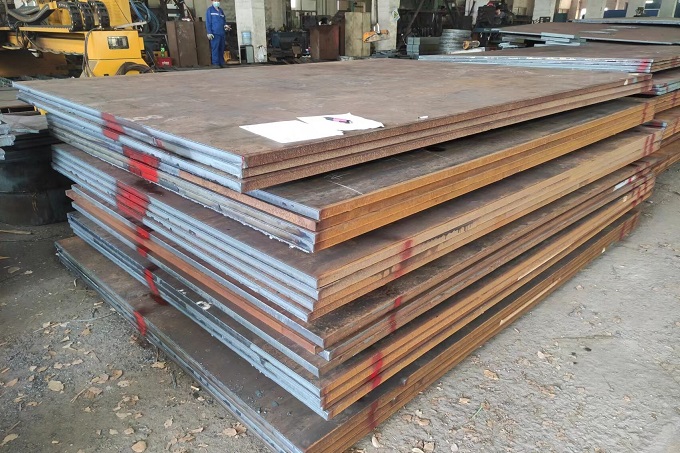
16Mo3 plate — EN number 1.5415 — is the molybdenum-alloyed pressure vessel plate for elevated temperature service, the flat product counterpart of the 16Mo3 tube. About 0.3% molybdenum is the entire alloy addition, and it is what raises the creep strength enough for service to roughly 500 °C where a plain carbon plate would sag. It is used for boiler shells, headers, furnace parts and heat exchanger bodies, and it has one practical advantage over the chrome-moly plates: it welds readily and does not need post-weld heat treatment at moderate thickness. This page covers the plate to EN 10028-2; the tube is a separate product on its own page.
Chemical composition
Table 1 — 16Mo3 / 1.5415 plate chemistry (%)
| Element | Requirement | Element | Requirement |
|---|---|---|---|
| C | 0.12 – 0.20 | P | 0.025 max |
| Si | 0.35 max | S | 0.010 max |
| Mn | 0.40 – 0.90 | Cr | 0.30 max |
| Ni | 0.30 max | Mo | 0.25 – 0.35 |
The molybdenum range has a floor: below 0.25% the creep strength falls away and the plate is no longer 16Mo3. Check the Mo figure on the certificate rather than the tensile result, which will pass either way.
Mechanical properties
Table 2 — Tensile and yield by thickness, normalized
| Thickness | Tensile Rm | Yield ReH min | Elongation A min |
|---|---|---|---|
| Up to 16 mm | 440 – 590 MPa | 275 MPa | 24% |
| Over 16 – 40 mm | 440 – 590 MPa | 265 MPa | 24% |
| Over 40 – 60 mm | 440 – 590 MPa | 255 MPa | 24% |
| Over 60 – 100 mm | 440 – 590 MPa | 245 MPa | 24% |
Plate or tube
Table 3 — The same grade, two product forms
| 16Mo3 plate | 16Mo3 tube | |
|---|---|---|
| Standard | EN 10028-2 | EN 10216-2 |
| Form | Plate, 6 – 100 mm | Seamless tube, OD 10 – 600 mm |
| Where it goes | Shells, headers, furnace parts, tube sheets | Boiler tubes, superheater, stub tubes |
| Certificate | EN 10204 3.1 | EN 10204 3.1 |
| Note | Chemistry and mechanical values are the same grade — supply both from one mill where the vessel needs matching certificates. | |
Where 16Mo3 plate is used
Boiler shells and drums
Shell courses and end plates in the 400–480 °C band, where carbon steel runs out of creep strength.
Headers and manifolds
Header bodies welded from plate, with 16Mo3 tube stubs rolled or welded in.
Furnace parts
Combustion chamber linings and supports exposed to hot gas on one side and steam on the other.
Heat exchanger bodies
Shells where the process side is hot and the design temperature exceeds the carbon steel range.
Tube sheets
Where the tubes are 16Mo3 and the tubesheet must match for weldability and thermal expansion.
Pressure vessel internals
Baffles and supports that run hot but carry little pressure — the creep strength at low stress is what matters.
Frequently asked questions
What is the difference between 16Mo3 plate and tube?
Product form and standard only. Plate is to EN 10028-2, tube to EN 10216-2; the chemistry and mechanical values are the same grade. Where a vessel needs both, buy them as a package so the certificates match.
What is the maximum service temperature for 16Mo3 plate?
About 500 °C, governed by the allowable stress in the design code at temperature rather than a datasheet figure. Above roughly 480 °C most designs move to 13CrMo4-5.
Does it need post-weld heat treatment?
Only when code or thickness requires it, typically above 25–30 mm. Unlike 13CrMo4-5 it does not harden badly in the heat-affected zone, which is why it is popular with fabricators who lack a furnace.
Is it the same as A204 Grade A?
Same chemistry family, different standard. A204 Gr.A is the ASTM plate equivalent; 16Mo3 is the EN designation. They are commonly accepted as alternatives after a review.
Can you cut to size?
Yes — CAD-controlled flame or plasma cutting to drawing, with edges ground where they will be welded. UT and edge preparation on request.
What thickness range is available?
6 to 100 mm as standard. Above that the elevated temperature properties through the section become harder to guarantee and the design should be reviewed.
Is it suitable for sour service?
No. 16Mo3 has no hardness control for H₂S service. Sour duty needs NACE-compliant material, usually stainless or clad plate.
What is the minimum order and lead time?
One tonne. Lead time is 25–35 days; normalized plate and UT run towards the longer end.
Request a quote
Related products
ASTM A537 PlateCl.1 / 2 / 3, impact tested
ASTM A285 PlateGr A / B / C, low pressure
ASTM A516 PlateGr 60 / 65 / 70
EN 10028-2 PlateP265GH, 13CrMo4-5 and this grade
13CrMo4-5 TubeThe next step up the creep ladder
All boiler and pressure vessel plate — carbon, alloy and nickel steel · Guide: ASTM vs ASME, and which one governs your order
Request a quotation
Tell us thickness, plate size, design temperature and quantity. We reply within 24 hours with price, lead time and certificate scope.