
Project Description
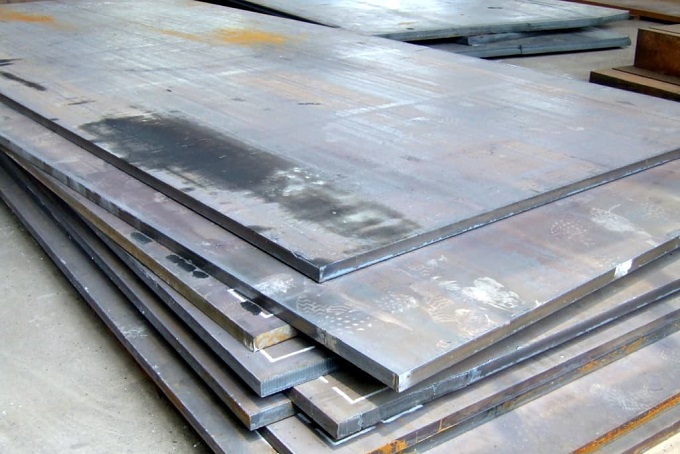
Lead time 30–45 days
Third party SGS / BV / TUV
Quote within 24 hours
Impact tested at −196 °C every lot
ASTM A353 is the 9% nickel cryogenic plate that is double normalized and tempered instead of quenched and tempered. It exists for two reasons: a fabricator without a water quench tank can still produce a tough 9% Ni vessel, and a double normalize leaves a lower residual stress and a more uniform structure through the thickness than a single quench. The price is strength — 515 MPa minimum yield against 585 MPa for A553 — and that difference runs straight into the wall thickness calculation. Both grades are tested at −196 °C to 27 J, both use nickel-based filler, and both look identical on the plate. The only way to tell them apart after delivery is the certificate and the heat treatment record.
What double normalizing does
Table 1 — The heat treatment cycle
| Step | Temperature | Cooling | Purpose |
|---|---|---|---|
| First normalize | 880 – 920 °C | Air | Dissolves the previous structure and removes segregation from the plate rolling |
| Second normalize | 780 – 820 °C | Air | Refines the grain; produces a fine ferrite plus tempered martensite/bainite structure |
| Temper | 565 – 605 °C | Air | Restores toughness and relieves stress without dropping below 515 MPa yield |
| Optional stress relief | ≤ 565 °C | Furnace | After welding, only where the code requires it |
The second normalize is not a repeat of the first. The lower temperature is what refines the grain, and skipping it produces a plate that passes tensile and fails Charpy at −196 °C — the failure mode is toughness, not strength, which is why the impact test is the acceptance that matters.
Chemical composition
Table 2 — Chemical requirements, heat analysis (%)
| Element | Requirement | Why it is controlled |
|---|---|---|
| Carbon | 0.13 max | Higher carbon raises strength but sharply lowers −196 °C toughness |
| Manganese | 0.90 max | Residual from deoxidation; too high promotes banding |
| Silicon | 0.35 max | Deoxidation; excess worsens toughness |
| Phosphorus | 0.035 max | Temper embrittlement; lower for thick plate |
| Sulphur | 0.035 max | Through-thickness ductility and HAZ toughness |
| Nickel | 8.50 – 9.50 | The alloying element that delivers the cryogenic toughness |
| Molybdenum | 0.10 max | Residual; restricted to keep the transformation behaviour predictable |
| Chromium | 0.25 max | Residual |
| Copper | 0.35 max | Residual; affects toughness |
| Vanadium | 0.05 max | Residual |
Mechanical properties
Table 3 — Requirements and typical values
| Property | Requirement | Typical as supplied |
|---|---|---|
| Yield, 0.2% | 515 MPa min | 530 – 600 MPa |
| Tensile | 690 – 825 MPa | 700 – 790 MPa |
| Elongation in 50 mm | 20% min | 23 – 28% |
| Charpy at −196 °C | 27 J average, 20 J single | 60 – 120 J |
| Hardness | Not specified | 200 – 240 HBW |
| Thickness range | 6 – 100 mm | — |
A353 against A553
Table 4 — Choosing between the two 9% nickel routes
| A353 | A553 Type I | |
|---|---|---|
| Heat treatment | Double normalize + temper | Quench + temper |
| Yield | 515 MPa | 585 MPa |
| Elongation | 20% | 18% |
| Residual stress | Lower | Higher, relieved by tempering |
| Thickness uniformity | Better through thick sections | Depends on quench severity |
| Wall thickness for the same duty | About 12% thicker | The thinner option |
| Chosen when | No quench facility, or the design was written around A353 | New LNG tanks and vessels where weight matters |
Welding
Table 5 — Welding parameters
| Parameter | Recommendation |
|---|---|
| Filler | ENiCrMo-3 (Alloy 625 type) or ENiCrFe-2 |
| Preheat | None; minimum 15 °C ambient |
| Heat input | 0.5 – 1.5 kJ/mm |
| Interpass | ≤ 150 °C |
| PWHT | Avoid; if the code requires it, cap at 565 °C |
| Impact test of procedure | At −196 °C, weld metal and HAZ |
| NDE | RT or UT on all main seams |
Inspection and certification
Table 6 — Test package
| Test | Frequency | Standard |
|---|---|---|
| Chemistry | Every heat | ASTM A751 |
| Tensile and yield | Every heat treatment lot | ASTM A370 |
| Charpy at −196 °C | Every heat treatment lot | ASTM A370, E23 |
| Dimensional | Every plate | ASTM A20 / A353 |
| Ultrasonic | When specified | ASTM A435 / A578 |
| Heat treatment record | Every lot | Furnace chart supplied with certificate |
| Certificate | Every order | EN 10204 3.1 |
Where A353 plate is used
Cryogenic pressure vessels
Liquid nitrogen, oxygen and argon storage, where the vessel is designed to A353 and the plate is not interchangeable with A553.
LNG satellite tanks
Smaller tanks and road tankers where the fabricator does not have a quench facility and the extra wall is acceptable.
Air separation cold boxes
Shell and support plate, welded with nickel filler and stress relieved only where the code requires it.
Ethylene and propylene
−104 °C service, where 9% Ni is chosen for toughness and the strength difference between A353 and A553 is not critical.
Repair plate
Matching an existing A353 vessel where the original design and welding procedure were built around double normalized plate.
Thick-wall cryogenic sections
Where a through-thickness property matters and the more uniform double normalize structure is preferred.
Frequently asked questions
Is A353 the same as A553?
No. Both are 9% nickel and both are tested at −196 °C to 27 J, but A353 is double normalized and tempered with 515 MPa minimum yield, while A553 is quenched and tempered with 585 MPa minimum yield. Different heat treatment, different strength, separate specifications.
Why choose A353 instead of A553?
Either because the fabricator has no water quench facility large enough for the plate, or because the vessel was designed and qualified around A353. The double normalize also gives a more uniform structure through thick sections, which some specifications prefer for through-thickness properties.
Does A353 need post-weld heat treatment?
Normally no. If the code requires stress relief, the temperature is capped at 565 °C because above that the plate over-tempers and the yield falls below 515 MPa. The welding procedure has to be qualified with impact testing after the stress relief cycle.
What filler is used for A353?
Nickel-based filler, ENiCrMo-3 or ENiCrFe-2. Ferrous 9% Ni filler gives inadequate weld metal and HAZ toughness at −196 °C because of dilution and grain coarsening.
Can A353 be used at −196 °C in a pressure vessel?
Yes, that is its design case, provided the impact test results meet 27 J average and 20 J single at −196 °C, and the welding procedure is qualified at the same temperature. The plate certificate alone is not sufficient — the fabrication procedure has to be qualified too.
What is the maximum thickness?
100 mm to A353. Above that the specification does not cover the thickness and a special approval with additional testing is needed, because the double normalize may not produce uniform properties through a heavier section.
How do I tell A353 from A553 on site?
You cannot, visually or with a PMI gun — both read about 9% nickel. The distinction is the certificate, the heat treatment record and the yield strength on the test report. Keep the plate identification through fabrication, because a mixed lot is a rework problem, not a paperwork problem.
What is the minimum order and lead time?
5 tonnes for standard thicknesses. Lead time is 30–45 days; the double normalize takes two furnace cycles and cannot be compressed. Third-party witness of the −196 °C test adds about a week.
Request a quote
Related products
ASTM A516 PlateGr 60 / 65 / 70 for moderate low temperature
304 / 304L PlateThe stainless alternative at −196 °C
13CrMo4-5 PlateHigh temperature vessel plate
A387 Gr.22 Plate2.25Cr for hydrogen and high temperature
ASTM A285 PlateLow and intermediate tensile vessel plate
All low temperature and cryogenic steel · All pressure vessel plate · Guide: A553 vs A353 — the same nickel, a different heat treatment
Also in this range: ASTM A516 vessel plate · 13CrMo4-5 (1.7335) plate · ASTM A553 9% nickel plate.
Request a quotation
Give us thickness, width, length, quantity, design temperature and the impact requirement. Tell us the design code and whether stress relief after welding is planned.