
Project Description
Lead time 20–30 days
Third party SGS / BV / TUV
Quote within 24 hours
Cutting plasma or waterjet to size
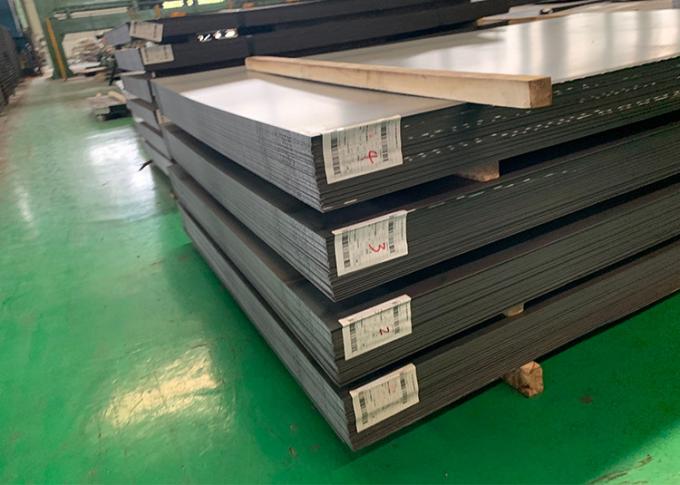
13CrMo4-5 is the 1.25Cr–0.5Mo pressure vessel plate of EN 10028-2, and it is the grade that lets a vessel run at 450–530 °C without moving to stainless. The chromium gives oxidation and hydrogen resistance, the molybdenum gives creep strength, and the low carbon keeps the plate weldable with a straightforward preheat. It is the European counterpart of ASTM A387 Gr.11, used for steam drums, hydrocracker and hydrotreater shells, hot separator vessels, and the transition course between carbon steel and 2.25Cr equipment. Plate is supplied normalized or normalized and tempered, with elevated-temperature proof stress tabulated in the standard, and ultrasonic testing to EN 10160 available when the vessel is in hydrogen or high-pressure service.
Chemistry and why each element is there
Table 1 — Chemical requirements, EN 10028-2 (heat analysis, %)
| Element | Requirement | Function |
|---|---|---|
| Carbon | 0.08 – 0.18 | Strength; the upper limit is what keeps the HAZ hardenability manageable |
| Silicon | 0.35 max | Deoxidation |
| Manganese | 0.40 – 1.00 | Strength and toughness |
| Phosphorus | 0.025 max | Restricted for temper embrittlement resistance |
| Sulphur | 0.010 max | Through-thickness ductility; lower for hydrogen service |
| Chromium | 0.70 – 1.15 | Oxidation and sulphidation resistance; creep strength |
| Molybdenum | 0.40 – 0.60 | Creep strength at 450–530 °C |
| Nickel | 0.30 max | Residual; restricted to avoid toughness scatter |
| Copper | 0.30 max | Residual |
| Aluminium, total | 0.020 min | Fine grain practice |
Mechanical properties
Table 2 — Room-temperature requirements by thickness
| Thickness | Yield, 0.2% | Tensile | Elongation | Impact |
|---|---|---|---|---|
| 6 – 60 mm | 275 MPa min | 450 – 600 MPa | 20% min | 27 J at 20 °C |
| 60 – 100 mm | 265 MPa min | 450 – 600 MPa | 20% min | 27 J at 20 °C |
| 100 – 150 mm | 255 MPa min | 450 – 600 MPa | 20% min | By agreement |
| 150 – 250 mm | 245 MPa min | 450 – 600 MPa | 20% min | By agreement |
The tensile range has a ceiling of 600 MPa for a reason: a plate that is too strong has a hard heat-affected zone after welding and a higher risk of hydrogen cracking. If a mill offers 640 MPa, it is not to EN 10028-2 whatever the certificate says.
Delivery condition
Table 3 — Heat treatment states and what they change
| Condition | Symbol | Normalizing | Tempering | When specified |
|---|---|---|---|---|
| Normalized | N | 900 – 960 °C, air cool | — | Standard supply for most vessels |
| Normalized and tempered | NT | 900 – 960 °C | 620 – 700 °C | Thick plate, or where toughness at low temperature is specified |
| Quenched and tempered | Q+T | 900 – 940 °C, water quench | 600 – 700 °C | By agreement; higher strength, tighter toughness control |
| Stress relieved after forming | — | — | 600 – 660 °C | After cold forming or welding, not a mill delivery condition |
Elevated temperature design
EN 10028-2 tabulates the 0.2% proof stress for 13CrMo4-5 up to 500 °C, and that table — not the room-temperature yield — is what the vessel calculation uses above about 350 °C. The allowable stress in EN 13445-3 is derived from it, with the creep rupture criteria taking over at the top of the range. Above 500 °C the grade runs out of tabulated data and the design moves to 10CrMo9-10 or to a 9Cr steel.
Table 4 — Design envelope
| Parameter | Value | Note |
|---|---|---|
| Tabulated proof stress range | 20 – 500 °C | EN 10028-2 Table 5 |
| Practical service ceiling | 530 °C | Above this, oxidation and creep both accelerate |
| Hydrogen service | API 941 Nelson curve | Partial pressure and temperature decide acceptability |
| Sour service | NACE MR0175 with hardness control | 200 HBW max typical |
| Low temperature limit | −20 °C for impact-tested plate | Below that, a low-temperature grade is required |
Plate sizes and tolerances
Table 5 — Dimensional capability
| Parameter | Range | Tolerance |
|---|---|---|
| Thickness | 6 – 250 mm | EN 10029 class A/B, or N per EN 10028-2 |
| Width | 1,500 – 3,000 mm | +20 / 0 mm |
| Length | 3,000 – 12,000 mm | +50 / 0 mm |
| Flatness | — | ≤ 5 mm per metre for as-rolled |
| Surface | As rolled, pickled, or shot blasted | EN 10163 class B2 typical |
| Ultrasonic test | EN 10160 S1/S2 or S3/E2 | Specified for hydrogen and thick-wall service |
| Cut to size | Plasma, waterjet, or saw | ±2 mm plasma, ±1 mm waterjet |
Welding and post-weld heat treatment
Table 6 — Welding parameters
| Parameter | Recommendation |
|---|---|
| Preheat | 150 – 200 °C for wall above 20 mm; 100 °C below |
| Interpass maximum | 300 °C |
| Filler | ER80S-B2 / E8018-B2 matching; ER90S-B3 for higher strength joints |
| PWHT | 630 – 690 °C, 1 hour per 25 mm, minimum 30 minutes |
| Hardness after PWHT | ≤ 225 HBW typical acceptance for sour service; 200 HBW for severe |
| Repair | Excavate fully, re-weld with the same procedure, re-PWHT the area |
13CrMo4-5 against the alternatives
Table 7 — Grade selection for elevated-temperature vessels
| Grade | Standard | Yield | Service ceiling | Chosen when |
|---|---|---|---|---|
| P355GH | EN 10028-2 | 355 MPa | 400 °C | Carbon steel is enough and no Cr-Mo is specified |
| 13CrMo4-5 | EN 10028-2 | 275 MPa | 530 °C | The default 1.25Cr vessel plate |
| 10CrMo9-10 | EN 10028-2 | 310 MPa | 580 °C | Higher temperature or hydrogen partial pressure |
| A387 Gr.11 Cl.2 | ASTM A387 | 310 MPa | 540 °C | US code vessel; not identical to 13CrMo4-5 |
| A387 Gr.22 Cl.2 | ASTM A387 | 310 MPa | 580 °C | 2.25Cr duty |
Where 13CrMo4-5 plate is used
Steam drums
Boiler drums and headers in the 450–530 °C range, where the shell plate is rolled and welded and then PWHT in one cycle.
Hydrotreater shells
Reactor and separator shells in hydrogen service, bought with UT and hardness control to the Nelson curve.
Hot separator vessels
Refinery units where sulphidation and creep act together; the chromium is what carries the oxidation resistance.
Transition courses
Nozzle and shell courses joining carbon steel to 2.25Cr equipment, where a graded transition avoids a hard interface.
Heat exchanger shells
Shell-side plate for high-temperature exchangers where tubes are stainless or alloy.
Pipe supports and internals
Hot internal supports and baffles that see the same temperature as the shell but not the pressure.
Frequently asked questions
Is 13CrMo4-5 the same as A387 Gr.11?
Close, not identical. Both are 1.25Cr–0.5Mo, but the chemistry limits and the elevated-temperature data differ, and A387 Gr.11 Class 2 has a 310 MPa minimum yield against 275 MPa for 13CrMo4-5. A vessel designed to ASME cannot simply substitute EN plate without a design review.
What is the difference between 13CrMo4-5 and 13CrMo4-5 NT?
N is normalized only; NT is normalized and tempered. Tempering improves toughness and reduces residual stress, which is why NT is specified for thick plate and for low-temperature impact requirements. The designation on the certificate must match the purchase order.
Can the plate be supplied with ultrasonic testing?
Yes, to EN 10160 class S1/S2 or S3/E2, and to ASTM A435 / A578 on request. For hydrogen service and thickness above 50 mm, UT is normally mandatory rather than optional.
What preheat is needed for welding?
150–200 °C for wall above 20 mm, and at least 100 °C below that. The interpass temperature should stay under 300 °C. PWHT at 630–690 °C follows, and hardness is checked after it.
Is 13CrMo4-5 suitable for sour service?
Only with hardness control to NACE MR0175, typically 200–225 HBW maximum after PWHT, and with the H2S partial pressure and temperature within the standard’s limits. State the sour duty at enquiry — it changes the welding procedure and the acceptance criteria.
What is the maximum thickness available?
250 mm to EN 10028-2, with mechanical properties guaranteed by thickness band. Above 150 mm the impact test scope has to be agreed at order because the standard leaves it open.
Can you cut to a profile?
Yes, plasma or waterjet cutting to a DXF, with ±2 mm tolerance on plasma and ±1 mm on waterjet. Cut edges are suitable for welding after grinding; for critical vessel seams, specify a machined edge.
What is the minimum order and lead time?
2 tonnes for standard thicknesses, with cut-to-size lots accepted above that. Lead time is 20–30 days; UT and third-party inspection add about a week.
Request a quote
Related products
16Mo3 Plate0.3% Mo plate for 400–500 °C duty
ASTM A516 PlateGr 60 / 65 / 70 for lower temperature vessels
10CrMo9-10 Plate2.25Cr plate for 580 °C duty
A387 Gr.11 PlateThe US equivalent, Class 1 and 2
A553 Nickel Plate9% Ni for cryogenic vessels
All boiler and pressure vessel plate · Guide: EN 10028-2 plate grades and what each one is for
Also in this range: ASTM A553 9% nickel plate · ASTM A353 9% nickel plate · ASTM A516 vessel plate.
Request a quotation
Give us thickness, width, length, quantity, delivery condition and the design temperature. Tell us if UT, impact testing or NACE compliance is required — those change the price and the lead time.