
Project Description
Lead time 20–30 days
Eddy current full length
Quote within 24 hours
A262 E on request
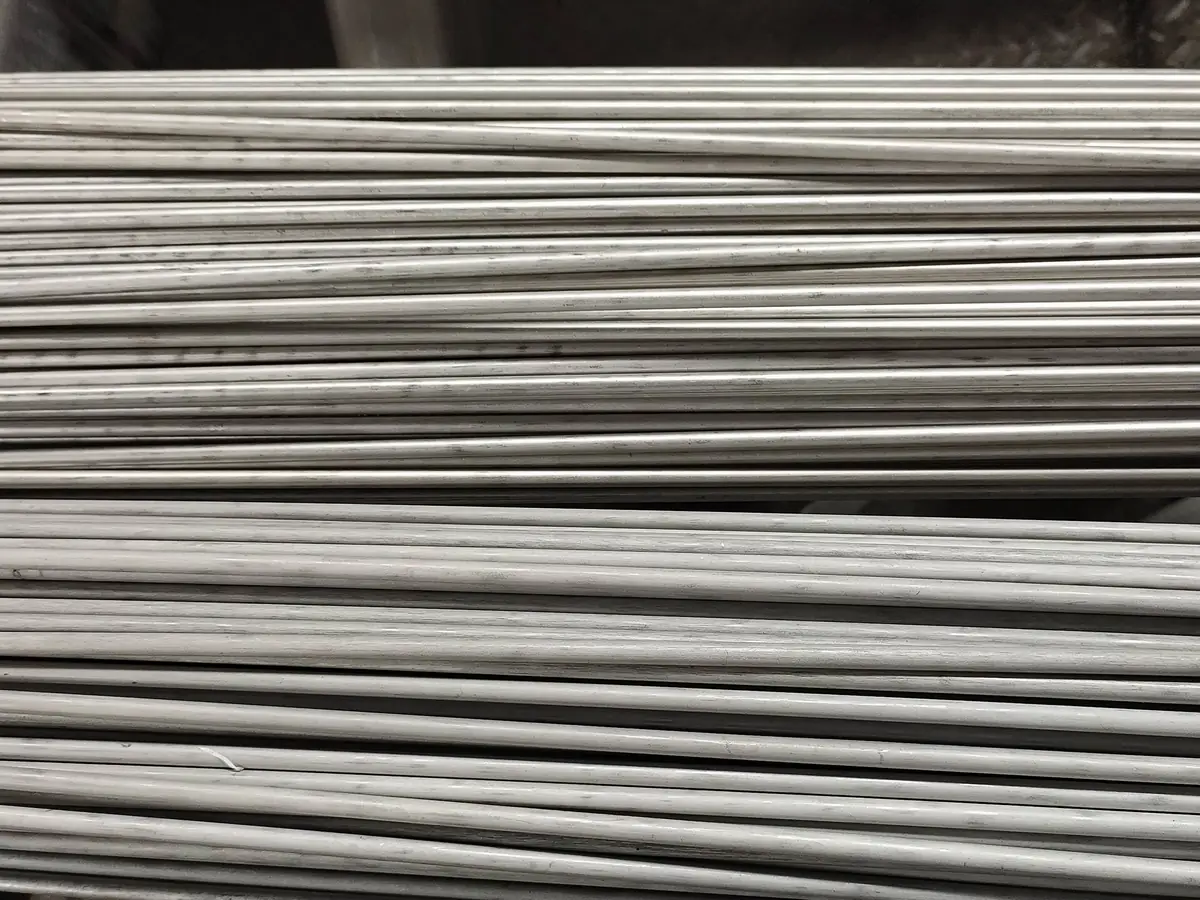
ASTM A269 is the general-service specification for austenitic stainless tube — the one that covers the everyday stainless tubing on a plant rather than the tubing inside a heat exchanger. It permits both seamless and welded construction, which is its defining feature: a welded A269 tube is acceptable provided the weld has been cold worked and the tube solution annealed, so the weld does not sit in the finished product as an as-welded seam. It covers TP201 through TP347, and because it is a general specification it does not carry a pressure or temperature rating — the design has to come from the piping code, and for heat exchanger or high-temperature duty the correct specification is A213 or A249, not this one. We supply 1/8 to 4 inch, seamless or welded, solution annealed and pickled or bright annealed.
Grades and chemistry
Table 1 — A269 grades we hold (%, maximum unless a range is given)
| Grade | C | Mn | Si | Cr | Ni | Mo | Other |
|---|---|---|---|---|---|---|---|
| TP201 | 0.15 | 5.5 – 7.5 | 1.00 | 16.0 – 18.0 | 3.5 – 5.5 | — | N 0.25 max |
| TP304 | 0.08 | 2.00 | 1.00 | 18.0 – 20.0 | 8.0 – 11.0 | — | — |
| TP304L | 0.035 | 2.00 | 1.00 | 18.0 – 20.0 | 8.0 – 12.0 | — | — |
| TP316 | 0.08 | 2.00 | 1.00 | 16.0 – 18.0 | 10.0 – 14.0 | 2.00 – 3.00 | — |
| TP316L | 0.035 | 2.00 | 1.00 | 16.0 – 18.0 | 10.0 – 14.0 | 2.00 – 3.00 | — |
| TP321 | 0.08 | 2.00 | 1.00 | 17.0 – 19.0 | 9.0 – 12.0 | — | Ti 5 × C min |
| TP347 | 0.08 | 2.00 | 1.00 | 17.0 – 19.0 | 9.0 – 13.0 | — | Nb + Ta 10 × C min |
TP201 is the manganese-substituted grade — it uses 5.5–7.5% manganese and only 3.5–5.5% nickel to hold the austenitic structure at a lower cost. It works, but it is noticeably less corrosion resistant than 304 and it work-hardens faster, which matters if the tube will be bent.
Mechanical properties
Table 2 — Minimum room temperature properties
| Grade | Tensile Rm min | Yield Rp0.2 min | Elongation in 2 in | Hardness max |
|---|---|---|---|---|
| TP201 | 655 MPa | 260 MPa | 35% | — |
| TP304 | 515 MPa | 205 MPa | 35% | 192 HBW / 90 HRB |
| TP304L | 485 MPa | 170 MPa | 35% | 192 HBW / 90 HRB |
| TP316 | 515 MPa | 205 MPa | 35% | 192 HBW / 90 HRB |
| TP316L | 485 MPa | 170 MPa | 35% | 192 HBW / 90 HRB |
| TP321 | 515 MPa | 205 MPa | 35% | 192 HBW / 90 HRB |
| TP347 | 515 MPa | 205 MPa | 35% | 192 HBW / 90 HRB |
The L grades give up 35 MPa of yield to gain resistance to sensitisation during welding. If the tube will be welded into an assembly and cannot be solution annealed afterwards, that trade is worth taking; if it is bent and installed cold, TP304 is stronger and cheaper.
Seamless or welded — what A269 actually permits
Table 3 — Construction routes and what each requires
| Route | Requirement | When to choose it |
|---|---|---|
| Seamless | No weld in the body | Small sizes, pressure duty, anywhere the specification or the client excludes welded |
| Welded, cold worked | Weld must be cold worked and the tube solution annealed after welding | Larger sizes and thinner walls where seamless is uneconomic |
| Welded, as-welded | Not permitted by A269 | Use A249 or A312 for as-welded products |
This is the single most misused part of A269. An as-welded tube cannot be certified to it, whatever the mill stamp says — the weld would sit in the finished product with a cast, unrecrystallised structure. If a quotation offers A269 welded tube at a price close to an as-welded product, ask which of the two routes it actually is.
Testing
Table 4 — Test scope and options
| Test | Status | Note |
|---|---|---|
| Chemical analysis | Required | Per heat, on the 3.1 certificate |
| Tensile test | Required | Rm, Rp0.2, elongation per lot |
| Flattening or reverse bend | Required | Confirms ductility and weld soundness on welded tube |
| Hydrostatic or non-destructive electric test | Required, either one | Eddy current is the normal choice for small diameters |
| Hardness | Required when specified | Confirms the anneal was effective |
| Grain size to ASTM E112 | On request | Usually 5 or coarser; specified for forming duty |
| Intergranular corrosion to ASTM A262 Practice E | On request | Required by many pharma and chemical specifications on 304L / 316L |
| Surface finish and PMI | On request | PMI on 316L is a common project hold point |
A269 against the specifications it gets confused with
Table 5 — Which one your duty actually needs
| Specification | Written for | Use it when |
|---|---|---|
| ASTM A269 | General service austenitic tube, seamless or welded | Instrument lines, general corrosive service, fabrication — no pressure design |
| ASTM A213 | Seamless boiler, superheater and heat exchanger tube | The tube is a pressure part inside a heat exchanger or boiler |
| ASTM A249 | Welded boiler and heat exchanger tube | As-welded tube for heat exchangers, where welded is permitted |
| ASTM A270 | Sanitary tube for dairy and food | Hygienic service with a specified surface finish and 3-A compliance |
| ASTM A312 | Seamless and welded stainless pipe | Nominal pipe sizes from NPS 1/8 upward, with a pressure rating |
| ASTM A554 | Welded ornamental and mechanical tube | Round, square and rectangular tube where appearance or shape is the point |
The practical distinction: A269 is a materials specification, A213 and A249 are pressure specifications, A270 is a hygiene specification. Choosing A269 for a heat exchanger bundle is not a dimensional error — it is a specification error that a notified body will pick up.
Size range and tolerances
Table 6 — Commercial range
| Parameter | Range | Note |
|---|---|---|
| Outside diameter | 1/8" – 4" (3.18 – 101.6 mm) | Larger diameters are normally A312 pipe rather than A269 tube |
| Wall thickness | 0.020" – 0.220" (0.51 – 5.59 mm) | Thin wall below 0.035" is welded and cold worked |
| OD tolerance | ±0.005" under 1/2", ±0.010" above | Per A269 table; tighter by agreement |
| Wall tolerance | ±10% | ±12.5% for some sizes |
| Length | Random 6 m, or cut to length | Cut lengths from 300 mm |
| Condition | Annealed and pickled, or bright annealed | Bright annealed for instrumentation and clean service |
Where A269 tube is used
Instrumentation and impulse lines
Small bore tube between the tap and the transmitter. Bright annealed TP316 or TP316L, eddy current tested, bent on site.
General corrosive service
Chemical transfer, dosing and sampling lines where the fluid is aggressive but the pressure is modest.
Pharmaceutical process lines
TP316L with an A262 Practice E corrosion test and a documented surface finish, where A270 is not strictly required.
Food and beverage
Non-hygienic sections of a food plant — utility, CIP return, glycol — where A270’s polish is unnecessary.
Marine and offshore
316L for salt-laden atmospheres and seawater-adjacent instrument runs, above the waterline.
Fabrication and frames
Structural and mechanical tube in mildly corrosive environments, bent and welded in the shop.
Frequently asked questions
What is the difference between A269 and A213?
A269 is a general service materials specification with no pressure or temperature rating. A213 is the seamless heat exchanger and boiler tube specification, where the tube is a pressure part. If the tube goes inside a shell or a boiler, it is A213 — using A269 there is a specification error, not a saving.
Can A269 be welded tube?
Yes, but only if the weld is cold worked and the tube solution annealed afterwards. As-welded tube cannot be certified to A269. This is the most common misuse of the specification.
TP304 or TP316L — which should I order?
304 unless there are chlorides. 316L adds 2–3% molybdenum, which is what resists chloride pitting, and it is the L grade so it survives welding without sensitising. In clean, chloride-free service 304 is stronger and cheaper.
Do I need an A262 Practice E test?
If the specification or the client’s dossier asks for intergranular corrosion resistance on 304L or 316L, yes. It is an optional test in A269, so it has to be ordered — it will not appear on the certificate by default.
What is the maximum temperature for A269?
The specification does not set one; it is a general service document. In practice austenitic tube is used to about 800 °C in oxidising service, but the moment the tube is a pressure part or sits in a fired heater, the design has to move to A213 and the appropriate code allowable stress.
Is TP201 a real substitute for 304?
Only where corrosion is not the governing requirement. TP201 uses manganese instead of part of the nickel, which raises strength and lowers cost but reduces corrosion resistance and makes it work-harden faster. For indoor frames and dry service it works; for wet corrosive duty it does not.
What finish do you supply?
Annealed and pickled as standard, bright annealed on request. Both are supplied in random 6 m lengths or cut to length, with ends plain or capped.
What is the minimum order and lead time?
300 kg per size. Lead time is 20–30 days; bright annealed and A262 tested material runs towards the longer end.
Request a quote
Related products
ASTM A554 Stainless TubeWelded ornamental and mechanical shapes
20Cr13 / 420 TubeMartensitic grade for hardened parts
410 / 410L TubeLower carbon martensitic
2205 Duplex TubeFor chloride service beyond 316L
Stainless Capillary Tube0.5–6 mm OD, instrument and medical
All stainless steel tube — austenitic, martensitic and duplex · Guide: NACE MR0175 sour service requirements
Request a quotation
Tell us grade, OD, wall, length, construction (seamless or welded cold worked) and the test scope you need. We reply within 24 hours with price, lead time and certificate content.