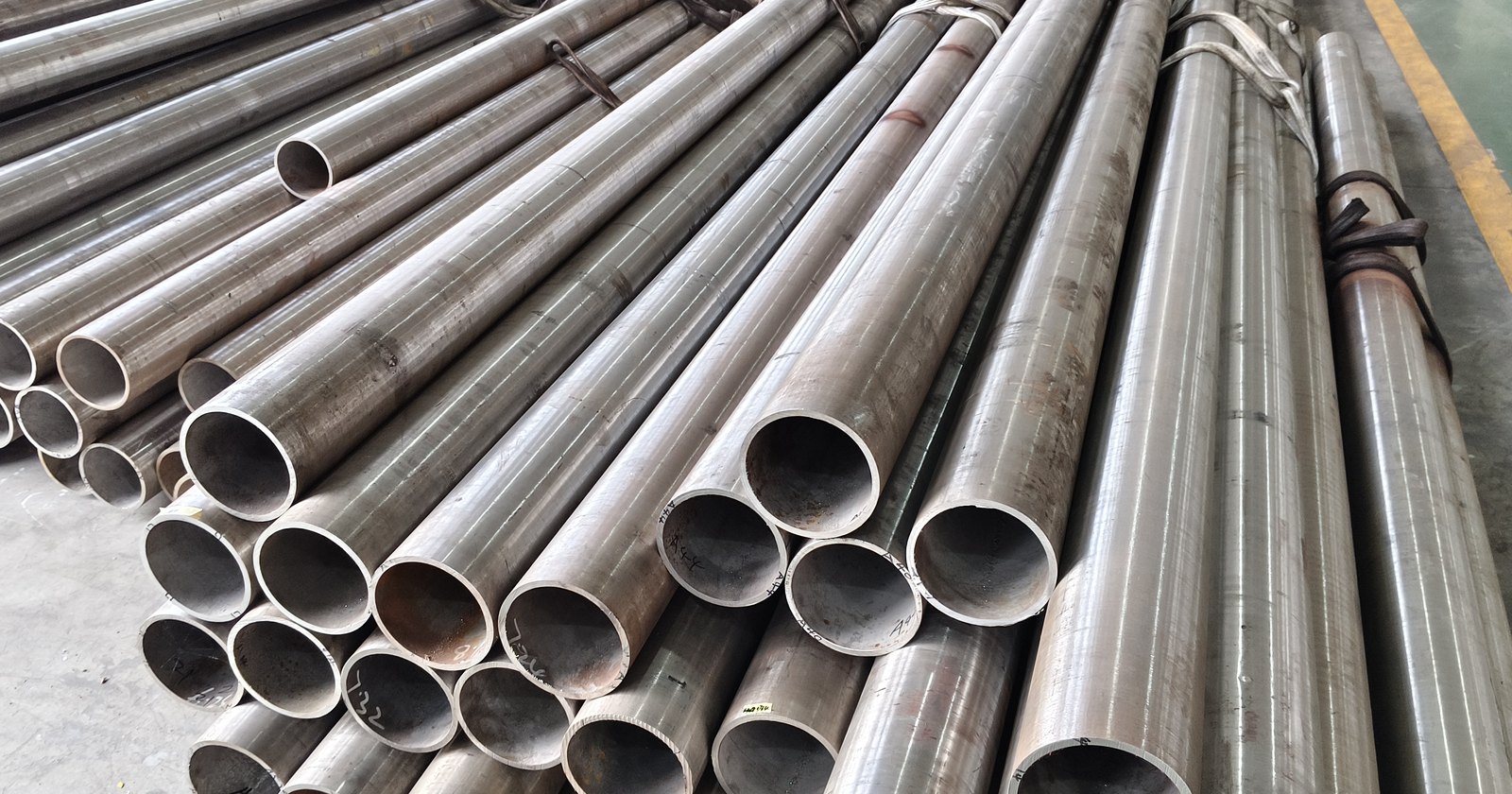
Almost every sour-service enquiry arrives the same way: one line in the specification saying that all materials shall comply with NACE MR0175, and a purchase order that has to be placed before anyone has answered the question that actually decides the grade — how sour is the service? This page works through that decision in the order a buyer has to make it: is the line sour, which severity region does it fall in, how far can carbon steel go, what forces an upgrade to a corrosion-resistant alloy, and what documents should arrive with the pipe.
On this page
What NACE MR0175 actually is — and what it is not
NACE International was founded in 1943 by eleven pipeline corrosion engineers. In 2021 it merged with SSPC to form AMPP, but the standard kept its NACE designation and is still published under it. MR0175 first appeared in 1975 as a NACE material requirement for oilfield equipment; since 2003 it has been jointly published with ISO, and the current designation is ANSI/NACE MR0175/ISO 15156.
The standard is split into three parts, and which one applies depends entirely on the material:
| Part | Scope | Who it applies to on a tube order |
|---|---|---|
| Part 1 | General principles for the selection of cracking-resistant materials | Defines what “sour” means, how to calculate H₂S partial pressure, and the severity regions |
| Part 2 | Cracking-resistant carbon and low-alloy steels, and the use of cast irons | Carbon steel line pipe, seamless tube, plate, forgings and fittings |
| Part 3 | Cracking-resistant CRAs and other alloys | 13Cr, super 13Cr, duplex, super duplex, austenitic stainless, nickel alloys |
What the standard is not is a certification scheme. AMPP does not certify mills, products, heats, or suppliers. There is no register of “NACE approved” pipe, and no mark to look for on a bundle tag. What exists is a heat of steel that was produced and tested to meet the requirements of a specific part and clause, documented on the mill certificate and on test reports that reference that clause.
Procurement consequence. A supplier who says a tube is “NACE certified” is either using loose language or does not know the standard. Neither is a reason to reject the offer outright — but it is a reason to ask which part and which annex the material is qualified under, and to expect a clause number in the answer.
Step 1 — Decide whether the service is sour at all
ISO 15156-1 defines a sour service by two conditions that must both be true:
- Free water is present — a water phase in contact with the steel, not merely water vapour.
- H₂S partial pressure is 0.3 kPa (0.05 psi) or higher.
The partial pressure is not the concentration. It is the concentration multiplied by the total absolute pressure of the system:
pH₂S = Ptotal (absolute) × yH₂S
where yH₂S is the mole fraction of hydrogen sulphide. Because the result is a pressure, the same gas composition lands in completely different regions depending on how hard the system is pressed. That single fact drives most of the material cost on a sour project.
Table 1 — The same H₂S concentration, four different answers
| Total absolute pressure | H₂S (mol ppm) | pH₂S | Region | What it means |
|---|---|---|---|---|
| 5 bar | 200 | 0.1 kPa | 0 | Below the threshold; standard carbon steel |
| 10 bar | 500 | 0.5 kPa | 1 | Sour; carbon steel permitted under A.2 |
| 50 bar | 2,000 | 10 kPa | 2 / 3 boundary | Carbon steel only with tight hardness and heat treatment control |
| 100 bar | 5,000 | 50 kPa | 3 | Pre-qualified carbon steel route closed; CRA required |
2,000 ppm sounds severe and is harmless at one bar; 5,000 ppm at 100 bar is a CRA well. Concentration alone never decides the grade.
Four mistakes that show up in almost every enquiry
- Quoting concentration instead of partial pressure. “H₂S 2,000 ppm” tells a mill nothing it can quote against. Ask for the mole fraction and the design pressure, or ask the end user for the calculated partial pressure directly.
- Quoting gauge instead of absolute pressure. Fifty barg is 51 bara. A two per cent error rarely changes the region, but the habit of calculating in the wrong unit eventually does.
- Forgetting the free-water condition. Dry gas at 200 bar with 1,000 ppm H₂S is not, by the ISO definition, a sour service. The exemption is real but narrow: it disappears the moment the dew point drops and liquid water appears.
- Designing only for steady state. Part 2 asks the user to consider upsets, shutdowns that leave unbuffered low-pH condensate on the steel, and acid stimulation or flowback. A well that tests non-sour in normal operation can be Region 3 during a workover, and the tubing does not get changed for the workover.
Step 2 — Place the service in a severity region
Once the service is sour, ISO 15156-2 plots H₂S partial pressure against in-situ pH to produce four severity regions. The region, not the H₂S number on its own, is what determines which materials are permitted.
Table 2 — Severity regions and what each one does to material choice
| Region | pH₂S | In-situ pH | Effect on material selection |
|---|---|---|---|
| 0 | below 0.3 kPa | any | Not a sour service by definition. Standard carbon steel; no sour-specific measures. |
| 1 | 0.3 – 1 kPa | ≥ 3.5 | Carbon and low-alloy steel permitted under Annex A.2 with hardness control. |
| 2 | 1 – 10 kPa | ≥ 3.5 | Carbon steel still permitted, but heat treatment, hardness and weld procedures become critical. |
| 3 | above 10 kPa | any | Pre-qualified carbon steel route closed. CRA, or project-specific qualification. |
| 3 | any | below 3.5 | Same — low pH alone puts a service in Region 3 regardless of H₂S level. |
Three numbers do most of the work: 0.3 kPa to enter the standard, 10 kPa and pH 3.5 to leave the carbon steel route. Everything else is interpolation between them.
Two cautions on using this table. First, the region belongs to the gas and the water together — the same gas at a different pH is a different region, which is why produced-water chemistry matters as much as the gas analysis. Second, the pH must be the in-situ pH of the water actually in contact with the steel, not the pH of a sample measured in a lab after degassing. The boundary between Regions 1 and 2 also varies with temperature, so read Figure 1 of Part 2 rather than interpolating between the numbers above.
Step 3 — Can carbon steel carry it?
Where the service sits in Region 1 or Region 2, Part 2 offers two routes to a compliant material.
Option 1 — pre-qualified chemistry. The steel is bought to a composition listed in Annex A.2 and held under a hardness ceiling. Nothing needs to be qualified against the actual well or line; the annex has already done that work. This is the route almost all tube and line pipe orders take.
Option 2 — qualification by testing. The steel falls outside A.2, and the user qualifies it against the real environment using actual pH, H₂S partial pressure and temperature, with a documented test programme and an agreement between supplier and end user. It is legitimate, it is expensive, and it is rarely the right answer for a mill order.
The chemistry ceilings that decide whether a mill can quote
A.2 sets limits per element and per product form. In practice four of them decide whether a heat is even eligible:
Table 3 — The A.2 limits most often written into sour-service purchase specifications
| Element | Typical ceiling | Why the limit exists |
|---|---|---|
| Carbon | ≤ 0.10% for welded product; up to 0.25% for some seamless grades | Carbon drives hardenability. Hard untempered martensite is where sulphide stress cracking starts. |
| Manganese | ≤ 1.40% | Segregation and banding give hydrogen a path; also raises hardenability. |
| Phosphorus | ≤ 0.020% | Grain-boundary embrittlement. Earlier editions allowed 0.030% — confirm which edition the project invokes. |
| Sulphur | ≤ 0.002%, with 0.010% accepted for some seamless forms | Manganese sulphide inclusions are the initiation sites for hydrogen-induced cracking. |
| Nickel | ≤ 1.0% | Raises hardenability; above this the steel behaves like a low-alloy steel, not a carbon steel. |
| Carbon equivalent | ≤ 0.43 typical | Controls heat-affected-zone hardness after welding. |
Annex A.2 gives these per product form and grade. The figures above are the ceilings that appear in most sour-service specifications; the annex is what governs, and the edition matters.
Hardness is the real gate, and it is tested on the finished part
Carbon and low-alloy steel for sour service is capped at 22 HRC (250 HV). That ceiling applies to three places, and a certificate that only covers the first is incomplete:
- the base metal
- the heat-affected zone of every weld
- the deposited weld metal
The limit is a proxy for microstructure rather than a number of independent importance: below 22 HRC you cannot have untempered martensite, and untempered martensite is what cracks. That is why the requirement is written on the finished component and not on the plate or billet it was made from.
The tube-specific trap. A cold-drawn tube can meet every chemistry limit in A.2 and still fail the hardness requirement, because the drawing pass itself raises hardness through work hardening. A heat that was fully compliant as hot-rolled hollow can leave the drawbench above 22 HRC with no change in composition at all. If a sour-service order is specified as cold-drawn, the process route has to include stress relief after the final draw and the certificate has to show hardness measured after it.
Which tests, and what they actually prove
Two laboratory tests sit underneath most sour-service specifications. They answer different questions and are not interchangeable.
Table 4 — The two tests a sour-service order usually invokes
| Test | Standard | What it evaluates | Typical duration |
|---|---|---|---|
| SSC — sulphide stress cracking | NACE TM0177, Method A (tensile) | Cracking of a stressed specimen in a sour brine. Addresses the combined effect of H₂S and applied stress. | 720 hours |
| HIC — hydrogen-induced cracking | NACE TM0284 | Internal blistering and stepwise cracking from hydrogen absorbed at inclusions. Reported as CLR, CTR and CSR. | 96 hours |
Which of the two is mandatory depends on product form and project specification. HIC is standard for line pipe and plate in sour service; a seamless tube order may specify SSC only. Confirm before quoting — the test cost is real.
Step 4 — When carbon steel runs out
The pre-qualified carbon steel route closes in four situations. Any one of them is enough on its own.
Region 3
pH₂S above 10 kPa, or in-situ pH below 3.5. The annex route is closed outright, not merely tightened.
Strength above the ceiling
22 HRC corresponds to roughly 550 MPa (80 ksi) yield. Anything above that cannot be delivered in carbon steel and stay qualified.
Temperature
Above about 150 °C with CO₂ present, carbon steel corrodes fast enough that cracking resistance stops being the governing problem.
Chlorides
Above roughly 50,000 mg/L at temperature, the carbon steel answer is a corrosion allowance that no longer pays.
Past those limits the choice moves into Part 3, and the first rung of the ladder is 13Cr — which is where most of the expensive mistakes happen, because 13Cr is widely assumed to be a general upgrade from carbon steel. It is not. It has its own hard stop.
Table 5 — The first rungs of the CRA ladder and where each one stops
| Grade | UNS | ISO 15156 sour envelope | The number that stops it |
|---|---|---|---|
| L80 13Cr | S42000 | Listed, conditional: pH₂S ≤ 10 kPa (1.5 psi), pH ≥ 3.5, hardness ≤ 23 HRC | 10 kPa H₂S, or pH below 3.5 |
| Super 13Cr | S41426 | Listed at 95 ksi only: pH₂S ≤ 10 kPa, pH ≥ 3.5. The 110 ksi condition is not qualified for sour service. | Strength condition, not just environment |
| 22Cr duplex | S31803 / S32205 | Part 3 annex listing; limited by temperature and pH₂S together | Temperature first, then H₂S |
| 25Cr super duplex | S32750 / S32760 | Wider envelope than 22Cr, still temperature-limited | Temperature |
| Nickel alloys | N08825 / N06625 / N10276 | Broadest listings; C276 for the most aggressive environments | Cost, and chloride SCC above the listed range |
Limits summarised from the ISO 15156-3 annex listings. The grade-by-grade ladder, including the cold-worked austenitic alloys that sit above 13Cr, is set out in Where 13Cr stops.
The practical point for a buyer: an enquiry that says “NACE 13Cr” without stating the H₂S partial pressure and pH is not a specification, it is a guess. If the answer turns out to be 12 kPa H₂S, the 13Cr offer was never valid, and the schedule pays for the discovery.
Step 5 — What the paperwork must say
Sour-service purchases rarely fail at the mill. They fail at document review, three weeks before shipment, when someone notices that the certificate does not actually say what the specification asked for. Here is what to require before the order is placed rather than after.
On the mill certificate
- The exact standard, part and edition: ANSI/NACE MR0175/ISO 15156-2:2015, Annex A.2 — not simply “NACE”.
- Measured chemistry, not maxima. Sulphur and phosphorus as actual ladle values.
- Hardness in HRC or HV, with the location of the test and whether it was taken on the body, the HAZ or the weld.
- The heat treatment record: austenitising temperature, tempering temperature, cooling method, and for cold-drawn product the stress-relief treatment after the final draw.
- For welded product, weld metal and heat-affected-zone hardness reported separately from parent metal.
On the test reports
- The method reference, including which method of TM0177 was used.
- The test solution. Solution A is 5% NaCl plus 0.5% glacial acetic acid, and it should be named.
- Initial and final pH. A report with no final pH cannot be assessed, because pH drift invalidates the exposure.
- Duration, and the applied stress expressed as a percentage of actual yield strength.
- Results per specimen. A single line reading “passed” is not a test report.
Red flags in a document package
- “Hardness: 22 HRC max” printed in the chemistry column. That is a specification, not a measurement. Something was not tested.
- An SSC report with no final pH. The exposure cannot be verified.
- An HIC report that says “passed” with no CLR, CTR or CSR values. Those three ratios are the result.
- A certificate citing MR0175-2002 when the project invokes the 2015 edition. The 2015 edition tightened the phosphorus limit from 0.030% to 0.020%; a 2002 certificate may not satisfy a 2015 specification.
- Chemistry given as “typical” rather than as ladle analysis. Typical values are marketing; ladle analysis is evidence.
Six traps that cost money
- “NACE certified” does not exist. Nothing is certified. A material is qualified to a clause. Ask for the clause.
- MR0175 is not a corrosion guarantee. It addresses cracking only. A fully compliant carbon steel tube can still lose two millimetres a year to CO₂ corrosion, and no certificate will mention it. Corrosion allowance and inhibitor strategy remain the buyer’s problem.
- Buying to the wrong part. Carbon steel is Part 2; 13Cr and everything above it is Part 3. A 13Cr tube documented only against Part 2 is not a valid submission, however good the steel is.
- Hardness measured on the parent plate. The ceiling applies to the finished component including every heat-affected zone. Parent-metal hardness is the easiest number to supply and the least meaningful.
- Cold-drawn tube with no stress relief after the final pass. Compliant chemistry, compliant heat treatment, and still above 22 HRC when it comes off the drawbench.
- Treating Region 3 as “carbon steel with more testing”. Region 3 does not tighten the pre-qualified route, it removes it. Going back to carbon steel there requires Option 2 qualification against the real environment, which is a different conversation with a different timeline.
Have a sour-service enquiry with a partial pressure you are not sure about? Send us the gas analysis, design pressure, temperature and produced-water chloride level. We will tell you which region the service falls in and whether the answer is carbon steel, 13Cr or something above it — before a quotation is written.
What to put in the enquiry
Eight parameters decide the answer. Without them, every quotation is conditional and every comparison between suppliers is meaningless.
Table 6 — The sour-service RFQ checklist
| # | Parameter | How to state it |
|---|---|---|
| 1 | Design pressure | In bara, not barg |
| 2 | H₂S content | Mol %, plus the basis: sales gas, wellstream or flash gas |
| 3 | Operating temperature | Minimum and maximum, not average |
| 4 | In-situ pH | Of the produced water in contact with the steel |
| 5 | Chloride concentration | mg/L |
| 6 | CO₂ partial pressure | Separately from H₂S; it governs corrosion, not cracking |
| 7 | Free water | Present or absent, and how much |
| 8 | Edition invoked | MR0175/ISO 15156:2015, and which part |
Where the end user has already calculated the H₂S partial pressure, supply that number directly as well. It removes the single most common source of disagreement between mill and buyer.
Frequently asked questions
Is 22 HRC the same as 250 HV?
The standard writes the carbon and low-alloy steel limit as 22 HRC, with 250 HV as the equivalent. Conversion between hardness scales is approximate rather than exact, particularly in this range, so test in whichever unit the purchase specification names and report the scale alongside the number.
Does NACE MR0175 apply to stainless steel?
Yes, but through Part 3 rather than Part 2. Austenitic stainless steels appear with limits on cold work and hardness, martensitic 13Cr grades appear in specific tables with their own H₂S and pH limits, and duplex grades have separate listings. A stainless tube is not automatically sour-service compliant just because it is stainless.
Is dry gas containing H₂S a sour service?
Not by the ISO 15156-1 definition, which requires free water in contact with the steel. The exemption is narrow and practical rather than permanent: as soon as the dew point drops and liquid water appears, the service becomes sour and the material that was acceptable is no longer qualified.
What is the difference between MR0175 and MR0103?
MR0175 covers oil and gas production — wells, flowlines, gathering systems, processing upstream of the refinery gate. MR0103 covers sulphide stress cracking in corrosive petroleum refining environments. Refinery piping is generally specified to MR0103, and citing MR0175 for a refinery service is a common and expensive mix-up.
Can carbon steel be used in Region 3?
Not under the pre-qualified Annex A.2 route — Region 3 removes it. Option 2 qualification against the actual environment exists in principle, but it requires real pH and partial pressure data and a documented test programme agreed between supplier and end user. In practice Region 3 means a corrosion-resistant alloy.
Is 13Cr a general upgrade from carbon steel?
No. L80 13Cr is listed only up to 10 kPa (1.5 psi) H₂S and pH 3.5, which is a narrower envelope than most buyers expect, and super 13Cr is qualified only in the 95 ksi condition. Above those lines the next answer is duplex or a nickel alloy, not a stronger martensitic grade.
Which edition should a purchase order cite?
Whichever edition the end user’s specification invokes. The 2015 edition is the current base text of ISO 15156, and MR0175 has been technically aligned with it since 2003. What matters commercially is that the edition on the certificate matches the edition on the specification, because the limits did change between editions.
Does a sour-service tube order always need both SSC and HIC testing?
No. SSC testing to TM0177 is the baseline for most sour-service tubular orders. HIC testing to TM0284 is commonly added for line pipe and plate, where the rolled microstructure and inclusion shape make hydrogen-induced cracking the governing risk. Confirm which tests the specification actually calls for before pricing.
Related products and guides
- What NACE means — the organisation, the acronym and why the name survived the AMPP merger.
- H₂S corrosion mechanisms in pipe steel — blistering, HIC, SSC and the conditions that drive each one.
- L80, super 13Cr and 13Cr seamless tubing — the grades, with mechanical properties and size range.
- Full product range — carbon, alloy, stainless and nickel alloy tube, with size and wall lists.
- Welding A333 Grade 6 in LPG service — procedure and hardness control on a low-temperature job.
- P91 alloy steel pipe — the high-temperature grade, and why hardness control matters there too.
- Non-destructive testing types — what the inspection certificate on a sour-service order is actually reporting.