
Project Description
Lead time 25–35 days
PMI 100% on every lot
Quote within 24 hours
Condition annealed or hardened
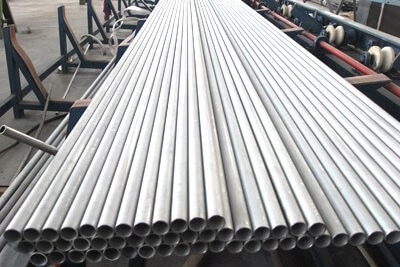
AISI 420 is the cutlery grade, and the two JIS variants are the ones that actually get ordered. SUS420J1 — 1.4021, 20Cr13 — carries 0.16–0.25% carbon and hardens to about 50 HRC. SUS420J2 — 1.4028, X30Cr13, 3Cr13 — carries 0.26–0.35% and reaches 55 HRC, at the cost of toughness and corrosion resistance. Both are 12–14% chromium martensitic steels: adequate against atmosphere, fresh water and mild acids, poor against chlorides, and not intended above about 427 °C because the hardness starts to fall away and the corrosion resistance with it. We supply pipe and tube in both variants, annealed for machining or hardened and tempered to a stated hardness, with 100% PMI because 420 and 410 are routinely mixed up in a rack.
The two variants
Table 1 — 420J1 against 420J2, and why the difference matters
| SUS420J1 / 1.4021 / 20Cr13 | SUS420J2 / 1.4028 / X30Cr13 | |
|---|---|---|
| Carbon | 0.16 – 0.25% | 0.26 – 0.35% |
| Chromium | 12.0 – 14.0% | 12.0 – 14.0% |
| Hardness after hardening | About 50 HRC | About 55 HRC |
| Toughness | Better | Lower — the extra carbon costs impact resistance |
| Corrosion resistance | Better at the same finish | Slightly lower; more carbide to act as a pit site |
| Typical use | Knife blades, surgical instruments, valve parts | Cutlery that must hold an edge, shear blades, wear parts |
The choice is hardness against toughness. Where the part will be sharpened to a fine edge or struck in service, J2 chips; where it must resist abrasion, J1 wears. Both are usually ordered annealed and hardened by the part maker rather than delivered hardened.
Chemistry
Table 2 — Chemical composition (%)
| Element | 420J1 / 1.4021 | 420J2 / 1.4028 |
|---|---|---|
| C | 0.16 – 0.25 | 0.26 – 0.35 |
| Si | 1.00 max | 1.00 max |
| Mn | 1.00 max | 1.00 max |
| P | 0.040 max | 0.040 max |
| S | 0.030 max | 0.030 max |
| Cr | 12.00 – 14.00 | 12.00 – 14.00 |
| Ni | 0.60 max | 0.60 max |
Heat treatment and hardness
Table 3 — What each condition delivers
| Condition | Treatment | Result | Use it for |
|---|---|---|---|
| Annealed | 800 – 900 °C, furnace cool | 223 HB max (J1), 235 HB max (J2) | Machining, drilling, tapping |
| Hardened | 980 – 1050 °C, oil or air quench | 52 – 56 HRC as quenched | Intermediate step before tempering |
| Tempered 200 °C | 2 h at temperature | 50 – 55 HRC | Cutting edges, wear parts |
| Tempered 400 °C | 2 h at temperature | 45 – 48 HRC | Parts needing some toughness |
| Tempered 600 °C | 2 h at temperature | 28 – 32 HRC | Valve stems and shafts |
Avoid tempering between 400 and 550 °C. That window produces temper embrittlement in this family — the hardness falls and the toughness does not recover. Once a 420 part has been in that range it cannot be fixed by re-tempering; it has to be re-austenitized.
Where 420 is used, and where it is not
Cutlery and blades
The original application. J2 for edge retention, J1 where the blade must survive impact.
Surgical instruments
Scalpel handles, forceps and reamers. J1 hardened to 50 HRC, passivated after polishing.
Valve internals
Needle valve stems and seats, where a polished hardened surface resists galling against the packing.
Shear and slitter blades
J2 at 55 HRC. Wear resistance is the whole requirement and toughness is secondary.
Hand tools
Scissors, shears and knives where hardness and a modest corrosion resistance beat plain carbon steel.
Not for chloride service
Marine, swimming pool and bleach environments pit 420 quickly. Use 316L or a duplex grade — even 304 performs better there.
Frequently asked questions
What is the difference between 420J1 and 420J2?
Carbon content: 0.16–0.25% for J1, 0.26–0.35% for J2. That takes the achievable hardness from about 50 HRC to 55 HRC and costs toughness and a little corrosion resistance.
Is 420 the same as 20Cr13?
Yes — 20Cr13, 2Cr13 and 420J1 are the same grade under Chinese, GB and AISI naming. 420J2 corresponds to 3Cr13 and 1.4028. The carbon figure on the certificate is what distinguishes them.
What is the maximum service temperature?
About 427 °C (800 °F). Above that the tempering that produced the hardness starts to reverse and both hardness and corrosion resistance fall away. It is not a heat resisting grade.
Can 420 be welded?
With difficulty. It is martensitic with up to 0.35% carbon, so the heat-affected zone hardens and cracks unless preheated to 200–300 °C and post-weld heat treated. Where welding is unavoidable, use an austenitic filler and accept a dissimilar joint.
Why does the certificate need PMI?
Because 410, 420 and 431 look identical and have different carbon. A 410 substitution on a part designed for 55 HRC passes every dimension check and fails in service. PMI is the only cheap defence.
Is 420 food safe?
It is used for cutlery and food-contact blades, so yes within that scope. For hygienic process lines the correct answer is a 316L sanitary tube to A270 — 420 does not hold up to cleaning chemicals.
Annealed or hardened delivery?
Annealed unless you say otherwise, because most buyers machine the part and then harden it. If you want the properties delivered, state the hardness range and we will quote the tempering cycle.
What is the minimum order and lead time?
300 kg per size. Lead time is 25–35 days; hardened and tempered to a specific hardness range runs towards the longer end.
Request a quote
Related products
410 / 410L Stainless TubeLower carbon, weldable martensitic
ASTM A269 Stainless TubeAustenitic TP304 / TP316L
ASTM A270 Sanitary TubeHygienic finish for food service
2205 Duplex TubeFor chloride service where 420 fails
ASTM A554 Stainless TubeWelded ornamental and mechanical
All stainless steel tube — austenitic, martensitic and duplex · Guide: NACE MR0175 sour service requirements
Request a quotation
Tell us OD, wall, grade (J1 or J2), condition, target hardness and quantity. We reply within 24 hours with price, lead time and certificate scope.