
Project Description
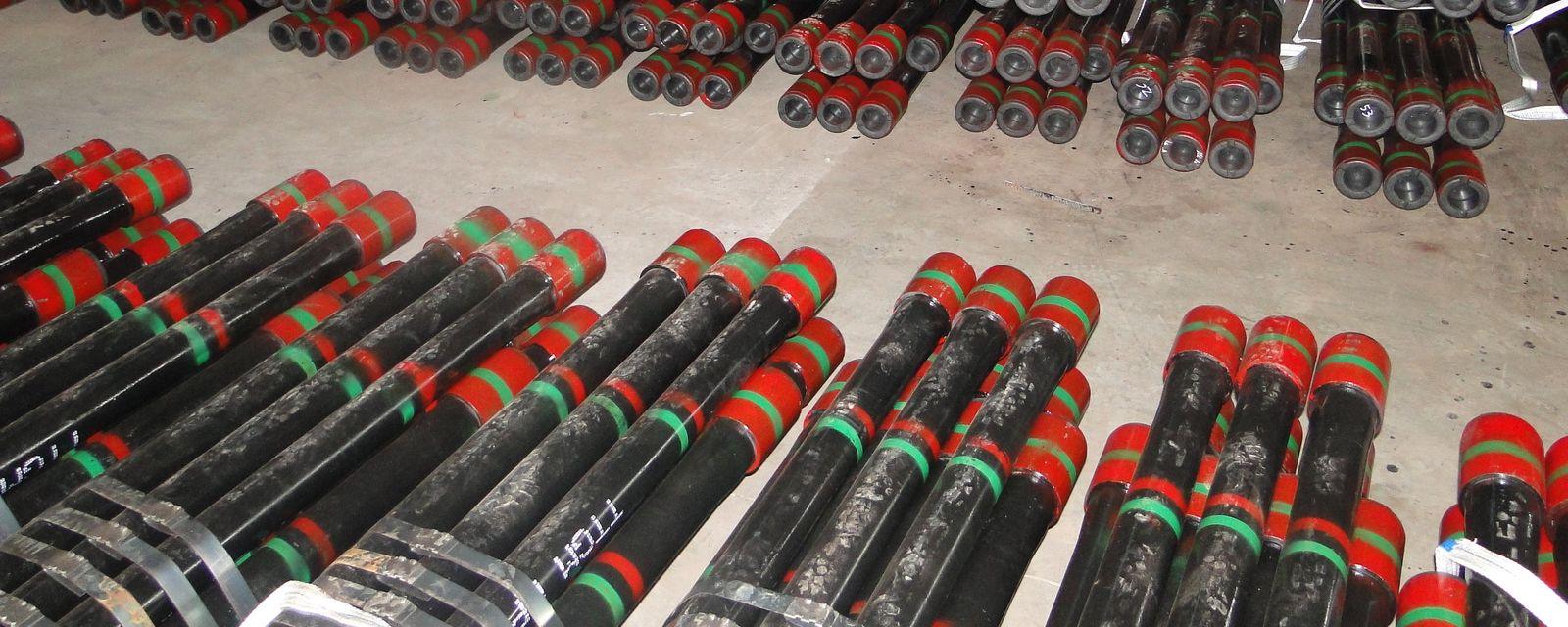
Lead time 25–40 days
Third party SGS / BV / TUV
Quote within 24 hours
Hardness tested both ends
C110 is the grade people misread. They see 110 in the name, compare it with P110, notice that C110 stops at 828 MPa while P110 runs to 965, and conclude that C110 is the weaker product. It is not weaker — it is narrower on purpose. The yield band is capped at the top because the grade also carries a 30 HRC maximum hardness, and you cannot hold a hardness ceiling while letting the yield drift up to 140 ksi.
That hardness ceiling is the whole commercial reason the grade exists. In wet H₂S service, sulphide stress cracking is governed by hardness and by stress, not by nominal strength. P110 has no hardness limit, so a P110 tube can contain hard transformation products that crack under a modest tensile load. C110 caps hardness at 30 HRC, which brings it inside the sour-service envelope for a defined range of conditions — assessed per well, not assumed.
So the comparison is not “C110 versus P110 at the same strength”. It is “C110 where P110 is not permitted”. If the well is sweet, P110 is cheaper and perfectly adequate. If there is H₂S, P110 is out of scope and C110 becomes the entry point at 110 ksi.
Mechanical requirements
Table 1 — API 5CT C110 requirements
| Property | Requirement | Note |
|---|---|---|
| Yield strength | 758–828 MPa (110–120 ksi) | Narrow band, capped 137 MPa below P110 |
| Tensile strength | ≥793 MPa (115 ksi) | Lower minimum than P110’s 862 |
| Hardness | ≤30 HRC (286 HBW) | The defining requirement |
| Elongation | Per API 5CT table | Wall dependent |
| Heat treatment | Quenched and tempered, seamless | Group 2 restrictions apply |
| Chemistry | Restricted compared with Group 3 | Supports the hardness control |
Hardness values in the market are quoted as 29 or 30 HRC depending on the source edition. We write 30 HRC and test to the standard table; if a project specification says 29, we work to the stricter number.
C110 against P110, both directions
Table 2 — Which one, and why
| Question | C110 | P110 |
|---|---|---|
| Highest yield allowed | 828 MPa | 965 MPa |
| Hardness ceiling | 30 HRC | None |
| Wet H₂S service | Assessable to NACE MR0175 | Out of scope |
| Cost per tonne | Higher | Lower |
| Availability | Narrower, mill dependent | Wide |
| Best fit | Sour wells needing 110 ksi | Sweet deep wells |
Note the direction of the trade: choosing C110 for a sweet well pays more for a property you do not need. Choosing P110 for a sour well is not a cost decision at all — it is a specification error.
How the hardness ceiling is held
Hardness is not something you inspect in at the end and hope for. It is held by chemistry, by the quench, and by the tempering temperature, and it is verified on every heat rather than on a sample from the month.
Table 3 — Hardness control path
| Lever | What it does | Verification |
|---|---|---|
| Restricted chemistry | Limits the alloys that raise as-quenched hardness | Heat analysis per ladle |
| Quench uniformity | Prevents soft and hard bands in the same tube | Hardness traverse, both ends |
| Tempering temperature | Sets the final hardness and the yield together | Process card per heat, hardness after tempering |
| Section size | Thick wall cools more slowly and can miss the ceiling low, not high | Mid-wall check on heavy sections |
| SSC assessment | Confirms the grade suits the actual partial pressure | Per NACE MR0175 / ISO 15156, by the well designer |
We supply the tube with the hardness evidence. We do not certify that C110 is suitable for a specific well — that assessment belongs to the well designer, using the actual H₂S partial pressure, pH and temperature.
Sizes and process
Table 4 — Availability
| OD | Wall | Route | Status |
|---|---|---|---|
| 60.3–168.3 mm | 4.5–18 mm | Hot rolled + cold drawn + Q&T | Standard |
| 168.3–355 mm | 6–50 mm | Hot rolled + Q&T | Standard |
| 355 mm and above | Per enquiry | Project route | On request |
Where C110 is used
Sour gas wells at 110 ksi
The main application: a well that needs P110-level strength but carries H₂S, so the hardness ceiling is mandatory.
Tubing and casing in CO₂ plus H₂S
Where carbon steel is acceptable but only with hardness control, before moving to 13Cr or duplex.
Project specifications that cap hardness
Some operators apply a 30 HRC ceiling across the string regardless of grade, which rules P110 out.
Frequently asked questions
Why is the C110 yield ceiling lower than P110?
Because the grade also has a 30 HRC hardness ceiling. Hardness and yield move together in a quenched and tempered steel, so allowing the yield to reach 965 MPa would make the hardness limit impossible to guarantee.
Is C110 always suitable for sour service?
No. C110 is assessable against NACE MR0175 / ISO 15156, which means it can be used within defined limits of H₂S partial pressure, pH and temperature. The assessment is a design activity, not a property of the steel.
How does C110 compare with L80, C90 and T95?
They are the same family at lower strength: L80 at 552–655 MPa with 23 HRC, C90 at 621–724 MPa and T95 at 655–758 MPa, both at 25.4 HRC. C110 extends the same hardness-controlled approach to 110 ksi.
Do I need an SSC test?
Only if the project specification calls for one. The standard route is hardness control plus the design assessment; a laboratory SSC test is a project-specific qualification, quoted separately.
What is the lead time?
25–40 days. The restricted chemistry and the hardness testing add time compared with P110, and availability is narrower because fewer mills hold the grade.
What certificate comes with it?
EN 10204 3.1 with heat traceability, including chemistry, tensile and hardness. Type 3.2 with third-party witness is available on request.
Request a quotation
WhatsApp +86 178 7358 1838
C125 Seamless TubeAdded by 5CT Addendum 1, 862–931 MPa.
Q125 Seamless Tube862–1034 MPa, narrow temper window.
Hot Rolled + Q&TLarge OD and heavy wall, quenched after rolling.
Cold Drawn + Q&TSmall OD, thin wall, drawn before quenching.
Drill Pipe Upset TubeTube body with thickened ends, 60.3–127 mm.
C110 is assessable, not automatically approved. Suitability depends on H₂S partial pressure, pH and temperature per NACE MR0175 / ISO 15156. Related: alloy steel tube · drill pipe upset tube
Request a quotation