
Project Description
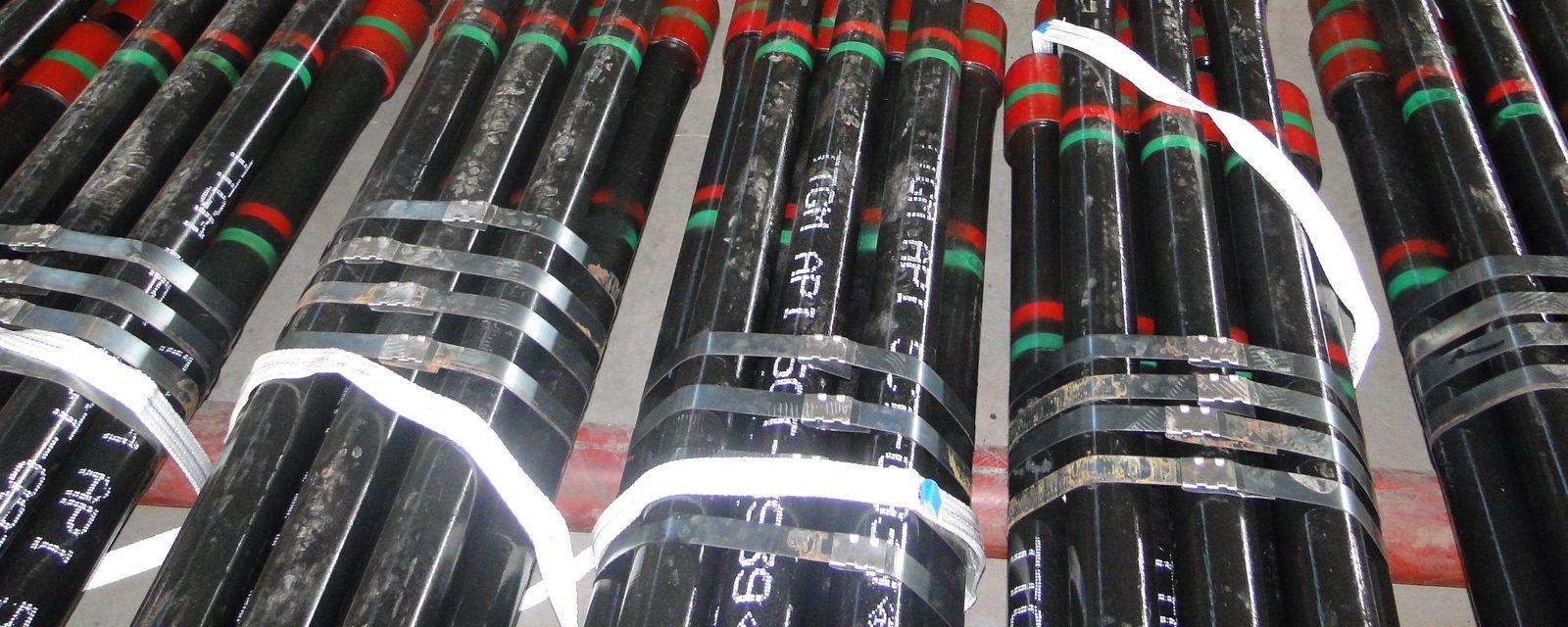
Lead time 30–45 days
Third party SGS / BV / TUV
Quote within 24 hours
Hardness both ends, per heat
C125 is the newest grade in the API 5CT family: it arrived with Addendum 1 in May 2025, and it exists to fill a gap that had no answer. Until then, a well that needed 125 ksi and also carried H₂S had only one option — Q125 — and Q125 is not a sour-service grade. C125 is the same strength level with a hardness ceiling attached.
The band tells you how hard the grade is to make. Yield runs 862–931 MPa — 69 MPa wide, narrower than any other grade in the family — and hardness is capped at 34 HRC. Getting 125 ksi and holding a hardness ceiling at the same time requires chemistry and quench control that most mills have not yet qualified. That is why the lead time is longer and the availability is thin.
This page does not claim stock. C125 is a project grade in 2026: we quote it against mill allocation, with the acceptance table agreed before the heat is rolled.
Mechanical requirements
Table 1 — API 5CT C125 requirements
| Property | Requirement | Note |
|---|---|---|
| Yield strength | 862–931 MPa (125–135 ksi) | 69 MPa band, the narrowest in the family |
| Tensile strength | ≥896 MPa (130 ksi) | Lower minimum than Q125’s 931 |
| Hardness | ≤34 HRC | What makes it a sour candidate |
| Heat treatment | Quenched and tempered | Full length |
| SSC testing | Specified in the addendum | Part of the grade definition, not optional |
| Elongation | Per API 5CT table | Wall dependent |
C125 is written here without a group number. Published sources place it differently, and the addendum is recent enough that the grouping is still being read consistently. The mechanical values above are the ones to design to; the group label adds nothing to a purchase order.
C125 against Q125 — same strength, opposite intent
This is the comparison that justifies the grade. Both sit at 125 ksi. One is built to carry load in sweet service, the other to survive H₂S.
Table 2 — C125 versus Q125
| Item | C125 | Q125 |
|---|---|---|
| Yield range | 862–931 MPa | 862–1,034 MPa |
| Min tensile | 896 MPa | 931 MPa |
| Hardness | 34 HRC max | No fixed maximum, variation controlled |
| Wet H₂S | Assessable to NACE MR0175 | Not a sour grade |
| Band width | 69 MPa | 172 MPa |
| Supplier base | Very narrow | Narrow but established |
C125 against C110 — the strength step
Table 3 — Where the family sits
| Grade | Yield (MPa) | Hardness | Position |
|---|---|---|---|
| C90 | 621–724 | 25.4 HRC | Sour, moderate strength |
| T95 | 655–758 | 25.4 HRC | Sour, higher strength |
| C110 | 758–828 | 30 HRC | Sour, 110 ksi class |
| C125 | 862–931 | 34 HRC | Sour, 125 ksi class |
The hardness ceiling steps up as the strength steps up: 25.4, 30, 34 HRC. That progression is the family logic — each grade buys strength by accepting a little more hardness, within limits the environment can tolerate.
Sizes and process
Table 4 — Availability and route
| OD | Wall | Route | Status |
|---|---|---|---|
| 60.3–168.3 mm | 4.5–18 mm | Hot rolled + cold drawn + Q&T | Project basis |
| 168.3–355 mm | 6–50 mm | Hot rolled + Q&T | Project basis |
| 355 mm and above | Per enquiry | Project route | On request only |
Where C125 is specified
Ultra-deep sour wells
Where C110 runs out of collapse or burst capacity and Q125 is disqualified by the H₂S content.
High pressure tubing with hardness limits
Project specifications that cap the string at 34 HRC and still call for 125 ksi.
Replacement for exotic alloys
In some CO₂ plus H₂S cases, C125 can delay the step to 13Cr or duplex — but only after an assessment, not by default.
Frequently asked questions
Is C125 a formal API grade?
Yes. It was added to API 5CT by Addendum 1, published in May 2025. Before that date it did not exist in the standard, which is why older grade charts do not list it.
What is the difference from Q125?
Hardness control. Q125 has no fixed hardness maximum and is not a sour-service grade; C125 caps hardness at 34 HRC and is assessable to NACE MR0175. The yield bands differ too — 69 MPa wide for C125 against 172 MPa for Q125.
Why is the yield band so narrow?
Because hardness and yield move together. Holding 34 HRC while allowing a 172 MPa yield spread is not achievable, so the standard narrows the band to keep the two requirements compatible.
Can you supply it from stock?
No. C125 is a project grade with mill allocation, and we will not describe it as an off-the-shelf item. Quotation follows confirmation of allocation and acceptance criteria.
What testing is required?
The grade definition includes SSC testing in addition to the usual tensile, hardness and NDT. The exact programme is agreed with the mill and the end user before rolling.
What lead time should I plan for?
30–45 days from allocation, and allocation itself can take longer. If the well programme is fixed, start the enquiry early rather than assuming availability.
Request a quotation
WhatsApp +86 178 7358 1838
C110 Seamless TubeSame band, hardness capped at 30 HRC for sour wells.
Q125 Seamless Tube862–1034 MPa, narrow temper window.
Hot Rolled + Q&TLarge OD and heavy wall, quenched after rolling.
Cold Drawn + Q&TSmall OD, thin wall, drawn before quenching.
Drill Pipe Upset TubeTube body with thickened ends, 60.3–127 mm.
C125 is a project grade. Quoted against mill allocation, not from stock. Related: alloy steel tube · high pressure gas cylinder tube
Request a quotation