
Project Description
Lead time 20–35 days
Third party SGS / BV / TUV
Quote within 24 hours
PSL 1, 2 or 3
P110 is the grade most deep wells land on: 110 ksi minimum yield, 125 ksi minimum tensile, and a yield ceiling of 140 ksi that gives the designer room to work. It is a Group 3 grade in API 5CT, which is the part that matters commercially — Group 3 has no hardness ceiling and no restricted chemical composition, so it is cheap to make and it is not a sour-service material.
That last sentence is the one that gets ignored. P110 has no maximum hardness, which means nobody controls the hard phases that hydrogen sulphide attacks. In a wet H₂S environment a P110 string can fail by sulphide stress cracking at stresses far below its yield strength — the grade is not “a bit less resistant”, it is outside the scope of NACE MR0175 for that service. If there is H₂S, the answer is C110, C125, L80, C90 or T95, not P110 with a coating.
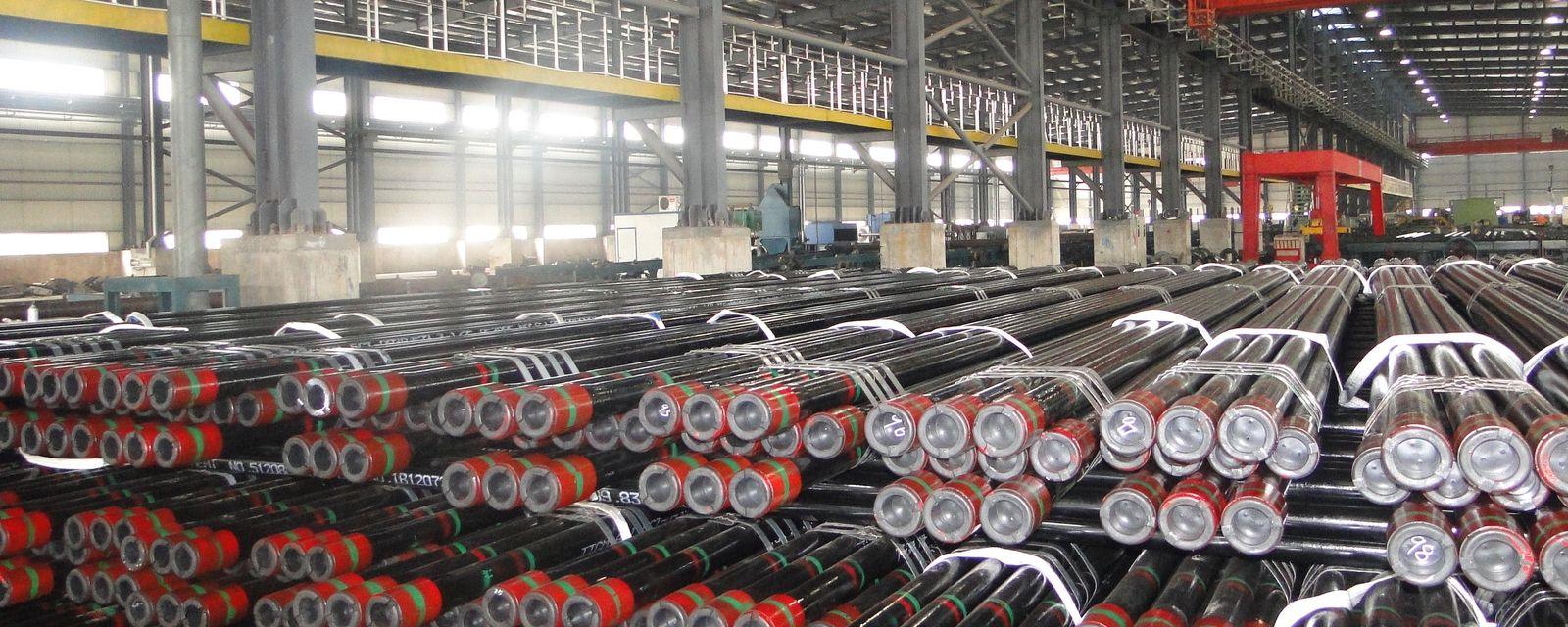
We supply P110 as tube to API 5CT mechanical requirements, hot rolled or cold drawn and then quenched and tempered. It goes into casing, tubing, coupling stock and — on a project basis — drill pipe bodies. It is not an API 5DP grade and is never described as one here.
Mechanical requirements
Table 1 — API 5CT P110 requirements
| Property | Requirement | Note |
|---|---|---|
| Yield strength | 758–965 MPa (110–140 ksi) | Wide band, deliberately |
| Tensile strength | ≥862 MPa (125 ksi) | Minimum, not typical |
| Elongation | Per API 5CT table, wall dependent | Minimum 12% at common walls |
| Hardness | No maximum | Group 3 characteristic |
| Heat treatment | Quenched and tempered, full length | Normalising is not permitted for P110 |
| Impact | Not mandatory at PSL1 | Specify if the well requires it |
The absence of a hardness limit is what separates P110 from C110 at the same nominal strength. It is also why P110 is cheaper per tonne: there is no hardness control step to pay for.
Where P110 sits against the neighbouring grades
Table 2 — P110 and its neighbours
| Grade | Yield (MPa) | Hardness cap | Sour service | Position |
|---|---|---|---|---|
| N80Q | 552–758 | None | No | General purpose, cheaper |
| L80 | 552–655 | 23 HRC | Yes | Sour service at lower strength |
| C110 | 758–828 | 30 HRC | Yes, with limits | Same strength, sour capable |
| P110 | 758–965 | None | No | Deep, high pressure, sweet |
Sizes and process route
Table 3 — Availability
| OD | Wall | Route | Status |
|---|---|---|---|
| 60.3–168.3 mm | 4.5–18 mm | Hot rolled + cold drawn + Q&T | Standard |
| 168.3–355 mm | 6–50 mm | Hot rolled + Q&T | Standard |
| 355–720 mm | Wall per enquiry | Project route | On request |
The process route is not cosmetic. Cold drawing before quenching gives the wall tolerance and concentricity that a thin wall needs; hot rolling is the only economic route above about 168 mm.
What to put on the purchase order
Table 4 — Ordering checklist
| Item | Options | Why it matters |
|---|---|---|
| Product specification level | PSL1 / PSL2 / PSL3 | PSL2 adds NDT and traceability; PSL3 adds the most inspection |
| NDT | UT to GB/T 5777 L2.5 or L3 | Not automatic at PSL1 |
| Hydrostatic | Per API 5CT or agreed pressure | State whether every tube or sample |
| Impact | Charpy at 0 / −20 °C | Only if the well design calls for it |
| Ends | Plain end, threaded, coupled | Threading is a separate operation from tube supply |
| Certificate | EN 10204 3.1 or 3.2 | 3.2 requires third-party witness |
| Sour service | Not applicable to P110 | If H₂S is present, change grade — do not change coating |
Where P110 is used
Deep and high pressure wells
Where burst and collapse loads push the design above N80 or L80 and there is no H₂S in the stream.
Casing and tubing strings
The most common OCTG application; the wide yield band lets the mill hit the target without narrow process windows.
Drill pipe bodies, project basis
For ultra-deep strings where 5DP grades run out of capacity. Supplied to 5CT properties, never described as a 5DP grade.
Frequently asked questions
Can P110 be used in an H₂S well?
No. P110 is Group 3 in API 5CT, which has no hardness ceiling, and hardness is what governs sulphide stress cracking. For sour service the applicable grades are L80, C90, T95, C110 or C125, assessed against NACE MR0175 / ISO 15156.
What is the difference between P110 and N80Q?
Strength and cost. N80Q is 552–758 MPa yield and is the general-purpose quenched and tempered grade; P110 is 758–965 MPa and is used when the load calculation exceeds what N80 can carry. Both are non-sour.
Does P110 have to be quenched and tempered?
Yes. API 5CT does not permit normalising or normalising and tempering for P110 — the grade is defined as quenched and tempered, full length. A mill certificate showing “N” for a P110 order is a red flag.
Can you supply a P110 drill pipe body?
We can supply the tube body to 5CT P110 mechanical properties on a project basis. It is not an API 5DP grade, and the tool joint and weld procedure must be qualified for the strength.
What is the lead time?
20–35 days depending on size and PSL. PSL3 and third-party witness add time at the inspection stage rather than at the mill.
What is the minimum order?
One tonne per size for tube. Threaded and coupled product has a higher minimum because it moves to a different line.
Request a quotation
WhatsApp +86 178 7358 1838
C125 Seamless TubeAdded by 5CT Addendum 1, 862–931 MPa.
Q125 Seamless Tube862–1034 MPa, narrow temper window.
Hot Rolled + Q&TLarge OD and heavy wall, quenched after rolling.
Cold Drawn + Q&TSmall OD, thin wall, drawn before quenching.
Drill Pipe Upset TubeTube body with thickened ends, 60.3–127 mm.
P110 is not a sour-service grade. If H₂S is present, specify C110, C125, L80, C90 or T95 and assess to NACE MR0175. Related: alloy steel tube · high pressure gas cylinder tube
Request a quotation