
Project Description
Lead time 30–45 days
Tooling die and mandrel quoted separately
Quote within 48 hours
Sample cut section on request
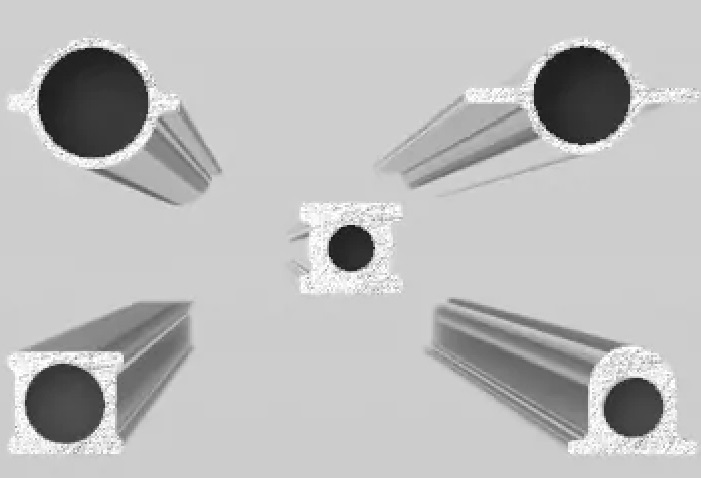
Hot extrusion is the route to a hollow section when the profile is too large, too thick-walled, or too intricate for cold drawing. A pierced billet at 1150–1250 °C is pushed through a shaped die over a mandrel, so the outside profile and the inside bore are formed in a single pass — square, rectangular, hexagonal, elliptical, D-shaped, finned, or a round bore inside a non-round outline. The economics are different from cold drawing: tooling is cheaper for large sections, the minimum order is tonnes rather than kilograms, and the tolerance is looser because the section is produced hot and then pickled. Where a cold drawn profile would need a 200-tonne draw bench and a die that costs more than the order, extrusion is often the only commercially sensible answer.
What extrusion can make that drawing cannot
Table 1 — Process comparison for special sections
| Hot extrusion | Cold drawing | Machining from bar | |
|---|---|---|---|
| Section size | Large: 25–200 mm circumscribed circle | Small to medium: 10–76 mm | Any, but material waste is high |
| Wall thickness | 3–25 mm | 0.5–4 mm | Any |
| Tolerance | ±12.5% wall, ±1% OD | ±8% wall, ±0.10 mm OD | ±0.05 mm |
| Tooling cost | Moderate, one die per profile | High for large sections | None, but cycle time is long |
| Minimum order | 3–5 tonnes | 300–500 kg | One bar |
| Best for | Large structural hollows, thick wall, few-offs at volume | Precision small sections at volume | Prototypes and low volume |
Profiles we extrude
Table 2 — Section families and typical use
| Family | Shape | Typical use |
|---|---|---|
| Square / rectangular hollow | Sharp or radiused corners, uniform wall | Structural frames, machine bases, busbar housings |
| Hexagonal | Across-flats 25–150 mm | Socket stock, column sections, decorative tube |
| Elliptical / oval | Flat or streamwise orientation | Handrails, aerodynamic struts, furniture |
| D-shape | Flat back, round front | Guard rails, hinges, extruded housings |
| Finned / ribbed | Longitudinal fins, 2–12 fins | Heat recovery, boiler economiser, radiator elements |
| Internal rib | Round OD with one or more internal webs | Stiffened shafts, multi-bore cylinders |
| Asymmetric | Customer section with a datum face | Special machinery, replacement of a casting |
Size and tolerance
Table 3 — Capability and permissible variation
| Parameter | Range | Tolerance |
|---|---|---|
| Circumscribed circle | 25 – 200 mm | ±1% of dimension |
| Wall thickness | 3 – 25 mm | ±12.5% |
| Length | 3 – 9 m | +50 / 0 mm |
| Straightness | — | ≤ 2 mm per metre after straightening |
| Twist | — | ≤ 1° per metre |
| Corner radius | 2 – 12 mm | ±1 mm |
| Wall eccentricity | — | ≤ 15% of nominal wall |
| Surface | Pickled, or shot blasted and pickled | Scale-free; grinding on request |
Materials
Table 4 — Grades routinely extruded
| Family | Grades | Comment |
|---|---|---|
| Carbon steel | 20#, 35#, 45#, Q345 | Cheapest route for large structural hollows |
| Alloy steel | 40Cr, 42CrMo4, 4140, 34CrMo4 | Machine parts, cylinder bodies; requires annealing after extrusion |
| Austenitic stainless | 304, 316L, 321, 347H | Good extrusion behaviour; pickle and passivate after |
| Duplex | 2205, 2304 | Narrower temperature window; extrusion ratio limited |
| Nickel alloy | 625, 800H | High flow stress; quoted case by case with a tooling review |
Tooling and order sequence
Table 5 — What happens between drawing and delivery
| Step | Duration | What we need from you |
|---|---|---|
| Profile review | 3 – 5 days | Dimensioned drawing or STEP file, datum marked |
| Die and mandrel manufacture | 5 – 8 weeks | Approval of the review drawing, tooling payment |
| Trial extrusion | 1 week | Confirmation of the section on a cut sample |
| Production | 30 – 45 days | Release of the balance of the order |
| Heat treatment and pickling | 7 – 10 days | Condition specified (annealed, normalized, Q+T) |
| Inspection and packing | 3 – 5 days | Test scope and marking requirements |
Where extruded hollow sections are used
Machine frames
Square and rectangular hollows replacing welded box sections, with uniform wall and no weld seam to distort after machining.
Hydraulic cylinder bodies
Thick-wall round and D-shaped hollows, honed after extrusion where the bore is the sealing surface.
Heat recovery elements
Longitudinally finned tube for economisers and air heaters, where the fin is extruded with the tube rather than welded on.
Socket and tool stock
Hexagonal hollow sections for socket manufacture, saving the drilling operation on every part.
Transport structures
Elliptical and D-shaped sections for handrails, luggage racks and body pillars where the profile is also the visible surface.
Casting replacement
Asymmetric hollow sections that replace a casting, removing pattern cost and porosity risk on medium volumes.
Frequently asked questions
What is the smallest section you can extrude?
Around 25 mm circumscribed circle with a 3 mm wall. Below that the billet cools before the section is fully formed and cold drawing becomes the better route.
Why is the minimum order 3 tonnes?
Because the press run has to fill a billet and the die has to be brought up to temperature. A 3-tonne order is the point at which the tooling and set-up cost stops dominating the price per tonne.
How much does the tooling cost?
Typically USD 3,000–8,000 for a die and mandrel set, depending on section complexity and whether internal webs are required. The tooling is charged once and kept for repeat orders.
Can extruded tube be cold drawn afterwards to tighten tolerance?
Yes, and it is a common route for large sections: extrude to the rough profile, anneal, then cold draw to the final size for ±0.10 mm on the OD. It adds cost and lead time but solves the tolerance problem.
What wall tolerance should I design to?
±12.5% is the standard extrusion tolerance. If the part is machined all over, design to the minimum wall; if the bore is a sealing surface, specify honing after extrusion rather than relying on the extruded bore.
Can you extrude stainless steel?
Yes — 304, 316L, 321 and 347H extrude well, with pickling and passivation after. Duplex grades need a narrower temperature window and a lower extrusion ratio, so the minimum order rises.
Do you supply cut lengths or full extruded lengths?
Both. Full lengths are 3–9 m; cut lengths from 300 mm with ±3 mm tolerance. Cut sections are deburred and can be supplied pickled or ground.
How do I know the profile will extrude before paying for tooling?
Send the drawing and we return a review within 3–5 days: whether the section is feasible, where the wall needs thickening, what the die cost is and what tolerance is realistic. The tooling order only starts after that review is approved.
Request a quote
Related products
Hollow BarThick-wall round hollow for machining
Cold Drawn Seamless TubeEN 10305-1 precision tube
ASTM A554 Ornamental TubeSquare, rectangular and round stainless
42CrMo4 Alloy TubeQuenched and tempered machine parts
EN 10297-1 E355 TubeMechanical tube for machined components
All alloy steel tube · Guide: seamless, welded and extruded — how the three routes differ
Also in this range: V-groove special shaped tube · EN 10297-1 E355 mechanical tube · EN 10297-1 E275 mechanical tube · cold rolled seamless tube.
Request a quotation
Attach the profile drawing with the circumscribed circle, wall, corner radii and datum. Tell us the grade, condition, length and annual quantity — feasibility and tooling cost come back within 48 hours.