
Project Description
Lead time 25–35 days
Base tube DOM, +SR
Quote within 24 hours
Salt spray tested per batch
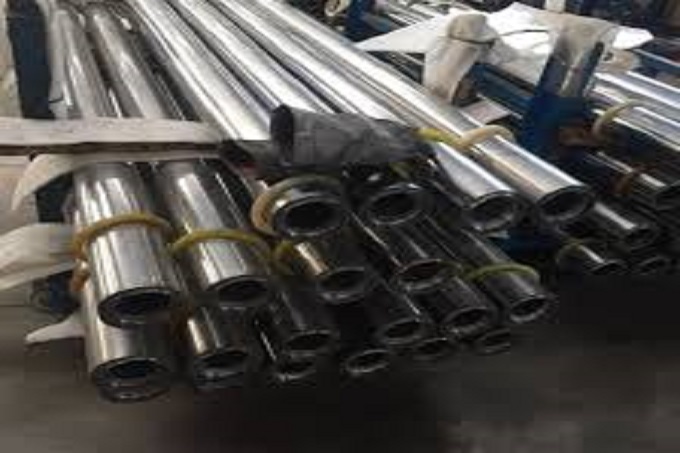
A chrome plated tube is a hydraulic piston rod before it becomes one. The base is drawn-over-mandrel tube in carbon steel, stress relieved; the outside diameter is centerless ground and polished, then hard chrome plated to 20 µm and polished again. That sequence produces three things a plain tube cannot: an f8 diameter that will seal against a rod gland, a surface at Ra 0.2–0.4 µm that carries a wiper without leaking, and a chromium layer of roughly 900 HV that resists abrasion and corrosion in the rod’s working stroke. The bore is separately ground to H7–H9 when the tube is also used as a cylinder barrel. We supply 10 to 300 mm OD, 3 to 30 mm wall, 1 to 12 m length, plated without hexavalent chromium, with salt spray results per batch.
Full specification
Table 1 — Supply specification
| Parameter | Value | Why it is specified that way |
|---|---|---|
| Outside diameter | 10 – 300 mm | Covers rod sizes from small bore cylinders to large press rams |
| Wall thickness | 3 – 30 mm | Wall carries the buckling and tensile load, not the chrome |
| Length | 1 – 12 m | Cut to stroke length plus gland allowance on order |
| OD accuracy | f8 | The shaft tolerance that fits an H8/H9 gland bore with a running clearance |
| OD roughness | Ra 0.2 – 0.4 µm | Too rough wears the seal; too smooth will not hold an oil film |
| Hard chrome thickness | 20 µm ±10% | Standard hydraulic layer; thicker for aggressive environments |
| ID accuracy | H7, H8, H9 | On request, when the bore is a functional surface |
| ID roughness | Ra 0.2 – 0.8 µm | On request, honed or skived |
| Delivery condition | +SR, stress relieved | Prevents movement when the rod is machined or welded after plating |
Base material
Table 2 — Grades we run
| Grade | Standard | Typical use |
|---|---|---|
| STKM 13C | JIS G3445 | General hydraulic rod; the most common grade in Asian supply chains |
| STKM 13A | JIS G3445 | Lower strength variant for lighter rods |
| ST52.3 BK+S | DIN 2391 / EN 10305-1 | Higher strength, European drawings; the E355 equivalent |
| SAE 1026 | ASTM A519 | US drawings, good hardenability for induction hardening after plating |
| SAE A106 | ASTM A106 | Where the buyer’s drawing names it; heavier wall rods |
The base grade decides what happens if the rod is later induction hardened. A 1026 or ST52.3 rod hardens predictably; a low-carbon STKM 13A does not. If the drawing calls for a hardened case under the chrome, say so at enquiry — the plating sequence changes.
Surface and chrome layer
Table 3 — What the surface actually gives you
| Property | Value | Consequence in service |
|---|---|---|
| Chrome hardness | Roughly 900 HV (about 68 HRC equivalent at the surface) | Resists abrasion from dust and metal particles drawn past the wiper |
| Layer thickness | 20 µm ±10% | Thick enough to survive regrinding once; thin enough not to crack under bending |
| Porosity | Micro-cracked, as deposited | Holds oil, which is why it seals well; the cracks must not reach the base metal |
| Corrosion resistance | Salt spray tested per batch | The chrome is a barrier, not a sacrificial coating — a through-crack pits the steel underneath |
| Process chemistry | Trivalent chrome, no hexavalent chromium | Required for REACH and RoHS compliance in European supply chains |
| Post-plate finish | Polished to Ra 0.2 – 0.4 µm | Determines seal life more than the chrome thickness does |
Chrome plated tube, chrome plated bar or induction hardened
Table 4 — Choosing the rod product
| Product | Construction | Use it when | Limitation |
|---|---|---|---|
| Chrome plated tube | Hollow, DOM base | The rod is long and weight matters; the bore may also be used as a passage | Buckling limit lower than a solid bar at the same diameter |
| Chrome plated bar | Solid, typically Ck45 | Short strokes, high side load, or the rod end needs to be machined solid | Heavier and more expensive per metre |
| Induction hardened + chrome | Tube or bar, case hardened under the chrome | High side load, abrasive environment, or where denting would end the seal | Cannot be straightened after hardening; more process steps |
| Stainless rod | Martensitic or duplex | Marine, offshore and food environments | Two to three times the cost; lower surface hardness than hard chrome |
Inspection
Table 5 — What is checked before it ships
| Check | Coverage | Method |
|---|---|---|
| Chrome thickness | Every batch, samples per lot | Magnetic induction gauge or coulometric |
| Surface hardness | Samples per lot | Microhardness on a polished section |
| OD dimension | 100% | Micrometer, f8 verified against the drawing |
| Roundness and straightness | 100% | V-block and dial indicator |
| Surface defect | 100% visual | Look for pitting, nodules, polishing marks and edge burns |
| Salt spray | Per batch | Neutral salt spray; hours recorded on the report |
| Base tube certificate | Every lot | EN 10204 3.1 for the tube, plus a plating report |
Where chrome plated tube goes
Hydraulic cylinder rods
The main application. The rod is the only part of the cylinder exposed to the environment on every stroke, so the chrome layer and the surface finish decide the seal life.
Telescopic cylinders
Multi-stage rods where each stage is a different diameter and every stage is chromed. Straightness matters more here than in a single-stage cylinder.
Elevator and lift cylinders
Long strokes and outdoor duty. Usually a heavier chrome layer and a higher wall for buckling.
Agricultural machinery
Dust, mud and stone chips. This is where a through-crack in the chrome becomes a pitted rod within a season.
Earthmoving equipment
High side load on the rod, so induction hardened tube under the chrome is often the right specification rather than plain chrome plated.
Press and forming rams
Large diameters, 200 mm and above, where the tube route saves weight against a solid bar.
Frequently asked questions
Why chrome plated tube rather than stainless steel?
Cost and surface hardness. Hard chrome runs at roughly 900 HV against 250–300 HV for a martensitic stainless rod, and the base tube is a fraction of the price. Stainless wins only where chloride attack would pit the chrome through to the steel — marine and offshore duty.
What does f8 mean in practice?
It is an ISO shaft tolerance: the rod is never larger than nominal and undersize by a defined band that grows with diameter. Paired with an H8 or H9 gland bore it gives a running fit with a controlled clearance, which is what the seal needs.
How thick should the chrome be?
20 µm is the hydraulic standard and what we hold as default. Go to 30–50 µm for abrasive or corrosive environments, and expect to grind back to size — a thick layer builds up on the diameter and must be removed.
Is the chrome hexavalent?
No. We plate from trivalent chromium baths, which is what REACH and RoHS require for anything entering the European market. If your drawing still specifies hexavalent chrome, the drawing needs updating.
Can you hone the inside as well?
Yes, to H7–H9 with Ra 0.2–0.8 µm. This is common for telescopic stages where the bore of one stage is the running surface for the next, and it has to be ordered explicitly — the default is an as-drawn bore.
Can a worn rod be re-plated?
Yes, if the base metal is sound. The old chrome is stripped, the diameter is ground undersize, re-plated and re-polished. A rod pitted through to the steel cannot be saved by plating — the pit is still there under the new layer.
What length can you supply?
1 to 12 m. Longer rods are made as butt-welded assemblies, which is a different product with its own weld qualification — ask before assuming a 15 m rod can be shipped in one piece.
What is the minimum order and lead time?
500 kg per size. Lead time is 25–35 days including plating; induction hardened and honed-bore variants add about a week.
Request a quote
Related products
DIN 2391 Precision TubeSt35 / St45 / St52, tight tolerance
EN 10305-1 Cold Drawn Tubeh9–h11, +SR and +N conditions
AISI 4140 Alloy TubeFor hardened rods and shafts
20Cr13 Stainless TubeMartensitic alternative for corrosive duty
E470 20MnV6 Hollow BarThick wall rod stock
All cold drawn tube — CDS, honed, skived and plated · Guide: cold drawn seamless tube, tolerance classes and delivery conditions
Request a quotation
Tell us OD, ID, length, chrome thickness and the base grade if the drawing names one. We reply within 24 hours with price, lead time and the inspection scope.