
Project Description
Lead time 25–35 days
Condition annealed or Q&T
Quote within 24 hours
UT on request
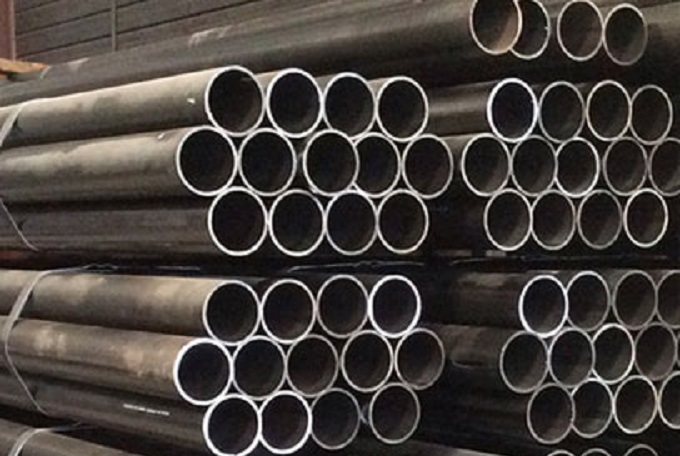
AISI 4140 is the American designation for the chrome-molybdenum through-hardening steel that Europe calls 42CrMo4 — about 0.4% carbon, 1% chromium, 0.2% molybdenum. It is bought for one reason: at that chemistry it hardens right through a substantial section, so a 100 mm wall can still be martensitic after quenching where a plain carbon steel would only harden at the surface. Annealed at about 197 HB it machines cleanly; quenched and tempered at 540 °C it carries 1000 MPa tensile with a 750 MPa yield and enough toughness for a shaft. We supply seamless tube and hollow bar in the annealed or quenched and tempered condition, with hardness and tensile values reported for the actual section, since those are what change with size.
Chemical composition
Table 1 — AISI 4140 / 42CrMo4 chemistry (%)
| Element | AISI 4140 | 42CrMo4 (1.7225) |
|---|---|---|
| C | 0.38 – 0.43 | 0.38 – 0.45 |
| Si | 0.15 – 0.35 | 0.40 max |
| Mn | 0.75 – 1.00 | 0.60 – 0.90 |
| P max | 0.035 | 0.025 |
| S max | 0.040 | 0.035 |
| Cr | 0.80 – 1.05 | 0.90 – 1.20 |
| Mo | 0.15 – 0.25 | 0.15 – 0.30 |
The two are metallurgically very close, and most projects accept one for the other after review. The EN grade allows slightly more chromium and a wider carbon band, which marginally improves hardenability at the top of the range.
Mechanical properties
Table 2 — Quenched and tempered, by ruling section
| Ruling section | Tensile Rm | Yield ReH min | Elongation | Hardness |
|---|---|---|---|---|
| Up to 16 mm | 1100 – 1300 MPa | 900 MPa | 10% | 34 – 38 HRC |
| Over 16 – 40 mm | 1000 – 1200 MPa | 750 MPa | 11% | 30 – 34 HRC |
| Over 40 – 100 mm | 900 – 1100 MPa | 650 MPa | 12% | 28 – 32 HRC |
| Over 100 – 160 mm | 800 – 950 MPa | 550 MPa | 13% | 25 – 29 HRC |
Ruling section is the thickness at the point that cools slowest. In tube that is the wall, not the diameter — which is why a 200 mm OD tube with a 30 mm wall achieves better properties than a 200 mm bar.
Table 3 — Tempering temperature against hardness
| Temper | Hardness, 25 mm section | Use it for |
|---|---|---|
| 200 °C | About 52 HRC | Wear parts, lightly loaded |
| 400 °C | About 45 HRC | Strength with some toughness |
| 540 °C | About 36 HRC | The usual shaft and rod condition |
| 620 °C | About 30 HRC | Maximum toughness at 1000 MPa |
| 680 °C | About 25 HRC | Approaching annealed |
Avoid tempering between 350 and 450 °C. That window produces temper embrittlement in this chemistry — hardness falls and toughness does not recover. Re-tempering above 500 °C will not undo it; the part has to be re-austenitized.
Where 4140 tube is used
Downhole tool bodies
Drilling and completion tools, where the tube becomes a machined body with threads at both ends.
Shafts and axles
Drive shafts machined from tube where the bore is not needed, saving the boring of a solid bar.
Hydraulic rods
Heavy-duty piston rods in mining and earthmoving, where a chrome plated carbon rod would not carry the load.
Gears and couplings
Blanks parted from tube and machined, then induction or case hardened locally.
Pressure retaining parts
Tool and valve bodies in oilfield service, where strength and hardenability matter more than a pressure code.
Not for welding
At 0.4% carbon the heat-affected zone hardens severely. Where welding is required, use 4130 or a lower-carbon alloy.
Frequently asked questions
Is 4140 the same as 42CrMo4?
Metallurgically very close and normally accepted as alternatives after a review. The chemistry windows differ slightly — the EN grade allows more chromium and a wider carbon band — and the certificate has to be re-issued against whichever standard the drawing cites.
What hardness can I expect?
It depends on the tempering temperature: about 36 HRC at 540 °C, 30 HRC at 620 °C, 25 HRC at 680 °C on a 25 mm section. Thicker sections read lower. State the hardness you need and the tempering cycle can be quoted.
Can 4140 be welded?
Not practically. At 0.38–0.43% carbon the heat-affected zone hardens severely and cracks. Preheating and PWHT make it possible but never good. Where welding is unavoidable, 4130 is the lower-carbon alternative.
Annealed or Q&T delivery?
Annealed at about 197 HB if you will machine and then harden. Q&T if you want the properties delivered — it machines less easily but arrives ready to use.
Why specify tube rather than bar?
Where the bore is large relative to the wall. Tube saves the material that would become swarf and the boring operation, and because it quenches from both surfaces the properties are often better than bar of the same diameter.
Is ultrasonic inspection available?
Yes on request. For heavy wall tube that becomes a pressure or lifting part, specify it — internal defects do not show up until the part is nearly finished.
What sizes are available?
10.2 to 810 mm outside diameter with wall from 1.6 to 100 mm, in the seamless route. Sizes above 500 mm are made to order.
What is the minimum order and lead time?
500 kg per size. Lead time is 25–35 days; Q&T to a specified hardness range and UT run towards the longer end.
Request a quote
Related products
AISI 4130 Alloy TubeLower carbon, weldable chrome-moly
AISI 4145 Alloy TubeHigher carbon, higher hardenability
4140 Hollow BarThick wall for rings and tool bodies
E470 20MnV6 Hollow BarWeldable high tensile alternative
Chrome Plated TubePiston rods from alloy or carbon tube
All alloy steel tube — chrome-moly, nickel-moly and through-hardening grades · Guide: cold drawn seamless tube, tolerance classes and delivery conditions
Request a quotation
Tell us OD, wall, length, condition and the hardness or strength you need. We reply within 24 hours with price, lead time and test scope.