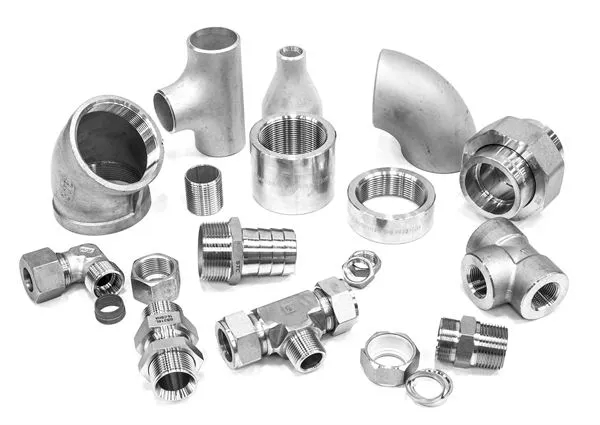
A line specification that calls for “fittings to ASME B16.9” and another that calls for “ASME B16.11 Class 3000” are not describing the same product at two quality levels. They describe two different joint systems. The choice between them is settled by line size, by what the inspection plan requires, and by what is flowing inside the pipe — usually in that order, and usually before anyone discusses price.
On this page
- One decision, two standards
- What each standard actually covers
- The class number is not a pressure rating
- The 1.6 mm that decides the joint
- Where socket weld stops working
- Where butt weld pays for itself
- Branch connections: tees, olets and MSS SP-97
- Matching fitting grade to pipe grade
- What to measure when the fittings arrive
- Sour, cryogenic and high-purity service
- Writing the enquiry so the quote comes back right
- Frequently asked questions
1. One decision, two standards
Both standards produce elbows, tees, reducers and caps in carbon, alloy and stainless steel. From a catalogue page they look interchangeable. They are not, because of three structural differences that no amount of careful purchasing can bridge.
The first is how the fitting is made. B16.11 fittings are forged — closed-die or upset — from bar or billet, then machined. The grain flow follows the shape of the elbow, which is why a forged elbow tolerates vibration and pressure cycling better than its wall thickness alone would suggest. B16.9 fittings are wrought: formed from seamless or welded pipe by hot or cold working. They inherit the pipe’s metallurgy rather than a forging’s.
The second is how they attach. A socket weld fitting receives the pipe into a machined socket and is joined with a single fillet weld on the outside. A butt weld fitting is joined end to end with a full-penetration groove weld. One weld is inspectable from the outside only; the other can be radiographed through its full thickness.
The third is how they are rated. This is where most ordering errors begin, and it is covered in section 3.
2. What each standard actually covers
Table 1 — Scope comparison, ASME B16.11 against ASME B16.9
| ASME B16.11 | ASME B16.9 | |
|---|---|---|
| Product family | Forged fittings, socket-welding and threaded | Wrought butt-welding fittings |
| Size range | NPS 1/8 – NPS 4 (DN 6 – DN 100) | NPS ½ – NPS 48 (DN 15 – DN 1200) |
| Rating basis | Pressure class 2000 / 3000 / 6000 / 9000, correlated to a pipe schedule | The schedule of the pipe it matches; no independent class |
| End connections | Socket weld; threaded NPT, BSPT or BSPP | Butt weld, bevelled to ASME B16.25 |
| Wall thickness | Set by the class and the socket geometry | Matches the ordered schedule; no point below 87.5% of nominal |
| Typical duty | Small bore, instrument and utility lines, high-pressure injection, steam tracing | Main process lines, large bore, high temperature, cyclic duty, CRA and high-purity service |
| Radiography | Not practicable on the root; surface NDT only | Full RT or UT of the butt weld is routine |
| Installed cost at NPS 2 | Lower — no bevel, no purging, fast fit-up | Higher — bevel prep, alignment, full-penetration weld, NDT |
| Installed cost at NPS 6 | Not normally available or specified | Standard, and cheaper than any alternative |
The overlap is real but narrow. Between NPS 1½ and NPS 4 both standards can supply an elbow of the same nominal size, and that is exactly where project specifications diverge. Most owner specifications resolve it by rule rather than by calculation: socket weld is permitted up to NPS 1½ or NPS 2, butt weld is mandatory above it. A few allow socket weld to NPS 4 on utility and instrument air. Almost none allow it on the process line of a sour gas train.
3. The class number is not a pressure rating
An A105 Class 3000 fitting is not “rated at 3000 psi” in the sense a flange rating is. The class is a shape designation: it fixes the body wall, the socket bore and the socket depth so that the fitting matches a specific pipe schedule. The standard publishes the correlation, and the correlation is not symmetric between the threaded and socket-weld series.
Table 2 — B16.11 class against pipe schedule (rating basis)
| Class | Socket weld | Threaded | Where it is used |
|---|---|---|---|
| 2000 | — | Schedule 80 / XS | Low-pressure utility, instrument air |
| 3000 | Schedule 80 / XS | Schedule 160 | The default class on most process projects |
| 6000 | Schedule 160 | XXS | High-pressure small bore, chemical injection |
| 9000 | XXS | — | Special high-pressure, made to order |
The correlation follows the wall-thickness basis published with B16.11. Class 2000 is a threaded-only class in normal supply, and Class 9000 socket weld is rarely stocked above NPS 2. Confirm against the edition cited in your project specification.
Read the table diagonally and the logic appears. A threaded Class 3000 fitting and a socket-weld Class 3000 fitting are not the same wall. The thread cuts metal away from the pressure boundary, so the threaded body has to start heavier to end up equivalent. That is why threaded Class 2000 and socket-weld Class 3000 both sit on Schedule 80 pipe: same containment, different geometry, different class number.
The practical consequence is simple and frequently missed. Order the class the line specification names, then check the bore against the pipe. If the line is Schedule 160 and someone orders Class 3000 socket weld because “3000 sounds stronger than 2000”, the fitting that arrives is dimensioned on a Schedule 80 basis — half the wall of the pipe it is about to be welded to. The joint will fit. It will also be the weakest point in the run.
4. The 1.6 mm that decides the joint
ASME B31.3 requires a gap of approximately 1.6 mm (1/16 in) between the end of the pipe and the bottom of the socket before welding. It is the least glamorous dimension on the whole fitting, and it is the one that produces most of the failures.
The reason is thermal. Welding heats the socket and the pipe unevenly. If the pipe is bottomed out in the socket, there is nowhere for differential expansion to go, and the contraction that follows the weld pass pulls the root apart. The crack starts inside the socket, where nobody can see it, and shows up months later as a leak or as a failed PT on a shutdown inspection.
Push the gap too wide and the failure mode changes rather than disappears. A large gap creates an annular crevice at the root that no weld reaches, an ideal site for crevice corrosion in stainless and duplex, and a stress raiser at the toe of the fillet weld.
Table 3 — Socket weld assembly control points
| Point | Requirement | Field check |
|---|---|---|
| Insertion depth | Pipe marked at socket depth before assembly | Marker line visible at the socket face after fit-up |
| Root gap | Approximately 1.6 mm (1/16 in) | Feeler gauge at four quadrants before tacking |
| Tack welds | Three or four, evenly spaced, same filler as the root | Visual; tacks fully fused into the finish pass |
| Alignment | Square to the socket face, no side load | Try square or laser, checked before the root pass |
| Root inspection | PT where the specification requires it | After root pass, before the cover pass |
| Stainless purging | Purge the bore before welding; the socket traps air | Oxygen monitor at the outlet, typically below 100 ppm |
The gap is not a suggestion and it is not self-correcting. On a small-bore spool with forty socket welds, one bottomed-out joint is enough to fail a hydrostatic test after the insulation is on.
5. Where socket weld stops working
The joint has a structural weakness that no weld procedure can remove: the pipe stops, the socket wall continues, and the load path has to turn a corner. The stress concentration factor at that corner is roughly two to three, depending on wall and fillet profile. That single fact explains most of the service limits.
Table 4 — Failure modes specific to socket weld joints
| Mechanism | What happens | Where it bites |
|---|---|---|
| Crevice corrosion | Stagnant electrolyte sits in the unswept root gap; chlorides concentrate | Stainless and duplex above 60 °C, seawater, chloride-bearing process |
| Fatigue | Cyclic load concentrates at the socket corner; crack initiates at the toe | Compressor and pump piping, relief lines, any vibrating small bore |
| Root crack | Pipe bottomed out, weld shrinkage tears the root | Any size; the classic small-bore failure |
| Erosion-corrosion | Bore step disturbs flow; turbulence accelerates metal loss downstream | Wet steam, high-velocity two-phase, slurry |
| Uninspectable root | RT cannot resolve the root through the socket wall; only surface methods apply | High-integrity lines, sour service, critical utility |
| Pigging obstruction | The bore step stops pigs and scrapers | Pipeline and transfer lines that are cleaned in service |
Two of these — crevice corrosion and uninspectable roots — are the reason socket weld disappears from sour service specifications above NPS 1. The third, fatigue, is why it disappears from compressor piping regardless of size.
6. Where butt weld pays for itself
A butt weld costs more to make and less to own. The weld is full penetration, the bore is flush, and the joint can be examined by radiography or ultrasonic testing through its full thickness. On a line that will be hydrotested, commissioned and inspected for twenty years, those three properties are worth more than the difference in fit-up time.
The dimensions that decide whether a spool fits are standardised and easy to check. A long-radius 90° elbow has a centre-to-face dimension of 1.5 × NPS, which is the number a pipe fitter uses to lay out a spool before any fitting arrives on site.
Table 5 — ASME B16.9 centre-to-face dimensions, long-radius elbows (mm)
| NPS | 90° LR, A | 45° LR, B | NPS | 90° LR, A | 45° LR, B |
|---|---|---|---|---|---|
| ½ | 38 | 16 | 3 | 114 | 51 |
| ¾ | 38 | 19 | 4 | 152 | 64 |
| 1 | 38 | 22 | 5 | 190 | 79 |
| 1¼ | 48 | 25 | 6 | 229 | 95 |
| 1½ | 57 | 29 | 8 | 305 | 127 |
| 2 | 76 | 35 | 10 | 381 | 159 |
| 2½ | 95 | 44 | 12 | 457 | 190 |
Values from the B16.9 dimension tables, rounded to the millimetre. Short-radius elbows are a separate table and are only made from NPS 1 upward.
Note what the table does not say. There is no pressure rating in it, because a B16.9 fitting has none of its own: it is rated as straight seamless pipe of the same material and schedule. That is the elegance of the system and the reason a Schedule 80 elbow and a Schedule 160 elbow of the same size have identical outside geometry and completely different pressure capability.
Choose socket weld when
NPS 2 or below, utility or instrument duty, no cyclic load, no chloride, and the inspection plan accepts surface NDT.
Choose butt weld when
NPS 2 and above, sour or high-purity service, cyclic or high-temperature duty, or the line will be radiographed.
Do not mix them on one spool
Every transition adds a weld, a heat-affected zone and an inspection point. Run the branch in the same system as the header.
7. Branch connections: tees, olets and MSS SP-97
Branch connections are where the standard confusion gets expensive, because a third document enters. Integrally reinforced branch outlets — weldolet, sockolet, threadolet, elbolet, latrolet, nipolet — are not covered by B16.9 or B16.11. They are made to MSS SP-97, and they are dimensioned to suit the run pipe they sit on rather than a nominal size of their own.
A tee replaces a length of run pipe: three welds, two of them in the header. An olet is welded onto the outside of the run: one weld, no cut in the header, and a reinforcement that is integral to the forging. Below a branch-to-run ratio of about 0.5, the olet is usually cheaper and mechanically better. Above it, the tee wins on flow and on weld access.
Table 6 — Tee or olet: the practical split
| Condition | Equal or reducing tee | Olet (MSS SP-97) |
|---|---|---|
| Branch / run ratio | 0.5 and above | Below 0.5 |
| Welds on the header | Two | One |
| Header cut required | Yes | No — hole only |
| Flow disturbance | Low | Slightly higher at the branch mouth |
| Pigging | Possible with barred tee | Not possible |
| Typical use | Process branches, manifolds, headers | Instrument, vent, drain, small utility branches |
| Standard to cite | ASME B16.9 (butt weld) or B16.11 (socket) | MSS SP-97, with the run size and branch size both stated |
An olet is ordered by run size × branch size, not by branch size alone: a 6″ × 1″ weldolet and a 2″ × 1″ weldolet are different forgings with the same branch opening. Purchase orders that state only the branch size are the single most common cause of a wrong olet arriving on site.
8. Matching fitting grade to pipe grade
Fittings are not ordered by “the same steel”. They are ordered by the ASTM product specification that covers the shape, and that specification is different from the one covering the pipe even when the chemistry is identical.
Table 7 — Pipe, fitting and flange grades that go together
| Service | Pipe | Butt weld fitting | Forged / socket fitting | Flange |
|---|---|---|---|---|
| Carbon steel, general | A106 Gr. B | A234 WPB | A105 | A105 |
| Low temperature, −46 °C | A333 Gr. 6 | A420 WPL6 | A350 LF2 | A350 LF2 |
| 304L stainless | A312 TP304L | A403 WP304L | A182 F304L | A182 F304L |
| 316L stainless | A312 TP316L | A403 WP316L | A182 F316L | A182 F316L |
| Duplex S31803 | A790 S31803 | A815 WP31803 | A182 F51 | A182 F51 |
| 1¼Cr–½Mo | A335 P11 | A234 WP11 | A182 F11 | A182 F11 |
| 2¼Cr–1Mo | A335 P22 | A234 WP22 | A182 F22 | A182 F22 |
Two details in that table cause more rework than the rest of it combined. The first is the “L” suffix: WP304L is not a synonym for WP304. Fittings are welded in service, and the low-carbon grade is what keeps the heat-affected zone from sensitising. Substituting the standard grade because it was in stock is a corrosion decision, not a commercial one.
The second is the low-temperature row. A333 Gr. 6 pipe with A234 WPB fittings is a common and expensive mistake: the pipe is impact-tested to −46 °C, the fitting is not, and the line loses its low-temperature qualification at every joint. A420 WPL6 exists precisely to close that gap.
9. What to measure when the fittings arrive
Incoming inspection on fittings is mostly dimensional, and it takes less time than the paperwork suggests. The tolerances are published; what is missing on most receiving benches is the list of which ones matter.
Table 8 — Receiving checks, butt weld fittings to B16.9
| Check | Method | Acceptance |
|---|---|---|
| Marking | Visual, against the certificate | Heat number, size, schedule, material grade, standard, manufacturer |
| Outside diameter at bevel | Caliper, two planes 90° apart | Per B16.9 tolerance table; roughly +1.6 / −0.8 mm at NPS 4 |
| Wall thickness | Ultrasonic gauge at extrados, intrados and both ends | No point below 87.5% of nominal for the marked schedule |
| Centre-to-face | Tape or height gauge on a surface plate | ±2 mm up to NPS 10 |
| Angularity | Square against the end face | 1 mm off-angle up to NPS 4, 2 mm above |
| Bevel | Bevel protractor and weld gauge | 37.5° ± 2.5°, root face 1.6 ± 0.8 mm for wall 4.8–22 mm |
| Surface | Visual; PT or MT on a sample | No cracks, laps or seams; no weld repair without documentation |
| Hardness | Portable tester, where sour service applies | ≤22 HRC (250 HV10) for carbon steel per NACE MR0175 |
The 87.5% wall rule deserves a note, because it surprises buyers who expect a fitting to be exactly as thick as the pipe. Forming an elbow stretches the extrados and compresses the intrados, so the mill starts from heavier stock and the standard accepts a minimum of 87.5% of nominal anywhere on the fitting. A Schedule 40 NPS 6 elbow may therefore measure 6.2 mm at the extrados against a nominal 7.11 mm and still be fully compliant. What is not compliant is a fitting whose marked schedule does not match the pipe it is welded to.
10. Sour, cryogenic and high-purity service
Three services override the size rule, and each pushes the decision in the same direction.
Sour service. NACE MR0175 / ISO 15156 governs material selection where H₂S is present. For carbon steel fittings the controlling requirement is hardness: 22 HRC maximum, verified on the finished part rather than on the heat analysis. For stainless grades the standard works from a qualified material list with environmental limits on temperature, chloride content and pH. The practical effect on fitting selection is that socket weld is restricted, because the root cannot be inspected and the crevice is a corrosion site. Butt weld with full RT is the default on the sour line. The material logic is set out in more detail in our NACE MR0175 selection guide.
Cryogenic service. Impact-tested grades are mandatory at every joint: A420 WPL6 for butt weld fittings, A350 LF2 for forged fittings, both qualified to −46 °C. The fitting must carry its own impact test, not inherit the pipe’s. Below −46 °C the choice narrows further to austenitic stainless or nickel alloys.
High-purity and hygienic service. The socket is disqualified outright. An unswept crevice in a pharmaceutical or food-grade line is a bacterial growth site that no cleaning cycle reaches. Orbital butt welding with a purge, and full bore inspection, is the only configuration that passes.
Ordering fittings with the pipe? Fushun Metal supplies butt weld, socket weld and threaded fittings in carbon, alloy, stainless and nickel alloy grades, matched to the pipe grade and certificate package on the same order. Send the line list and we will quote the fittings against it.
11. Writing the enquiry so the quote comes back right
Most fitting quotations that come back wrong were ambiguous before they were sent. A useful enquiry answers eight questions, and a line item that answers all eight can be priced without a single clarification email.
Table 9 — The eight fields that make a fitting enquiry quotable
| Field | What to state | Why it matters |
|---|---|---|
| Standard | ASME B16.9, B16.11, or MSS SP-97, with edition if the project cites one | Sets the dimension table and the tolerance |
| Size | NPS, plus run × branch for olets | Olets are not ordered by branch size alone |
| Thickness | Schedule for B16.9; class for B16.11 | Two different rating languages |
| Material | ASTM grade, with the L suffix where it applies | Determines weldability and corrosion allowance |
| End type | Butt weld, socket weld, threaded; NPT or BSP for threaded | Threads are not interchangeable between standards |
| Quantity | Per size and per type | Drives whether the item is stock or made to order |
| Inspection | NDT method and extent, third-party witness, hardness survey | The largest single variable in the price |
| Documentation | EN 10204 3.1 as standard; 3.2 only where the specification demands it | 3.2 adds a notified body and weeks of lead time |
A line item that satisfies the table reads like this: 8 pcs, 90° long-radius elbow, ASME B16.9, NPS 6, Schedule 40, ASTM A234 WPB, butt weld, 100% RT, EN 10204 3.1, heat number marked. There is nothing left to interpret, and the quotation that comes back can be compared line by line with the next one.
12. Frequently asked questions
Is a Class 3000 fitting the same as Schedule 80?
For socket weld, yes in rating basis: Class 3000 socket weld is correlated to Schedule 80 pipe. For threaded, no: Class 3000 threaded is correlated to Schedule 160, because the thread removes wall and the body has to start heavier. Always confirm the class against the pipe schedule on the line list rather than assuming the numbers align.
Can socket weld fittings be used above NPS 2?
B16.11 covers socket weld fittings up to NPS 4, so the parts exist. Most project specifications still cap socket weld at NPS 1½ or NPS 2, and above that the joint becomes uninspectable and the fatigue penalty grows with diameter. Above NPS 2 the default should be butt weld unless the line is a low-pressure utility.
Can a socket weld be radiographed?
Not usefully. The weld is a fillet on the outside of the socket, and radiation cannot resolve the root through the socket wall. Inspection is limited to visual, penetrant or magnetic particle testing of the cap and, where specified, the root pass before the cover pass. That limitation is the main reason socket weld is excluded from sour and high-integrity service.
What is the difference between ASME B16.9 and B16.11?
B16.9 covers wrought butt-welding fittings from NPS ½ to NPS 48, rated by the schedule of the pipe they match. B16.11 covers forged socket-welding and threaded fittings from NPS 1/8 to NPS 4, rated by pressure class. They overlap between NPS 1½ and NPS 4 but describe different joint systems, not different quality levels.
Are olets covered by ASME B16.9?
No. Integrally reinforced branch outlets — weldolet, sockolet, threadolet, elbolet — are made to MSS SP-97. They are dimensioned to the run pipe and ordered as run size × branch size. Citing B16.9 on an olet purchase order is a document error that will surface at the vendor drawing review.
Which fitting grade should be used for NACE sour service?
Carbon steel to A105 or A350 LF2, hardness controlled to 22 HRC maximum and verified on the finished part, with welding procedure qualification to the same limit. Stainless and duplex grades must fall within the material list and environmental limits of NACE MR0175 / ISO 15156. The joint should be butt welded with full radiography; socket weld is normally excluded.
What wall thickness tolerance applies to B16.9 fittings?
No point on the fitting may be thinner than 87.5% of the nominal wall for the marked schedule, unless the purchaser specifies otherwise. The tolerance exists because forming redistributes metal from the intrados to the extrados. It is checked at the welding ends and at the crown of bends.
Do I need a 3.1 or a 3.2 certificate?
EN 10204 3.1 is the normal supply for pressure fittings and is accepted by most end users: it is issued by the manufacturer’s own inspection department against the actual heat. Type 3.2 requires an independent notified body to witness and endorse the testing, which adds cost and typically two to four weeks. Order 3.2 only when the project specification explicitly calls for it.
13. Related products and guides
- Pipe fittings: butt weld, socket weld and threaded — the full range, with size and material lists.
- Socket weld fittings to ASME B16.11 — Class 3000 and 6000 elbows, tees, couplings, caps and unions.
- Stainless butt weld elbows to ASME B16.9 — 90° and 45°, long and short radius, WP304L and WP316L.
- Concentric and eccentric butt weld reducers — NPS ½ × ¾ up to 24 × 12.
- Olets to MSS SP-97 — weldolet, sockolet, threadolet and elbolet in A105 and F316.
- NACE MR0175 / ISO 15156 material selection — hardness limits, severity regions and the paperwork a sour service order needs.
- What a hydrostatic test actually proves — the test that fails when a socket weld is bottomed out.
- Non-destructive testing types — RT, UT, PT and MT, and what each one can and cannot see on a fitting.