
Project Description
Lead time 15–25 days
Third party SGS / BV / TUV
Quote within 24 hours
Marking heat number on every tee
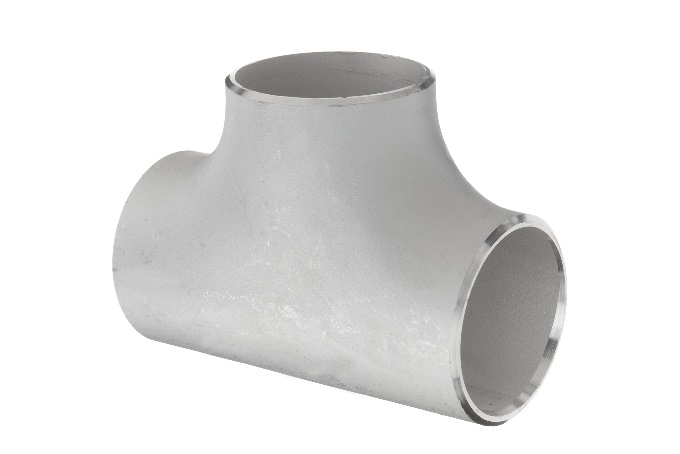
A stainless welding tee is a butt weld fitting that splits or combines a stainless line, made to ASME B16.9 for dimensions and ASTM A403 for material. The two standards do different jobs: B16.9 fixes the centre-to-end length, the bevel and the wall match, while A403 fixes the grade, the chemistry and the intergranular corrosion test. Most enquiry mistakes happen at that boundary — a tee can be dimensionally perfect to B16.9 and still be rejected because the grade is WP304 instead of WP304L, or because the intergranular corrosion test was not performed. We supply equal and reducing tees in WP304L, WP316L and WP321 from NPS 1/2 to 24, in Schedule 10S through 80S, with PMI on every heat and ASTM A262 Practice E available on request.
Grades: what the WP prefix means
Table 1 — A403 grades and where each is used
| Grade | Chemistry | When specified |
|---|---|---|
| WP304L | 18–20% Cr, 8–12% Ni, C 0.030 max | General stainless piping; the default for welded systems because it resists sensitisation |
| WP316L | 16–18% Cr, 10–14% Ni, 2–3% Mo, C 0.030 max | Chloride and chemical service where 304L pits |
| WP321 | 17–19% Cr, 9–12% Ni, Ti 5×C min | Service above 500 °C, where titanium stabilisation prevents sensitisation |
| WP347 | 17–19% Cr, 9–13% Ni, Nb 10×C min | High-temperature and heavy-section welds; better weld toughness than 321 |
| WP316Ti | 316L with Ti stabilisation | European drawings that call for 1.4571 |
The “WP” prefix denotes a wrought fitting to A403. “CF” denotes a casting to A351, and the two are not interchangeable in a pressure class even when the alloy is the same. A certificate that says CF8M where the drawing says WP316L is a rejection, not a substitution.
Dimensions: centre-to-end
Table 2 — ASME B16.9 centre-to-end, equal tee (mm)
| NPS | C | NPS | C | NPS | C |
|---|---|---|---|---|---|
| 1/2 | 25 | 4 | 105 | 14 | 279 |
| 3/4 | 29 | 5 | 124 | 16 | 305 |
| 1 | 38 | 6 | 143 | 18 | 343 |
| 1 1/4 | 45 | 8 | 178 | 20 | 381 |
| 1 1/2 | 51 | 10 | 216 | 24 | 432 |
| 2 | 64 | 12 | 254 | — | — |
| 2 1/2 | 76 | 3 1/2 | 95 | — | — |
| 3 | 86 | — | — | — | — |
For a reducing tee, C is the run centre-to-end and M is the branch centre-to-end. M is not on this table because it depends on the branch size; state both sizes when ordering, for example 6 × 3 in SCH 10S.
Mechanical properties
Table 3 — A403 requirements
| Grade | Yield, 0.2% | Tensile | Elongation |
|---|---|---|---|
| WP304L | 170 MPa | 485 MPa | 28% |
| WP316L | 170 MPa | 485 MPa | 28% |
| WP321 | 205 MPa | 515 MPa | 28% |
| WP347 | 205 MPa | 515 MPa | 28% |
Wall schedule and end preparation
Table 4 — Matching the tee to the pipe
| Item | Requirement | Practical note |
|---|---|---|
| Wall at the ends | Matches the pipe schedule within B16.9 tolerance | A SCH 10S tee on SCH 40S pipe leaves a step the welder cannot close |
| Schedule series | Stainless uses the S series | SCH 10S is thinner than SCH 10 above NPS 8 |
| Bevelling | 37.5° ±2.5°, root face 1.6 mm | Standard for butt welding; plain ends on request |
| Length tolerance | ±1.5 mm on C | Check before fabrication, not after |
| Squareness | Run and branch within 1° | A tee out of square twists the spool |
| Surface | Pickled and passivated | Heat tint must be removed before service |
Testing and certification
Table 5 — Test package
| Test | Frequency | Standard |
|---|---|---|
| Chemical analysis | Every heat | A403 / A751 |
| Tensile | Every lot | A370 |
| Intergranular corrosion | Every heat, when specified | ASTM A262 Practice E |
| PMI | Every heat or every piece | XRF or OES |
| Radiography | When specified | ASME Section V, Art. 2 |
| Penetrant | When specified | ASME Section V, Art. 6 |
| Hydrostatic | Per B16.9 unless NDE is agreed | B16.9 |
| Certificate | Every order | EN 10204 3.1 |
Intergranular corrosion testing is the one that catches a real problem: a WP304L tee that was heated into the sensitisation range during forming will pass tensile and PMI and fail A262 Practice E. For welded stainless systems in corrosive service, specify it rather than accepting the mill’s word for the grade.
Where stainless welding tees are used
Chemical process piping
Branch outlets on 304L and 316L lines, with PMI and IGC to match the pipe certificate.
Pharmaceutical and food
Sanitary systems where the tee is bored and polished to match the tube, often with a 3-A finish.
Water treatment
Demineralised water and low-chloride service, where 304L is adequate and 316L is not justified.
High-temperature headers
321 and 347 tees on superheater and hot gas lines above 500 °C.
Marine and offshore
316L for deck piping and utility systems, with 2205 or super duplex on the seawater side.
Semiconductor and clean utilities
High-purity 316L with low sulphur and a controlled surface finish, often to an owner specification beyond A403.
Frequently asked questions
What is the difference between a welding tee and a butt weld tee?
Nothing — they are the same fitting. “Welding tee” and “butt weld tee” both describe a tee with bevelled ends for butt welding. The distinction that matters is against a socket weld or threaded tee, which have recessed sockets and are not radiographable.
What does WP304L mean?
WP is the wrought fitting designation in ASTM A403, and 304L is the low-carbon austenitic grade. A WP304L tee has 0.030% maximum carbon and is the standard choice for welded stainless piping because it resists sensitisation in the heat-affected zone.
Can a WP304 tee be used instead of WP304L?
Only if the system is not welded, or if the fitting is solution annealed after welding. WP304 has 0.08% carbon and will sensitise in the weld zone, which leads to intergranular corrosion in acid or high-chloride service.
What is the difference between SCH 10S and SCH 10?
The S denotes the stainless schedule series, which has different wall thicknesses from the carbon steel series at the same number. Above NPS 8, SCH 10S is thinner than SCH 10. Always quote the schedule with the S for stainless fittings.
Do you supply reducing tees?
Yes, equal and reducing, with the run and branch sizes stated separately. For a reducing tee, B16.9 gives C for the run and M for the branch, and the branch height depends on the branch size.
Is radiography required on A403 tees?
Not as standard. B16.9 requires either a hydrostatic test or NDE, and radiography of the branch weld is specified when the line class demands it. For critical service, specify RT and the acceptance level.
Can you supply 316Ti instead of 316L?
Yes, WP316Ti for European drawings that call for 1.4571. It is titanium-stabilised and resists sensitisation at higher carbon, which suits thicker sections and higher temperature than 316L.
What is the minimum order and lead time?
50 pieces per size for standard schedules. Lead time is 15–25 days; reducing tees and non-standard schedules run longer. Third-party inspection adds about a week.
Request a quote
Related products
Stainless Steel Butt Weld ElbowLong and short radius, B16.9
Stainless Steel Butt Weld ReducerConcentric and eccentric
ASTM A312 TP304 PipeThe run pipe the tee is welded to
ASTM A312 TP316L PipeMatching 316L line pipe
Socket Weld FittingsB16.11 Class 3000 and 6000
All pipe fittings — butt weld, socket weld and threaded · Guide: B16.9, B16.28 and B16.11 — which standard covers which fitting
Also in this range: carbon steel butt weld tee · ASTM A312 TP304 pipe · ASTM A335 chrome-moly boiler pipe.
Request a quotation
Give us NPS, run and branch schedule, grade, equal or reducing, quantity, and whether IGC testing or radiography is required. We reply within 24 hours with price, lead time and certificate scope.