
Project Description
Lead time 15–20 days
Solution annealed 1040 °C min
Quote within 24 hours
Radiography on request
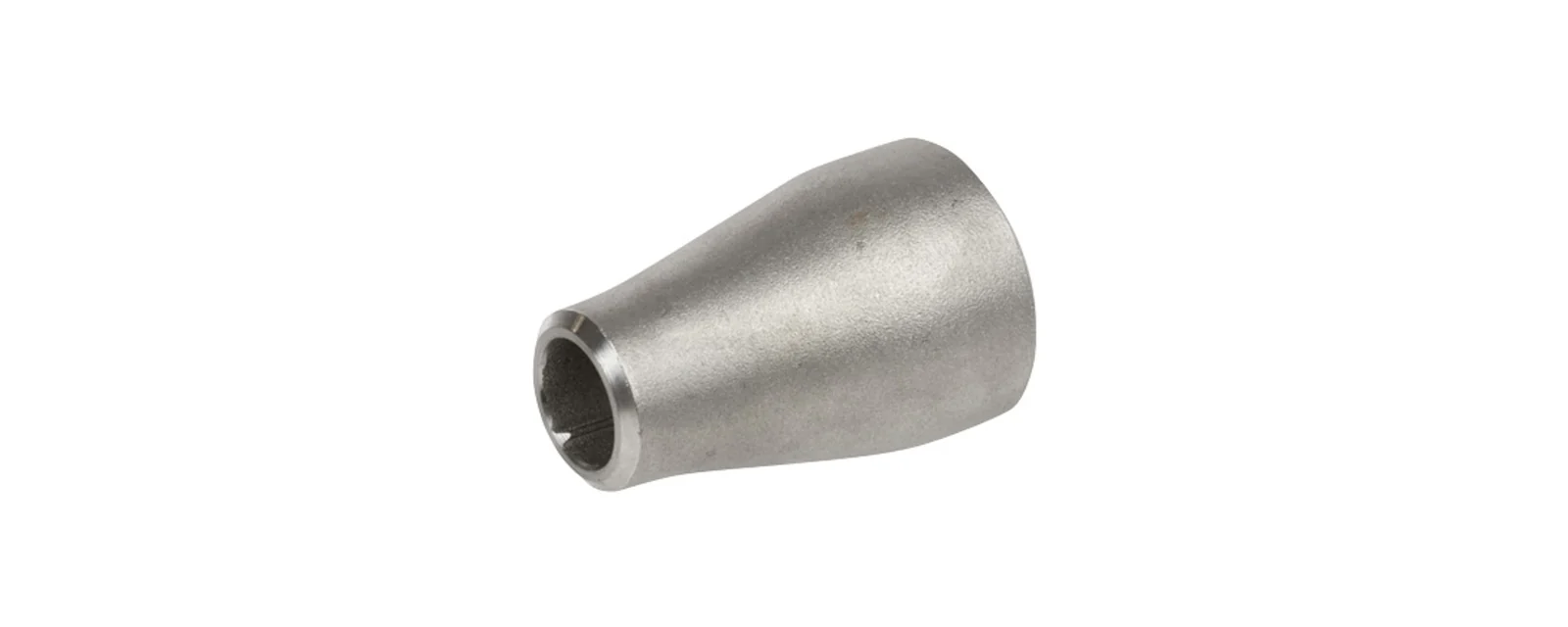
A butt weld reducer changes line size without a threaded joint or a flange pair. Two pipes of different diameter are welded to the two ends of a single wrought fitting, and because the joint is a full-penetration butt weld it can be radiographed and it does not create a crevice. ASME B16.9 fixes the overall length, the two end diameters and the wall at each end, so a reducer is ordered by the pair of sizes — 4 × 2 in, run first, branch second — plus the schedule of each end. The choice that actually matters is concentric or eccentric: a concentric reducer is symmetrical and used in vertical or in-line service, an eccentric one has a flat side that keeps a liquid line draining or a pump suction free of an air pocket. We supply A403 WP304, WP304L, WP316 and WP316L, solution annealed, 100% PMI checked, with the weld bevel machined to B16.9.
Concentric or eccentric — the decision that matters
Table 1 — Choosing the reducer type by line orientation and duty
| Type | Geometry | Use it when | Do not use it when |
|---|---|---|---|
| Concentric | Cone symmetrical about the axis | Vertical lines, in-line size change, no drainage requirement, pump discharge | The line must drain fully, or gas can collect at the top of the cone |
| Eccentric, flat bottom | One side parallel to the axis, flat on the underside | Horizontal liquid lines, drain points, gravity flow, slurry and pulp lines | Vertical runs — the offset serves no purpose and wastes space |
| Eccentric, flat top | One side parallel, flat on top | Pump suction lines and any line where vapour must not be trapped | Lines that must drain completely |
The classic field error is fitting a concentric reducer on a pump suction. The cone traps vapour at the top, the pump cavitates, and the problem is diagnosed everywhere except at the fitting. If the drawing does not say which way the flat goes, ask — the two orientations are different parts and are not interchangeable in service.
Size range and schedules
Table 2 — Availability by manufacturing route
| Route | Size range | Schedules | Note |
|---|---|---|---|
| Seamless | NPS 1/2 – 24 | SCH 10S to XXS | No longitudinal weld, so no weld seam to radiograph |
| Welded (from pipe) | NPS 1/2 – 48 | SCH 10S to XXS | Cheaper above NPS 24; the longitudinal seam is in the fitting body |
| Large diameter fabricated | Above NPS 24 | To drawing | Made from plate; requires a qualified weld procedure and radiography |
Reducers are ordered as a size pair with the schedule of each end stated separately: “NPS 6 × 4, SCH 40S × SCH 40S”. Where the two schedules differ, the fitting wall follows the heavier end and the lighter end is machined to match — say so explicitly or you will get the same schedule both ends.
Material grades
Table 3 — A403 chemistry for the four grades we hold (%)
| Element | WP304 | WP304L | WP316 | WP316L |
|---|---|---|---|---|
| C max | 0.08 | 0.035 | 0.08 | 0.035 |
| Mn max | 2.00 | 2.00 | 2.00 | 2.00 |
| Si max | 1.00 | 1.00 | 1.00 | 1.00 |
| P max | 0.045 | 0.045 | 0.045 | 0.045 |
| S max | 0.030 | 0.030 | 0.030 | 0.030 |
| Cr | 18.0 – 20.0 | 18.0 – 20.0 | 16.0 – 18.0 | 16.0 – 18.0 |
| Ni | 8.0 – 11.0 | 8.0 – 12.0 | 10.0 – 14.0 | 10.0 – 14.0 |
| Mo | — | — | 2.00 – 3.00 | 2.00 – 3.00 |
Table 4 — Mechanical properties and where each grade is right
| Grade | Tensile min | Yield min | Elongation min | Use it when |
|---|---|---|---|---|
| WP304 | 515 MPa | 205 MPa | 28% | General corrosion, food and pharma, no welding after installation |
| WP304L | 485 MPa | 170 MPa | 28% | The line will be welded in place and cannot be solution annealed afterwards |
| WP316 | 515 MPa | 205 MPa | 28% | Chloride-bearing and marine service; PREN around 25 |
| WP316L | 485 MPa | 170 MPa | 28% | Sour, chemical and offshore duty where field welding is unavoidable |
The L grades give up 35 MPa of yield in exchange for resistance to sensitisation. That trade is right when the fitting will be welded into a line that cannot be annealed; it is unnecessary cost when the fitting is welded in a shop that controls heat input. Ask which case applies before defaulting to L.
Standards and where each one applies
Table 5 — Specifications and their actual scope
| Standard | Title | Covers reducers? | Note |
|---|---|---|---|
| ASME B16.9 | Factory-Made Wrought Buttwelding Fittings | Yes | The dimensional reference for NPS 1/2 – 48 |
| ASTM A403 | Wrought Austenitic Stainless Steel Piping Fittings | Yes | The material specification — grades, chemistry, heat treatment |
| MSS SP-43 | Wrought and Fabricated Butt-Welding Fittings for Low Pressure, Corrosion Resistant Applications | Yes | SCH 5S and 10S light wall; dimensions differ from B16.9 |
| MSS SP-75 | High-Strength Wrought Butt-Welding Fittings | Yes | Carbon and high-strength low-alloy, not stainless |
| ASME B16.28 | Wrought Steel Buttwelding Short Radius Elbows and Returns | No | Elbows and returns only — not applicable to reducers |
| EN 10253-4 | Butt-welding pipe fittings, wrought austenitic and duplex steels | Yes | European route; dimensions to EN 10253 differ from B16.9 |
| JIS B2312 | Steel butt-welding pipe fittings | Yes | Japanese dimensional system |
B16.28 appears in a lot of published data sheets next to reducers. It does not cover them — it is short radius elbows and 180° returns only. If a supplier lists it as a reducer standard, the rest of their datasheet deserves checking too.
Manufacture, heat treatment and inspection
Table 6 — Process route and what is checked
| Step | What happens | Checked |
|---|---|---|
| 1. Forming | Hot or cold forming from seamless tube or from plate | Wall thinning at the small end, ovality |
| 2. Solution annealing | 1040 °C minimum, water quench | Required by A403 for all WP grades; not optional |
| 3. Bevel machining | Ends machined to B16.9 bevel geometry | Bevel angle, root face, end diameter, overall length |
| 4. PMI | XRF on 100% of pieces | Confirms the grade actually supplied; catches mix-ups |
| 5. Hydrostatic | Per B16.9 or waived against NDT | Leak tightness of the body |
| 6. Radiography | On request, welded reducers only | Longitudinal seam soundness |
| 7. Final | Pickled and passivated, marked, capped, boxed | Surface, marking: size, schedule, grade, heat number |
What to measure when the box arrives
Table 7 — Dimensional checks worth doing before installation
| Check | What it proves |
|---|---|
| Overall length H, face to face | Whether it is a B16.9 fitting or a short-pattern substitute that will not close the gap |
| Large end OD and small end OD | Confirms the size pair; reversed ordering is the most common shipping error |
| Wall at both ends | Confirms the schedule — the small end is where wall thinning shows up |
| Concentricity or the flat side | Confirms concentric vs eccentric, and which way the flat faces |
| Bevel angle and root face | Whether the welder can make the root without back-gouging |
| Marking and heat number | Whether the certificate in the box belongs to these pieces |
Where stainless reducers are used
Food and beverage
Line size changes between process vessels and transfer lines, where the bore must stay cleanable and the alloy must not react with the product.
Pharmaceutical process lines
316L with a documented surface finish. Eccentric flat-bottom reducers are used where the line must drain completely between batches.
Water treatment and desalination
316L for chloride-bearing streams, particularly on the brine side where 304 would pit within months.
Chemical dosing skids
Small-bore size changes in packaged skids. Concentric reducers and a compact B16.9 envelope keep the skid footprint down.
Marine and offshore
316L with PREN around 25 for seawater-adjacent systems. PMI on every piece is normally a project hold point.
Pulp and paper
Eccentric flat-bottom reducers on stock lines, where fibre settles in any pocket the geometry creates.
Frequently asked questions
How do I write the size on the order?
Run size first, branch second: a 6 × 4 reducer takes 6 inch pipe on the large end and 4 inch on the small end. Then state the schedule for each end separately, for example SCH 40S × SCH 40S. Ambiguous orders are the main source of wrong fittings.
Should I use a concentric or an eccentric reducer?
Concentric for vertical runs and pump discharge; eccentric with the flat on the bottom for horizontal liquid lines that must drain; eccentric with the flat on top for pump suction. The flat side is what decides whether the line drains or traps vapour.
Is MSS SP-43 a substitute for B16.9?
Only for SCH 5S and 10S light wall fittings. SP-43 dimensions are shorter and the wall is thinner; an SP-43 fitting will not match a B16.9 gap. They are different products serving different specifications.
Does B16.28 cover reducers?
No. B16.28 covers wrought steel buttwelding short radius elbows and 180° returns. Some published datasheets list it against reducers — that is an error and a useful signal about the datasheet.
WP304 or WP304L — does it matter?
It matters if the fitting will be welded after delivery and cannot be solution annealed. The L grades have 0.035% carbon maximum, which prevents chromium carbide precipitation in the heat-affected zone. If the shop controls heat input and the service is not aggressive, WP304 is fine and slightly stronger.
Do you supply with radiography?
Yes on welded reducers, and normally only those — a seamless reducer has no longitudinal seam to radiograph. Specify the acceptance level; we quote against ASME B16.9 with the NDE level you state.
Can you supply NACE MR0175 material?
Yes, in 316L with the hardness and chemistry route documented on the certificate. MR0175 has no hardness restriction for austenitic stainless at the usual 22 HRC limit, but the certificate still has to say so for the client’s dossier.
What is the minimum order and lead time?
20 pieces per size and type for stock sizes. Lead time is 15–20 days; large sizes above NPS 24 and non-standard schedules run 25–30 days.
Request a quote
Related products
Stainless Butt Weld TeeEqual and reducing, SCH 10S–80S
Stainless Butt Weld CapB16.9, NPS 1/2–24
Socket Weld FittingsASME B16.11 Class 3000 and 6000
Threaded FittingsNPT / BSP, Class 3000 and 6000
O’let FittingsWeldolet, sockolet, MSS SP-97
All pipe fittings — elbows, tees, reducers, caps, olets and flanges · Guide: socket weld vs butt weld, dimensions and weld procedure
Request a quotation
Give us the size pair, schedule at each end, type, grade and quantity. We reply within 24 hours with price, lead time and certificate scope.