
Project Description
Lead time 15–20 days
Third party SGS / BV on request
Quote within 24 hours
Hydro tested before packing
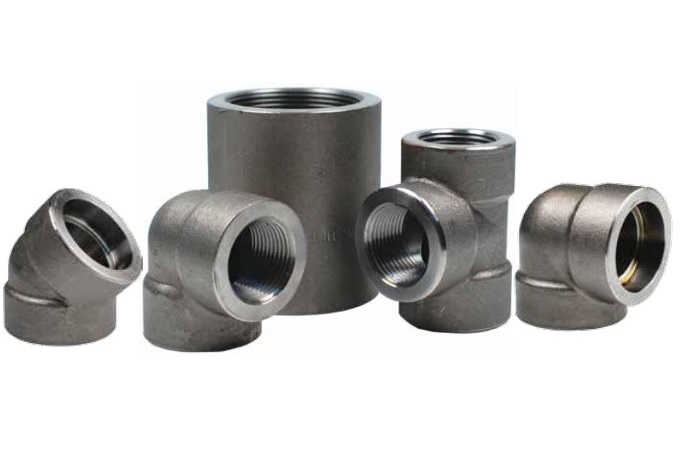
Socket weld fittings join small-bore pipe by slipping the pipe into a recessed socket and fillet welding around the outside. ASME B16.11 fixes the socket bore, socket depth and centre-to-end dimensions, so a Class 3000 elbow from any qualified forge will accept the same Schedule 80 pipe. They are the standard choice below NPS 2 where a butt weld prep would be impractical to align, and they hold up to vibration far better than a threaded joint because there is no thread root to crack. We forge and machine to B16.11 in carbon, stainless and low-temperature grades, mark every piece with heat number, and issue a 3.1 certificate with PMI and hydrostatic results attached. If your line class calls for Class 6000 or 9000, the same tooling covers it — only the wall and socket depth change.
Types we forge to B16.11
Table 1 — Socket weld fitting types, size range and pressure class
| Type | Function in the line | NPS range | Class | Standard |
|---|---|---|---|---|
| 90° elbow | Changes direction by 90°, short pattern forged body | 1/8 – 4 | 3000 / 6000 | B16.11 |
| 45° elbow | Changes direction by 45°, used where a 90° would over-stress the run | 1/8 – 4 | 3000 / 6000 | B16.11 |
| Tee, equal | Branches a line at 90° with all three ends socket weld | 1/8 – 4 | 3000 / 6000 | B16.11 |
| Tee, reducing | Branch is smaller than the run; branch size stated separately | 1/4 – 4 | 3000 / 6000 | B16.11 |
| Full coupling | Joins two pipes of the same size in a straight run | 1/8 – 4 | 3000 / 6000 | B16.11 |
| Half coupling | Branches an instrument or drain off a run; one socket end | 1/8 – 4 | 3000 / 6000 | B16.11 |
| Reducing coupling | Joins two different pipe sizes in a straight run | 1/4 – 4 | 3000 / 6000 | B16.11 |
| Cap | Closes a line end permanently; also used as a test cap | 1/8 – 4 | 3000 / 6000 | B16.11 |
| Union | Conical seat joint that can be broken down without cutting pipe | 1/8 – 3 | 3000 / 6000 | B16.11 |
| Cross | Four-way intersection, equal or reducing | 1/2 – 2 | 3000 | B16.11 |
| Weldolet / sockolet | Branch reinforcement welded onto the run pipe | 1/2 – 24 outlet | 3000 / 6000 | MSS SP-97 |
Class 2000 exists in B16.11 but is threaded only. Socket weld bodies are supplied in Class 3000, 6000 and 9000. Class 9000 is normally a special order — state it on the enquiry and we quote against drawing.
Which class do you actually need?
Buyers often ask for Class 6000 because the line class sheet says so, then find the fitting will not fit the pipe schedule they bought. The two systems are not the same thing: B16.11 class numbers describe the fitting wall and socket, while Schedule numbers describe the pipe wall. The working equivalence most EPC specifications accept is below.
Table 2 — Pressure class against pipe schedule (working equivalence, not a code rule)
| B16.11 class | Normal matching schedule | Typical service | Note |
|---|---|---|---|
| Class 3000 | SCH 80 / XS | General process, utility, instrument air | Most common; stock item from NPS 1/8 to 4 |
| Class 6000 | SCH 160 | High pressure process, small-bore manifolds | Available to NPS 2 in most sizes |
| Class 9000 | XXS | Very high pressure, wellhead and test loops | Made to order; longer lead time |
Confirm against your piping class before ordering. Where the specification calls for a class that does not match the purchased pipe schedule, the socket depth — not the pressure rating — is what fails first.
Materials: which grade for which service
Table 3 — Chemical composition of the four grades we hold most often (%, ladle analysis)
| Element | A105 (carbon) | A350 LF2 (low temp) | A182 F304 | A182 F316 |
|---|---|---|---|---|
| C max | 0.35 | 0.30 | 0.08 | 0.08 |
| Mn | 0.60 – 1.05 | 0.60 – 1.35 | 2.00 max | 2.00 max |
| P max | 0.035 | 0.035 | 0.045 | 0.045 |
| S max | 0.040 | 0.040 | 0.030 | 0.030 |
| Si | 0.10 – 0.35 | 0.15 – 0.30 | 1.00 max | 1.00 max |
| Cr | 0.40 max | 0.30 max | 18.0 – 20.0 | 16.0 – 18.0 |
| Ni | 0.40 max | 0.40 max | 8.0 – 11.0 | 10.0 – 14.0 |
| Mo | 0.15 max | 0.12 max | — | 2.00 – 3.00 |
| Cu max | 0.40 | 0.40 | 1.00 | 1.00 |
Table 4 — Mechanical properties and the service each grade is right for
| Grade | Tensile min | Yield min | Elongation | Use it when |
|---|---|---|---|---|
| A105 | 485 MPa | 250 MPa | 20% | Non-corrosive process lines from −29 °C to 425 °C. The default carbon choice. |
| A350 LF2 | 485 MPa | 250 MPa | 22% | Impact tested to −46 °C. LPG, ammonia, cold box and winterised lines. |
| A182 F304 / F304L | 515 / 485 MPa | 205 / 170 MPa | 30% | Food, pharma, general corrosion. Do not use in chlorides above 50 ppm. |
| A182 F316 / F316L | 515 / 485 MPa | 205 / 170 MPa | 30% | Chloride-bearing and marine service; molybdenum raises pitting resistance (PREN ≈ 25). |
| A182 F5 / F11 / F22 | 485 – 585 MPa | 205 – 310 MPa | 20% | Steam and hydrogen service above 425 °C. 1.25Cr, 2.25Cr classes quoted to drawing. |
What we inspect, and what arrives with the box
Table 5 — Inspection and test scope by default
| Check | Coverage | Method | Recorded on |
|---|---|---|---|
| Chemical analysis | Every heat | Spectrometer at forge | MTC 3.1 |
| PMI | 100% of stainless and alloy pieces | XRF, each piece scanned | PMI report by heat |
| Hardness | Carbon and low-alloy lots | Brinell or Rockwell | MTC 3.1 |
| Hydrostatic | Every lot (waivable on request) | 1.5 × class rating, 5 s hold | MTC 3.1 |
| Surface / RT | On request | Dye penetrant or radiography | Separate NDE report |
| Dimension | Sample per lot | Socket bore, depth, centre-to-end | Dimensional report |
| Marking | Every piece | Laser or stamp: size, class, grade, heat no. | Visual |
Standards and cross-references
Table 6 — The same fitting under other systems
| System | Designation | Covers | How it differs from B16.11 |
|---|---|---|---|
| ASME | B16.11 | Forged socket weld and threaded fittings, Class 2000–9000 | The reference standard for this page |
| MSS | SP-79 / SP-83 / SP-95 / SP-97 | Couplings, unions, bull plugs, branch outlets | Product-specific; B16.11 calls them up by reference |
| EN | EN 10241 | Steel threaded fittings | Threaded only — no direct socket weld equivalent; specify B16.11 |
| JIS | JIS B2316 | Steel pipe fittings, socket weld type | Same concept, different socket depth table |
| GB | GB/T 14383 | Forged steel socket weld fittings | Written on B16.11 dimensions |
| ISO | ISO 4144 | Stainless threaded fittings | Threaded only |
Fittings ordered to a European specification usually still need B16.11 dimensions, because the pipe schedule and the socket depth come from the ASME system. Say which one governs on the purchase order — we mark the certificate accordingly.
Where these fittings earn their place
Instrument and impulse lines
Small bore, frequent direction changes, vibration from pumps. A fillet weld on a socket absorbs vibration better than a thread root, which is why B16.11 dominates instrument air and impulse tubing.
Steam tracing and condensate
Class 3000 in A105 covers saturated steam to 425 °C. Short pattern elbows keep the trace close to the main line, which matters when insulation thickness is fixed.
Hydraulic power units
Class 6000 in A105 or F316 for pressures where Schedule 160 pipe is specified. Unions allow a pump or accumulator to be removed without cutting the line.
Chemical dosing skids
F316 or F316L where the dosing line carries chloride-bearing chemicals. PMI on every piece is the evidence auditors ask for.
Low-temperature and LNG
A350 LF2 impact tested to −46 °C for cold box piping and ammonia plants. Confirm the impact test temperature on the certificate, not just the grade name.
Shipbuilding and offshore
Small-bore systems in engine rooms and on deck. Class 3000 in A105 with hot-dip galvanised or zinc-rich primer finish where the yard specifies it.
Frequently asked questions
Should I use socket weld or butt weld fittings below NPS 2?
Below NPS 2 a butt weld prep is difficult to align and inspect, and the weld volume is small enough that lack of fusion is a real risk. Socket weld is the practical default. Butt weld becomes preferable above NPS 2, in severe cyclic service, and wherever radiography of the joint is a contractual requirement — a socket fillet cannot be radiographed meaningfully.
Is a socket weld joint stronger than a threaded joint?
Yes, under vibration and thermal cycling. The fillet weld has no thread root to act as a stress raiser, and the socket gives a mechanical stop that prevents over-tightening. Threaded joints remain easier to break down in the field, which is why both still appear on the same skid.
Do you supply Class 9000?
Yes, to drawing or to the B16.11 table, normally in A105 and F316 for NPS 1/2 to 2. Class 9000 is not a stock item — expect 25–30 days rather than the standard 15–20.
What gap should be left at the bottom of the socket when welding?
Approximately 1.6 mm (1/16 in) expansion gap between the pipe end and the socket bottom. Without it, the pipe expands into the socket during welding and can crack the fitting wall or leave a gap at the root. This is a fabricator responsibility, not a fitting dimension.
Can the fittings be supplied to NACE MR0175?
Yes. For sour service we supply A105 with hardness controlled to 22 HRC maximum and certified to NACE MR0175 / ISO 15156, or F316 which meets the hardness limit by chemistry. State the partial pressure of H2S on the enquiry so the material selection can be confirmed.
What certificate comes with the shipment?
EN 10204 3.1 as standard: heat number, chemical composition, tensile and yield, hardness, hydrostatic test pressure, and the PMI result for stainless and alloy pieces. 3.2 with a third-party witness is available on request and adds roughly a week.
What is the minimum order?
100 pieces per size and type for stock sizes. Below that we can often combine with another lot already in production — ask, and we will tell you honestly whether it is worth waiting for.
Can you match a specific mill’s marking or a customer stencil?
Yes, laser marking to your format is available from 500 pieces. Standard marking is size, class, grade and heat number, which is what B16.11 asks for.
Request a quote
Related products
Stainless Butt Weld TeeEqual and reducing, SCH 10S–80S
Stainless Butt Weld ReducerConcentric and eccentric, B16.9
Stainless Butt Weld CapB16.9, NPS 1/2–24
Threaded FittingsNPT / BSP, Class 3000 and 6000
O’let FittingsWeldolet, sockolet, threadolet, MSS SP-97
All pipe fittings — elbows, tees, reducers, caps, olets and flanges · Guide: socket weld vs butt weld, dimension tables and weld procedure
Request a quotation
Tell us the class, size, grade and quantity. We reply within 24 hours with price, lead time and the certificate scope — and we will say so if the class you asked for does not match the pipe schedule on your line.