
Project Description
Lead time 15–20 days
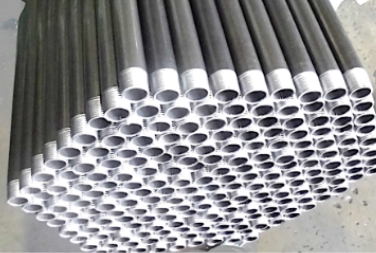
Bundled hex or round, strapped
Quote within 24 hours
Cut length to your furnace
Oxygen lancing tube is a consumable, not a component. A low-carbon steel pipe is pushed into molten steel, copper or zinc and oxygen is blown through it to oxidise carbon, silicon and other impurities; the pipe itself burns away in the process, which is why it is bought by the tonne rather than by the piece. That changes what matters in the specification: wall thickness controls how long the pipe survives, the bore controls oxygen flow, and the price per metre controls whether the shop uses it or reaches for something cheaper. We supply 5 to 21.3 mm outside diameter, 1.0 to 2.0 mm wall, in 1.2, 3, 5.5 and 6 m lengths, plain or threaded, in low-carbon ERW tube — plus thermic lance pipe for cutting scrap and refractory where a plain lance will not burn hot enough.
Sizes and end types
Table 1 — Standard lancing tube sizes
| Outside diameter | Wall thickness | Length | End type | Typical use |
|---|---|---|---|---|
| 5.0 mm | 1.0 mm | 1.2 m or 3 m | Plain | Small foundries, sample lances, taphole opening |
| 6.0 mm | 1.0 mm | 1.2 m or 3 m | Plain | Hand lancing on small induction furnaces |
| 8.0 mm | 1.0 mm | 5.5 m or 6 m | Plain | General EAF lancing |
| 10.0 mm | 1.0 mm | 5.5 m or 6 m | Plain | General EAF lancing, the most common size |
| 12.0 mm | 1.5 mm | 5.5 m or 6 m | Threaded | Mechanised lance machines |
| 13.2 mm | 1.8 mm | 5.5 m or 6 m | Threaded | Lance machines with couplings, longer reach |
| 17.2 mm | 1.8 mm | 5.5 m or 6 m | Threaded | High flow rate, heavy scrap |
| 21.3 mm | 2.0 mm | 5.5 m or 6 m | Threaded | Converter and large EAF, maximum oxygen flow |
Sizes above are the standard range. If your lance machine takes a coupling with a specific thread, send the drawing — the thread is the part that fails first when it is not matched.
Plain lance or thermic lance
These are two different tools that get confused because both are steel pipe and both burn. The plain lance injects oxygen into a melt that is already liquid. The thermic lance is packed with steel wire and burns its way through solid material, generating its own heat.
Table 2 — Which lance for which job
| Plain oxygen lance | Thermic lance | |
|---|---|---|
| Construction | Hollow low-carbon pipe | Pipe filled with steel wire, sometimes with an inner tube |
| What it does | Blows oxygen into liquid metal | Burns through solid steel, concrete or refractory |
| Working temperature | Melt temperature, 1,500–1,700 °C | Up to about 4,000 °C at the tip |
| Consumed by | Melting and oxidation of the pipe wall | Combustion of the wire packing |
| Used for | Decarburisation, dephosphorisation, melt stirring, taphole opening | Cutting scrap, lancing furnace accretions, breaking up skulls, demolition |
| Consumption | Metres per heat | Metres per cut |
Base material
Table 3 — Tube specification
| Property | Requirement | Why it matters here |
|---|---|---|
| Material | Low carbon steel, fully killed | Any alloy addition is money burnt; carbon content drives how readily the wall oxidises |
| Manufacture | Electric resistance welded (ERW) | Cheapest route for thin wall in long length; the seam is not a failure point in a consumable |
| Carbon | 0.10% max typical | Higher carbon burns less evenly and spatters |
| Wall tolerance | ±10% of nominal | Wall is consumption rate — a thin patch becomes a hole and the lance fails early |
| Bore condition | Free of scale and weld flash | Flash obstructs flow and causes pressure spikes at the regulator |
| Straightness | Adequate for the feed mechanism | A bent lance jams the machine and stops the heat |
Choosing the size for the furnace
Table 4 — Size against furnace type
| Furnace | Typical OD | Reason |
|---|---|---|
| Induction furnace, small foundry | 5 – 8 mm | Short lance, hand held, low oxygen flow |
| Electric arc furnace, hand lancing | 8 – 10 mm | The workhorse; balances flow against consumption |
| Electric arc furnace, lance machine | 12 – 17.2 mm | Threaded joints, longer reach, higher flow |
| Converter | 17.2 – 21.3 mm | High oxygen flow and heavy slag conditions |
| Taphole opening | 5 – 8 mm | Reach and control matter more than flow |
| Scrap cutting and skulls | Thermic lance, 12 – 21.3 mm | Needs the packed wire to generate its own heat |
Packing and delivery
Table 5 — How it ships
| Item | Standard | Note |
|---|---|---|
| Bundle shape | Hexagonal up to 114 mm OD, round above | Keeps the bundle stable in the yard |
| Strapping | Steel strip, at least five places | Loose bundles arrive bent |
| Bundle weight | Up to 5,000 kg | Reduced on request for crane limits |
| Ends | Plain cut, deburred, or threaded with protectors | Threaded ends are capped to protect the thread |
| Marking | Tag with size, heat number, quantity | Per bundle, three tags |
Where lancing tube is consumed
Electric arc furnace
Carbon injection and melt stirring through the slag door. Consumption is measured in metres per heat and is one of the largest single consumable costs after scrap and power.
Basic oxygen converter
Post-combustion and slag foaming lances, where the flow rate is high enough that a 21.3 mm bore is normal.
Foundries
Induction and cupola shops using short lances by hand for deoxidation and taphole work.
Copper and zinc smelting
Lancing into non-ferrous melts, where the same mild steel pipe is consumed in the same way.
Scrap yards
Thermic lances for cutting heavy scrap, engine blocks and oversized material that a shear cannot handle.
Cement and refractory
Thermic lance work on kiln rings, ladle skulls and furnace accretions that have to be burned out rather than broken.
Frequently asked questions
What is the difference between a lancing tube and a thermic lance?
A lancing tube is hollow and blows oxygen into liquid metal. A thermic lance is packed with steel wire and burns through solid material at up to 4,000 °C. They look similar and are not interchangeable.
Why is wall thickness more important than outside diameter?
Because the wall is what gets consumed. A 1.0 mm wall on a 10 mm pipe will burn through in a predictable time; a thin patch in that wall ends the lance early and wastes the oxygen that follows. Wall tolerance matters more than the nominal figure.
Can you supply a threaded end to match our lance machine?
Yes. Send the coupling drawing or the thread specification — the sizes we list as threaded use a standard coupling, but lance machines vary and a mismatched thread stops the machine.
What lengths do you cut?
Standard 1.2, 3, 5.5 and 6 m. Other lengths from 0.5 m upwards on request; the practical limit is transport, not production.
Is ERW acceptable for a lance tube?
Yes. The pipe is consumed in use, so the longitudinal weld is not a service concern. Seamless is available but the cost premium buys nothing in this application.
How do I estimate consumption?
Measure metres consumed per heat over a week and divide by heats — most shops run 0.3 to 1.5 m per heat depending on furnace size and practice. Order against that figure, not against a tonnage guess.
Do you supply to a fixed monthly quantity?
Yes, and it is the sensible way to buy this product. A standing order holds the price and keeps a buffer in your yard, which matters because lancing tube runs out at the worst possible moment.
What is the minimum order and lead time?
One tonne. Lead time is 15–20 days; threaded sizes with a custom coupling run longer because the ends are machined after the tube is cut.
Request a quote
Related products
Hot Rolled Carbon Steel TubeThick wall mechanical stock
Cold Drawn Seamless TubePrecision bore, EN 10305-1
ASTM A333 Low Temp PipeImpact tested to −46 / −101 °C
AISI 4140 Alloy TubeTooling and machine parts
Stainless Capillary Tube0.5–6 mm OD, instruments and medical
All pressure tube · Guide: which standard governs your order
Request a quotation
Give us OD, wall, length, end type and the tonnage you burn per month. We reply within 24 hours with price, lead time and a standing order option.