
Project Description
Lead time 15–20 days
PMI 100% of pieces
Quote within 24 hours
Drawings to your run pipe OD
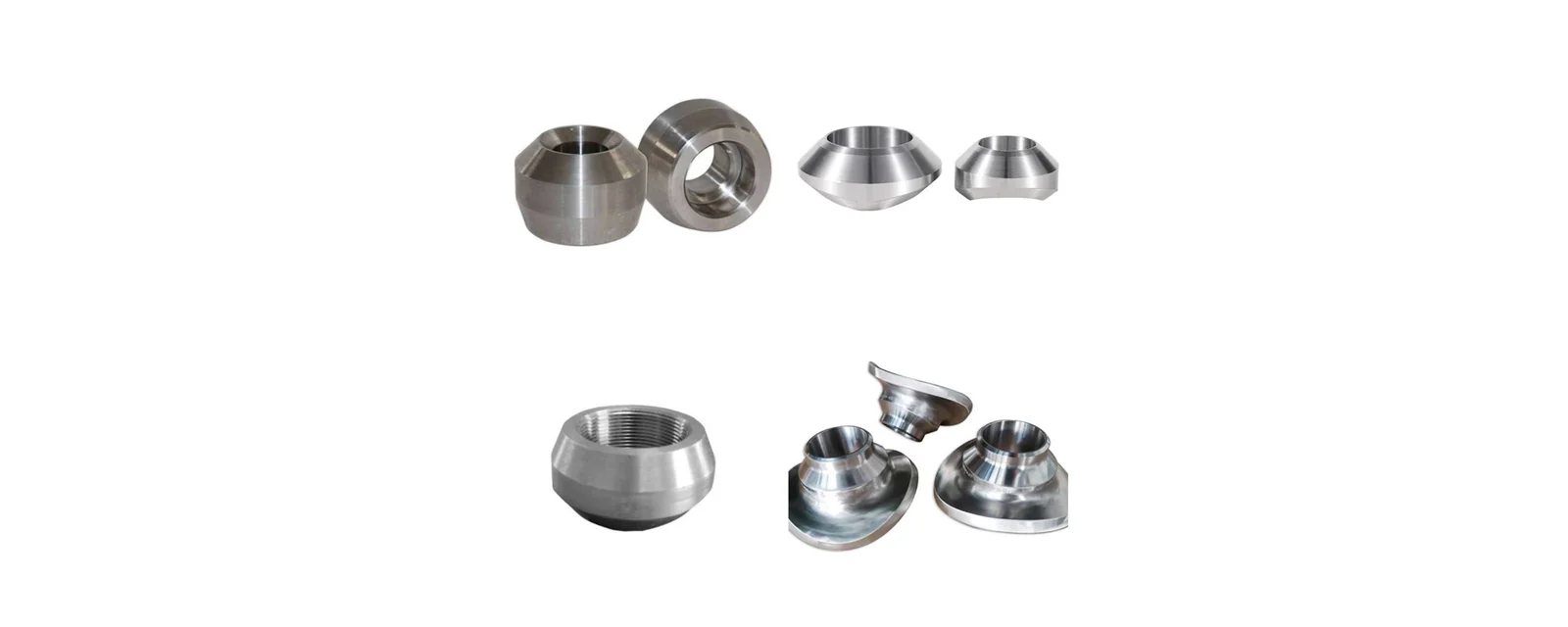
An o’let is a branch outlet forged to sit on the outside of a run pipe and be welded to it. The base is saddle-shaped to fit the run pipe’s curvature, and the outlet end is bevelled, socketed or threaded to receive the branch. Compared with a tee, it does the same job with less metal, less welding and — the reason it exists — it can be welded onto a run pipe that is already installed, because no section of the run has to be cut out. MSS SP-97 fixes the dimensions, and the fitting is ordered by two sizes: the run pipe it sits on, and the branch it feeds. We supply weldolet, sockolet, threadolet, latrolet, elbolet and nipolet in Class 3000, 6000 and 9000, in carbon, stainless, low-alloy and nickel-alloy grades.
The seven outlet types
Table 1 — What each one is for
| Type | Outlet end | Where it is used |
|---|---|---|
| Weldolet | Butt weld, bevelled | The default for a welded branch. Saddle base on the run, bevel for the branch pipe. |
| Sockolet | Socket weld, to B16.11 dimensions | Small bore branches — normally NPS 2 and under — where a socket weld joint is used |
| Threadolet | Taper pipe thread (NPT / BSP) | Instrument, gauge and drain connections up to about NPS 2 |
| Latrolet | Butt weld, socket or threaded | The branch leaves at 45° instead of 90° |
| Elbolet | Butt weld, socket or threaded | Sits on the back of a long radius 90° elbow to take a branch off the bend |
| Nipolet | Threaded nipple outlet | Short threaded stub for gauges and vents; combines the olet and the nipple |
| Sweepolet | Butt weld, swept contour | Gentle transition for high-velocity or erosive service where a sharp branch would wear |
All seven are ordered the same way: run pipe size, branch size, pressure class, material. The type is a separate decision and a wrong one is expensive — a sockolet cannot be changed into a weldolet at the fabrication stage.
O’let or tee
Table 2 — The decision that changes the whole fabrication sequence
| O’let | Tee | |
|---|---|---|
| Run pipe | Not cut — the fitting sits on the outside | Cut and two welds made |
| Welds | One weld (the branch), plus the saddle fillet | Two full-penetration butt welds |
| Reinforcement | Built into the fitting body | Built into the fitting body |
| Fabrication | Can be added to an existing line | Requires the spool to be re-made or cut |
| Weight and cost | Lower for the same duty, especially at large run sizes | Rises steeply with run size |
| Inspection | Fillet plus branch butt — the saddle weld is harder to radiograph | Both welds are butt welds and can be radiographed |
| Use it when | Branch is small relative to the run, or the line is already installed | Branch is close to the run size, or full radiography is required |
The rule of thumb in most line classes: an o’let up to about half the run size, a tee above that. Where the specification demands 100% radiography of every branch weld, a tee is often the only acceptable answer because the saddle weld on an o’let cannot be fully examined.
Materials
Table 3 — Grades we supply by service
| Service | Grade | Standard | Note |
|---|---|---|---|
| General carbon steel | A105 | ASTM A105 | The default. −29 to 425 °C, non-corrosive. |
| Low temperature | A350 LF2 / LF3 | ASTM A350 | Impact tested to −46 °C. LPG, ammonia, cold box. |
| Austenitic stainless | F304, F304L, F316, F316L | ASTM A182 | F316L for chloride and field-welded branches. |
| Stabilised stainless | F321, F347 | ASTM A182 | Above 500 °C, or where sensitisation is a risk. |
| Super-austenitic | F904L | ASTM A182 | Chloride and acid service beyond 316L. |
| Low alloy, high temperature | F1, F5, F9, F11, F22, F91 | ASTM A182 | Steam and hydrogen service above 425 °C. Must match the run pipe grade. |
| Nickel alloy | N02200, N04400, N06625, N10276 | ASTM SB564 | Sour, acid and high-chloride duty. |
The o’let grade should match the run pipe, not the branch pipe. A mismatch at the saddle weld is a dissimilar joint that needs its own procedure and, in the case of a Cr-Mo run pipe, its own post-weld heat treatment. State the run pipe grade on the order.
Size and class
Table 4 — How the fitting is designated
| Parameter | How it is written | What goes wrong |
|---|---|---|
| Run pipe size | e.g. 12 in — the pipe the saddle sits on | The saddle curvature will not fit; the gap is un-weldable |
| Branch size | e.g. 2 in — the outlet | Branch pipe will not enter the bevel |
| Pressure class | 3000, 6000 or 9000 | Wall at the outlet will not match the branch pipe schedule |
| Type | Weldolet, sockolet, threadolet… | Wrong joint type at the branch — cannot be corrected on site |
| Material | A105, F316L, F11… | PMI rejection, or a dissimilar weld nobody qualified |
| Run pipe OD | Needed when the run is not ASME pipe | Saddle does not fit a non-standard or heavy-wall run |
Branch outlets run from 1/2 to 24 inch, but the practical range is 1/2 to 12 — above that a tee is almost always the better answer. MSS SP-97 tabulates the height and the branch end dimensions; we quote against that table and manufacture the saddle to your run pipe outside diameter.
Inspection
Table 5 — Test scope
| Check | Coverage | Method |
|---|---|---|
| Chemical analysis | Every heat | Spectrometer, on the 3.1 certificate |
| PMI | 100% of pieces | XRF — especially where F316 and F304 are both on site |
| Hardness | Carbon and low alloy lots | Brinell or Rockwell, for NACE and PWHT control |
| Hydrostatic | Every lot, or waived against NDE | Per MSS SP-97 |
| Saddle fit | Sample per lot | Checked against the run pipe OD stated on the order |
| Surface / PT | On request | Dye penetrant on the saddle edge |
| Marking | Every piece | Run size × branch size, class, grade, heat number |
Where branch outlets are used
Instrument connections
Pressure, temperature and sampling points off a main. Threadolet or sockolet, small bore, added after the line is installed.
Drains and vents
Low point drains and high point vents. Sockolet or nipolet, sized to the valve that will be fitted.
Header branches
Small branches off a large header where a tee would be uneconomic. The case o’lets were invented for.
Retrofit and tie-ins
Adding a connection to an existing line without cutting it out — the one job a tee cannot do.
Erosive service
Sweepolet where a sharp branch would wear through. Slurry, catalyst and high-velocity gas lines.
Elbow branches
Elbolet on the back of a long radius bend, where there is no straight run available for a conventional branch.
Frequently asked questions
How is an o’let ordered?
Run pipe size × branch size, pressure class, type and material — for example “12 in × 2 in, Class 3000, weldolet, A105”. Add the run pipe outside diameter if the run is not standard ASME pipe.
O’let or tee — which should I specify?
O’let when the branch is small relative to the run, or when the line is already installed. Tee when the branch approaches the run size, or when the specification demands full radiography of every branch weld.
Does the o’let grade have to match the run pipe?
Yes in practice. Matching avoids a dissimilar weld, its own procedure and — with a Cr-Mo run pipe — a separate post-weld heat treatment. State the run pipe grade on the enquiry rather than the branch grade.
Can the saddle be matched to a non-standard pipe?
Yes, if you give us the run pipe outside diameter. Standard saddles are cut for ASME pipe; a heavy-wall or metric run needs the saddle machined to suit, which is a drawing-controlled item.
Is Class 9000 available?
Yes, to drawing, normally 1/2 to 2 inch. It is not a stock item — expect 25–30 days rather than the standard 15–20.
Can the saddle weld be radiographed?
Not fully. The saddle-to-run weld is a partial penetration fillet in most configurations, so it is examined by penetrant or magnetic particle rather than radiography. That is the price of not cutting the run pipe.
Do you supply with NACE MR0175 certification?
Yes, in A105 with hardness controlled to 22 HRC maximum, or in F316 which meets the limit by chemistry. State the H₂S partial pressure at enquiry.
What is the minimum order and lead time?
20 pieces per size and type. Lead time is 15–20 days; Class 9000 and non-standard saddles run 25–30 days.
Request a quote
Related products
Stainless Butt Weld Elbow90° and 45°, long and short radius
Stainless Butt Weld ReducerConcentric and eccentric, B16.9
Stainless Butt Weld TeeEqual and reducing, SCH 10S–80S
Threaded FittingsNPT / BSP, Class 3000 and 6000
Stainless Butt Weld CapB16.9, NPS 1/2–24
All pipe fittings — elbows, tees, reducers, caps, olets and flanges · Guide: socket weld vs butt weld, dimensions and weld procedure
Request a quotation
Give us run pipe size and OD, branch size, pressure class, type, grade and quantity. We reply within 24 hours with price, lead time and certificate scope.