
Project Description
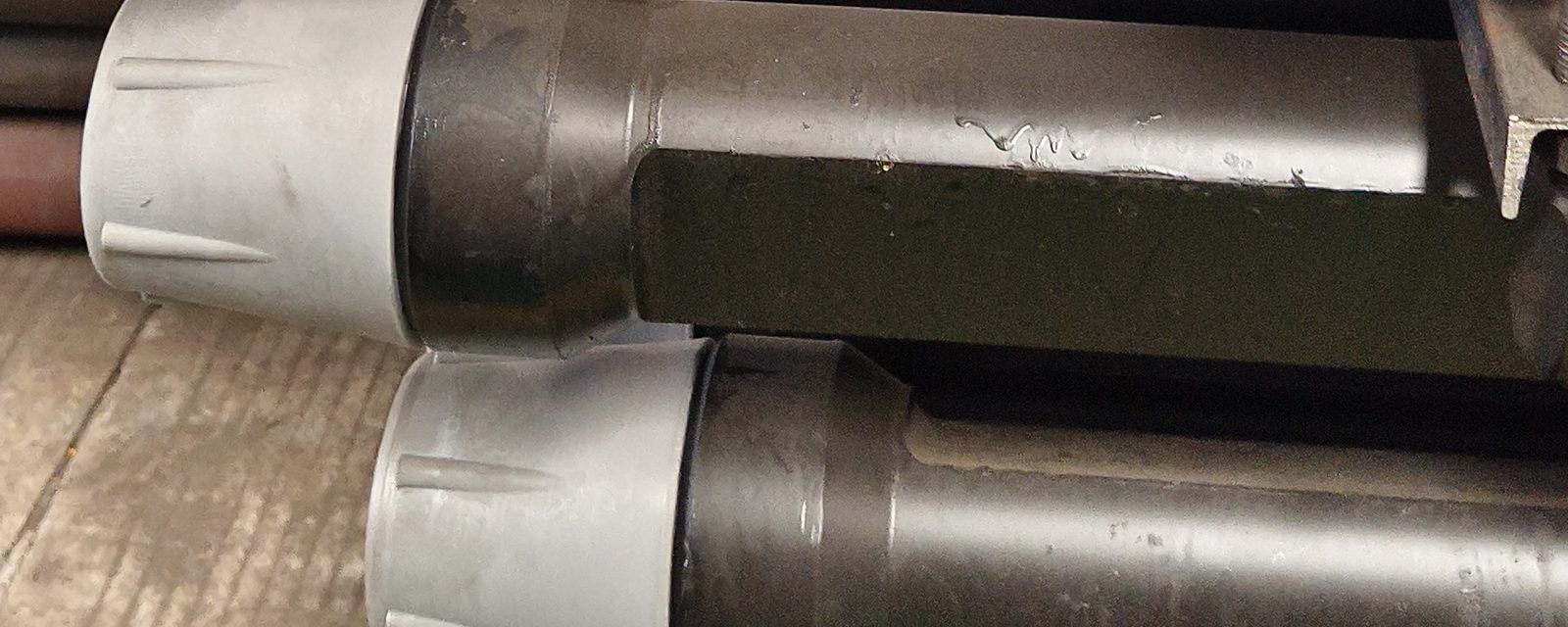
Lead time 25–40 days
Third party SGS / BV / TUV
Quote within 24 hours
Ends upset, thread-ready
A geological drill string is built from small diameter rod — 33 mm at the bottom of the range, 127 mm at the top — and it is threaded directly onto the tube, not welded to a separate tool joint. That single difference changes everything downstream: the upset has to suit a thread rather than a weld, the wall has to survive repeated make-and-break, and the steel has to stay straight over three metres of unsupported span inside a core hole.
The Chinese grade system for this product is the DZ series, defined in GB/T 3423 for diamond core drilling. DZ40 through DZ75 name the minimum yield in kgf/mm², which translates to roughly 392 to 735 MPa. Above the DZ range, wireline coring rods are usually made in 45MnMoB or 27MnMoVB, where the boron addition buys hardenability in a thin wall that would otherwise fail to transform.
We supply the upset tube, thread-ready, in the sizes the coring industry actually uses — the 43.5 to 114.3 mm wireline series and the 33 to 127 mm conventional series. Below 60 mm the tube leaves the continuous heat treatment line and is quenched in a box furnace, which changes the lead time and the batch size. We will say so at quotation rather than after the order.
The DZ grade series
The grade number is the minimum yield in kgf/mm². The tensile and elongation requirements sit in the standard tables and are not reproduced here as approximations.
Table 1 — DZ grades and their place in the string
| Grade | Min yield (MPa, nominal) | Typical component |
|---|---|---|
| DZ40 | ≈392 | Bit body, reaming shell |
| DZ50 | ≈490 | Casing, outer tube |
| DZ55 | ≈539 | Casing, core barrel, rod |
| DZ60 | ≈588 | Core barrel, rod |
| DZ65 | ≈637 | Core barrel, rod |
| DZ75 | ≈735 | Rod coupling, high load joint |
Values are nominal conversions of the grade designation; the binding tensile, elongation and tolerance requirements are those of GB/T 3423. For wireline work above the DZ range, ZT750 and ZT850 appear in GB/T 16950, and 45MnMoB is the common mill grade.
Conventional rod sizes
Table 2 — Standard geological rod tube sizes
| OD × wall (mm) | Mass (kg/m) | Typical use |
|---|---|---|
| 33 × 6.0 | 4.0 | Small diameter rod, shallow hole |
| 42 × 5.0 | 4.6 | Rod, core barrel |
| 50 × 7.0 | 6.0 | Rod, casing |
| 60.3 × 5.6 | 6.1 | Rod |
| 73 × 6.5 | 7.0 | Rod, casing |
| 89 × 7.1 | 9.3 | Rod, casing |
| 114 × 7.5 | 9.8 | Casing, large hole rod |
| 127 × 9.0 | 14.2 | Large hole casing |
Wireline coring sizes
Wireline coring uses a nested series where the rod pulls the inner tube up by wire, without pulling the whole string. The sizes follow the DCDMA conventions, which is why the millimetre figures look irregular.
Table 3 — Wireline rod tube sizes and the DCDMA series
| OD × wall (mm) | DCDMA series | Hole size (nominal) |
|---|---|---|
| 43.5 × 4.75 | AQ | 48 mm |
| 55.5 × 4.75 | BQ | 60 mm |
| 70 × 5.0 | NQ | 75.7 mm |
| 71 × 5.0 | NQ (variant) | 75.7 mm |
| 89 × 5.5 | HQ | 96 mm |
| 114.3 × 6.4 | PQ | 122.6 mm |
The 70 mm and 71 mm variants both exist in the market and are not interchangeable with the same coupling. Confirm the series, not just the diameter.
Material and hardenability
A 4.75 mm wall quenched in water will transform; the problem is doing it without distortion and without cracking at the thread roots. That is what the boron and molybdenum additions are for.
Table 4 — Common materials for geological rod tube
| Material | Role of the alloy | Where it is used |
|---|---|---|
| 45MnB | Boron for hardenability in thin wall | DZ40–DZ50 rod |
| 40Mn2 / 40Mn2Si | Cost-effective strength | DZ50–DZ55 |
| 45MnMoB | Mo plus B: deeper hardening, better toughness | Wireline rod, DZ60 and above |
| 27MnMoVB | Vanadium for grain control | DZ65–DZ75 |
| 30CrMo / 42CrMo | Higher hardenability, sour or heavy load | Special order |
| 30CrMnSiA | Strength with impact resistance | Coupling stock, special order |
Upset and thread form
Geological rod is threaded onto the upset, so the upset has to be long enough to carry the thread and the shoulder, and the thread itself is usually a trapezoidal form rather than the API round thread used on oil pipe.
Table 5 — Upset and thread combinations
| Element | Option | Note |
|---|---|---|
| Upset location | Both ends, or one end with a coupling | Depends on whether the string uses couplings or integral joints |
| Thread form | Asymmetric trapezoidal | Common on wireline rod; deeper stab than a round thread |
| Thread form | Negative-angle trapezoidal | Better resistance to breakout torque |
| Surface | Phosphated or copper plated on request | Reduces galling on repeated make-and-break |
| Coupling | Supplied separately or not at all | We supply tube; coupling supply is a separate line item |
Inspection
Table 6 — Non-destructive testing
| Method | Reference | Acceptance |
|---|---|---|
| Eddy current | GB/T 7735 | A1 |
| Magnetic flux leakage | GB/T 12606 | L3, for surface and near-surface |
| Ultrasonic | GB/T 5777 | L2.5 for cold drawn, L3 for hot rolled |
| Hydrostatic | Agreed pressure | When specified |
| Straightness | 1.0–1.5 mm/m | Tighter for wireline rod |
| Certificate | EN 10204 3.1 | Heat traceable |
Where the tube goes
Wireline coring rod
AQ to PQ, threaded on the upset, with the inner tube running inside. Straightness and thread concentricity decide the rod life.
Conventional rod and casing
DZ50 to DZ65, coupled or integral, for core drilling where the string is pulled between runs.
Core barrel and outer tube
Thicker wall, tighter bore, often in 45MnMoB where the barrel has to stay round under load.
Frequently asked questions
How is geological drill pipe different from oil drill pipe?
Size, grade system and connection. Geological rod runs from 33 to 127 mm and is threaded directly onto the upset tube; oil drill pipe is larger and uses a friction welded tool joint. The grade lists are different too — DZ and ZT rather than E75 to S135.
What standard covers DZ60?
GB/T 3423 covers diamond core drilling seamless tube and defines the DZ40 to DZ75 grades. GB/T 16950 covers the drilling tools themselves, including the ZT750 and ZT850 tube grades used for wireline work.
Which material is used for wireline coring rod?
45MnMoB is the common mill grade, with 27MnMoVB for the higher strength end. The boron raises hardenability in a 4.75 mm wall; the molybdenum adds toughness at the thread root.
Why does 45MnMoB have to be quenched and tempered?
Because the wall is thin and the thread root is a stress concentration. Normalised material will not reach the strength the rod needs, and an un-tempered quench will crack at the thread. The tempering step is what makes the thread root survive make-and-break.
Can you supply a full NQ or HQ set?
We supply the rod tube and the outer tube. Couplings, inner tubes and core lifters are different products; we will say clearly what is in scope rather than quoting a “set”.
Is the end upset or friction welded?
Upset and threaded. Geological rod does not normally use a welded tool joint — the thread is cut directly into the thickened end, which is why the upset length and taper have to match the thread drawing.
What is the minimum order?
One tonne per size. Small diameter sizes below 60 mm are quenched in a box furnace, so the minimum is set by the furnace batch rather than by the mill run.
What lead time should I plan for?
25–40 days. Sizes below 60 mm take longer because they leave the continuous line, and the batch size is smaller — we will quote the actual schedule, not an average.
Request a quotation
WhatsApp +86 178 7358 1838
Small OD Thick Wall60–168.3 mm OD, wall 4.5–18 mm, bore Ra ≤1.6 µm.
Cold Drawn + Q&TSmall OD, thin wall, drawn before quenching.
Hot Rolled + Q&TLarge OD and heavy wall, quenched after rolling.
P110 Seamless Tube758–965 MPa, wide band, not for sour service.
Large OD Thick Wall219.1–355 mm OD, wall 22–50 mm, full body UT.
Sizes below 60 mm are quenched in a box furnace, not on the continuous line; lead time and batch size are quoted separately. Related: alloy steel tube · L80 13Cr tubing
Request a quotation