
Project Description
Lead time 25–35 days
Surface black, ground or peeled
Quote within 24 hours
UT on request
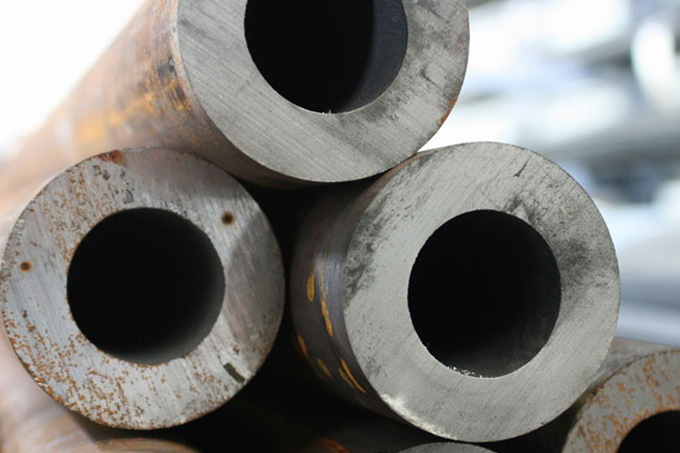
E470 hollow bar is a thick-wall seamless tube made to be machined, and it earns its place on one calculation: how much of a solid bar would end up as swarf. At 470 MPa minimum yield with a wall up to 100 mm, it replaces a solid billet for rings, bushes, cylinder barrels and hollow shafts, saving both the material and the boring time. 20MnV6 is the micro-alloyed grade behind it — vanadium and a little nitrogen give it the strength as-rolled, without a quench and temper cycle, which keeps the price down and means the bar machines uniformly through the section. We supply 10.2 to 810 mm outside diameter, in black, ground or peeled condition, to EN 10294-1 and BS 6258.
Chemistry
Table 1 — Grades we run (%)
| Element | 20MnV | E470 | BS 6258 Grade 600 |
|---|---|---|---|
| C | 0.17 – 0.24 | 0.18 – 0.22 | 0.22 max |
| Si | 0.17 – 0.37 | 0.10 – 0.50 | 0.50 max |
| Mn | 1.30 – 1.60 | 1.30 – 1.70 | 1.60 max |
| P max | 0.025 | 0.030 | 0.050 |
| S max | 0.025 | 0.015 – 0.030 | — |
| V | 0.07 – 0.12 | 0.08 – 0.15 | — |
| Al min | 0.10 | 0.10 | — |
| N max | 0.020 | 0.020 | — |
| Nb max | 0.07 | 0.07 | — |
Vanadium at 0.07–0.15% is the whole trick: it forms fine carbonitrides during cooling that pin the grain and raise the yield strength without a heat treatment. Aluminium at 0.10% minimum does the same job for grain size during rolling — both need to be on the certificate, not just the carbon.
Mechanical properties
Table 2 — Yield, tensile and elongation by wall thickness
| Wall thickness | Tensile Rm min | Yield ReH min | Elongation A5 min |
|---|---|---|---|
| Up to 16 mm | 650 MPa | 470 MPa | 17% |
| Over 16 – 25 mm | 620 MPa | 460 MPa | 17% |
| Over 25 – 40 mm | 600 MPa | 430 MPa | 17% |
| Over 40 – 50 mm | 550 MPa | 430 MPa | 17% |
Note the yield drops from 470 to 430 MPa between 16 mm and 25 mm wall — the section cools more slowly and the vanadium carbonitrides coarsen. A design that just passes at 16 mm will not pass at 30 mm on the same grade.
Surface condition
Table 3 — Three finishes, three different first operations
| Condition | What it looks like | Machining allowance | Use it when |
|---|---|---|---|
| Black with oxygen skin | Dark scaled OD and ID | Needs a roughing cut on both surfaces | Cheapest; the part will be machined all over anyway |
| Ground, OD only | Bright OD, scaled ID | Light cut on OD, rough on ID | The OD is a datum or a sealing surface |
| Peeled, OD and ID | Bright both surfaces, visible tool marks | Finishing cut only | Bore is functional; saves a boring pass |
Peeling removes about 1 mm per surface depending on size, so the ordered OD must account for it. If you specify “peeled 200 mm” and the drawing needs 200 mm finished, you will receive 198 mm — state whether the dimension is before or after peeling.
Size range and standards
Table 4 — What is available
| Parameter | Range | Note |
|---|---|---|
| Outside diameter | 10.2 – 810 mm | Larger sizes are made to order |
| Wall thickness | 1.6 – 100 mm | Wall-to-OD ratio drives the price more than the size |
| Length | 3 – 7 m random, or cut | Cut from 300 mm |
| Standard | EN 10294-1 | Hollow bars for machining — the current European reference |
| Standard | BS 6258 | Hollow steel bars for machining, Grade 600 |
| Condition | As-rolled | No quench and temper; the strength comes from chemistry |
Where hollow bar beats solid bar
Hydraulic cylinder barrels
Bored and honed from peeled stock. The saved core is the largest single saving on a heavy barrel.
Bushes and bearing housings
Parted off and bored. At 470 MPa the grade carries the load without a heat treatment step in the customer’s shop.
Conveyor and mill rolls
Hollow rolls for conveyors, where rotating mass matters and a solid core is wasted weight.
Hollow shafts
Drive and axle shafts where torsional stiffness is what counts and the centre contributes nothing.
Gear blanks and nuts
Large nuts and gear wheel blanks, parted from bar and machined, with the bore already there.
Drill jigs and fixtures
Thick wall sections machined into jig bodies, where dimensional stability through the section matters.
Frequently asked questions
What is the difference between hollow bar and thick wall tube?
Hollow bar is made to a tighter bore tolerance and supplied specifically as machining stock, usually with a peeled or ground option. Thick wall tube is the broader category. Where the bore is a functional surface, specify hollow bar.
Is E470 the same as 20MnV6?
Closely related but not identical. E470 is the EN 10294-1 designation with its own chemistry window; 20MnV6 is the micro-alloyed steel grade underneath it. Both are quoted against the same mechanical table, and the certificate should state which one it is.
Does it need heat treatment after machining?
Usually not. The vanadium and nitrogen give the strength as-rolled, so the bar machines and performs without a quench and temper step. If the part needs higher surface hardness, a surface treatment such as nitriding or induction hardening is applied locally.
Why does the yield drop as the wall gets thicker?
Because the section cools more slowly after rolling and the vanadium carbonitrides coarsen. The standard accounts for it in a stepped table, and the design should use the value for the actual wall rather than the headline 470 MPa.
Can the bore be supplied to a tolerance?
Yes — as-drawn bore, or honed to H9/H10 on request. Peeling improves the surface but does not tighten the tolerance by itself; if the bore is a sealing surface, specify honed.
Is ultrasonic inspection available?
Yes, on request. For heavy wall hollow bar that will become a pressure or lifting part it is worth specifying rather than assuming — internal defects in a thick wall do not appear until the part is almost finished.
Can it be welded?
Yes, with a procedure suited to the carbon and vanadium content. It is not a pressure vessel grade, so welding is normally for attaching end fittings rather than for the pressure boundary itself.
What is the minimum order and lead time?
One tonne per size. Lead time is 25–35 days; peeled and honed material and sizes above 500 mm run towards the longer end.
Request a quote
Related products
42CrMo4 Alloy TubeQuenched and tempered when 470 MPa is not enough
Cold Drawn Seamless TubeThinner wall, tighter tolerance
Chrome Plated TubePiston rods from alloy or carbon tube
AISI 4140 Alloy TubeThe US equivalent of 42CrMo4
DIN 2391 Precision TubeSt35–St52 for smaller sections
All hollow bar — thick wall stock for rings, sleeves and rollers · Guide: cold drawn seamless tube, tolerance classes and delivery conditions
Request a quotation
Tell us OD, ID or wall, length, surface condition and quantity — or send the finished part drawing. We reply within 24 hours with price and lead time.