
Project Description
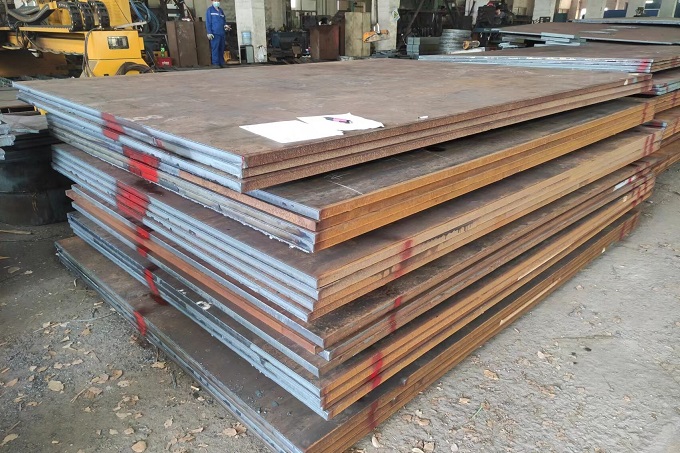
Lead time 20–30 days
Cut to size flame or plasma
Quote within 24 hours
UT on request
ASTM A285 is the lowest-strength carbon steel plate specification written for pressure vessels — three grades of increasing carbon, from Gr A at 310–450 MPa tensile to Gr C at 450–585 MPa, all with a 165–205 MPa yield. It is the grade a designer reaches for when the vessel is governed by corrosion allowance or by stiffness rather than by pressure, and where a higher-strength plate would simply cost more without making the shell thinner. It is not impact tested as standard and it is not intended for low temperature or for thick sections. ASME SA285 is the identical material under the code name, and the plate is normally supplied as-rolled or normalized depending on thickness.
The three grades
Table 1 — Mechanical properties
| Grade | Tensile Rm | Yield ReH min | Elongation | Use it when |
|---|---|---|---|---|
| A | 310 – 450 MPa | 165 MPa | 27% | Low pressure, corrosion allowance governs the wall |
| B | 380 – 515 MPa | 185 MPa | 25% | The usual middle choice for general vessels |
| C | 450 – 585 MPa | 205 MPa | 23% | Higher pressure at the same thickness, or thinner wall |
Table 2 — Chemistry (%)
| Element | Gr A | Gr B | Gr C |
|---|---|---|---|
| C max | 0.17 | 0.22 | 0.28 |
| Mn max | 0.90 | 0.90 | 0.90 |
| Si | 0.15 – 0.40 | 0.15 – 0.40 | 0.15 – 0.40 |
| P max | 0.035 | 0.035 | 0.035 |
| S max | 0.035 | 0.035 | 0.035 |
Carbon is the only real variable between the grades, and it is also what limits weldability. Gr C at 0.28% carbon needs preheat on anything above thin plate; Gr A does not.
A285, A516 or A537
Table 3 — Which plate specification the vessel actually needs
| A285 | A516 | A537 | |
|---|---|---|---|
| Yield range | 165 – 205 MPa | 260 – 345 MPa | 345 – 415 MPa |
| Impact testing | Not standard | Optional by grade | Required |
| Condition | As-rolled or normalized | Normalized | Normalized (Cl.1) or Q&T (Cl.2 / 3) |
| Use it when | Low pressure, wall set by corrosion allowance | The general purpose vessel plate | Thick wall or low temperature, where toughness is required |
Most vessels that start on A285 end up on A516 once the pressure is calculated. A285 survives where the shell is thick for reasons other than pressure — corrosion, abrasion, or structural stiffness.
Where A285 plate is used
Low pressure vessels
Tanks and drums where the design pressure is modest and the wall is set by corrosion allowance.
Storage tanks
Atmospheric and low-pressure storage where the plate is structural rather than pressure-critical.
Large diameter ductwork
Pressure duct and fan casings, where stiffness rather than strength governs the thickness.
Structural vessel parts
Support skirts, saddles and internals inside a coded vessel, where the plate is not the pressure boundary.
Non-critical apparatus
Furnace casings and hot air plenums in plants not built to a pressure code.
Not for low temperature
No impact requirement as standard. Below about 0 °C, specify A516 with impact testing or A537.
Frequently asked questions
What is the difference between A285 and SA285?
The issuing body only. ASTM writes the material specification, ASME adopts it for code construction as SA285. The chemistry and mechanical properties are identical; the certificate names whichever one the purchase order cites.
Is A285 impact tested?
Not as standard. Impact testing can be ordered as a supplementary requirement, but if the design needs guaranteed toughness the correct route is A516 with impact testing or A537, which requires it.
Which grade should I choose?
Gr B for most general work. Gr A where the wall is set by corrosion and weldability matters, Gr C where a modest strength increase avoids a thickness step.
Can it be used above 50 mm thickness?
The specification covers plate to about 2 inch (50 mm). Above that the properties are not defined and a normalized fine grain plate should be used instead.
What condition is it supplied in?
As-rolled for thin plate, normalized for heavier sections where the as-rolled properties will not reliably meet the table. State which one you need — the certificate will say.
Can you cut to size?
Yes, flame or plasma cut to your drawing, with the cut edge ground where it will be welded. UT and edge preparation are available on request.
What is the delivery condition for welding?
Supplied as-rolled or normalized, ready to weld. Gr C above about 25 mm needs preheat per the fabricator’s WPS; Gr A and B normally do not.
What is the minimum order and lead time?
One tonne. Lead time is 20–30 days; normalized plate and UT run towards the longer end.
Request a quote
Related products
ASTM A516 PlateGr 60 / 65 / 70, the general vessel plate
16Mo3 Plate0.3% Mo for elevated temperature
EN 10028-2 PlateEuropean elevated temperature plate
ASTM A553 Plate7 / 8 / 9% nickel for cryogenic service
ASTM A353 Plate9% nickel, double normalized
All boiler and pressure vessel plate — carbon, alloy and nickel steel · Guide: ASTM vs ASME, and which one governs your order
Request a quotation
Tell us grade, thickness, plate size and quantity. We reply within 24 hours with price, lead time and certificate scope.