
Project Description
Lead time 15–25 days
Third party SGS / BV / TUV
Quote within 24 hours
Hydro 60% SMYS, every length
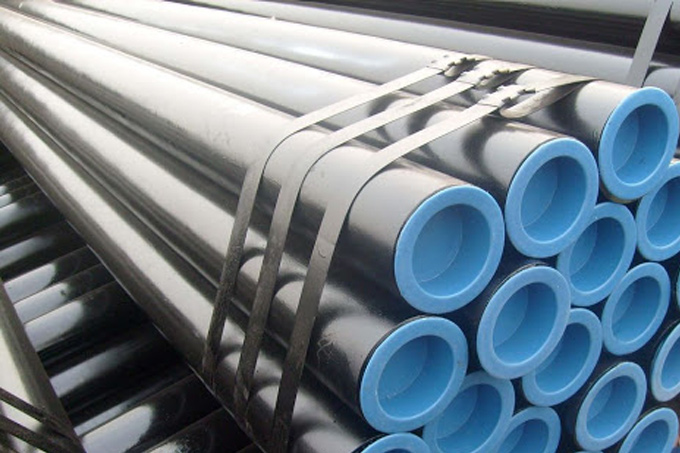
ASTM A106 is the seamless carbon steel pipe specification written for high-temperature service: steam, condensate, process fluid and hot gas lines where the pipe must still hold pressure at 400–540 °C. It covers three grades — A, B and C — differing only in carbon and manganese, which is why Grade B accounts for most of what moves internationally and Grade C is bought when the design pressure will not close in B. The pipe is killed steel, seamless by definition, hydrotested to 60% of yield, and suitable for bending, flanging and similar hot forming. We supply NPS 1/8 to 24 in Schedule 10 through XXS, hot finished or cold drawn, with the heat number stencilled on every length and a 3.1 certificate carrying chemistry, tensile, yield, elongation and hydrostatic pressure. Cut lengths, bevelled ends and third-party witnessed inspection are routine, not exceptions.
Scope — what A106 actually covers
A106 is a seamless-only specification. Welded pipe cannot be certified to it, whatever the mill claims; if a supplier offers A106 in EFW or ERW, what they mean is A53 or API 5L with a similar chemistry. The standard covers nominal wall pipe for high-temperature service, suitable for bending and flanging. NPS 1½ and smaller may be hot finished or cold drawn; NPS 2 and larger is hot finished unless cold drawing is specified on the order.
Table 1 — The three A106 grades and where each one is used
| Grade | Carbon max | Tensile min | Yield min | Choose it when |
|---|---|---|---|---|
| Grade A | 0.25% | 330 MPa (48 ksi) | 205 MPa (30 ksi) | Low-pressure steam, water and non-critical utility lines where forming is heavy. |
| Grade B | 0.30% | 415 MPa (60 ksi) | 240 MPa (35 ksi) | The default. Process piping, boiler tubing, heat exchanger shells up to 538 °C. |
| Grade C | 0.35% | 485 MPa (70 ksi) | 275 MPa (40 ksi) | Higher design pressure at the same wall, or a thinner wall at the same pressure. Weldability is tighter. |
Chemical composition
Table 2 — A106 chemical requirements, heat analysis (%)
| Element | Grade A | Grade B | Grade C |
|---|---|---|---|
| Carbon, max | 0.25 | 0.30 | 0.35 |
| Manganese | 0.27 – 0.93 | 0.29 – 1.06 | 0.29 – 1.06 |
| Phosphorus, max | 0.035 | 0.035 | 0.035 |
| Sulphur, max | 0.035 | 0.035 | 0.035 |
| Silicon, min | 0.10 | 0.10 | 0.10 |
| Chromium, max | 0.40 | 0.40 | 0.40 |
| Copper, max | 0.40 | 0.40 | 0.40 |
| Molybdenum, max | 0.15 | 0.15 | 0.15 |
| Nickel, max | 0.40 | 0.40 | 0.40 |
| Vanadium, max | 0.08 | 0.08 | 0.08 |
Cr + Cu + Mo + Ni + V must not exceed 1.00% in total. Residual elements are the usual reason a heat fails review on a refinery project even though carbon and manganese look correct — check the sum, not the individual lines.
Mechanical properties and testing
Table 3 — Tensile requirements and test frequency
| Property | Grade A | Grade B | Grade C | Test frequency |
|---|---|---|---|---|
| Tensile strength, min | 330 MPa | 415 MPa | 485 MPa | 1 per lot: 400 lengths (NPS 5 and under), 200 lengths (NPS 6 and over) |
| Yield strength, min | 205 MPa | 240 MPa | 275 MPa | Same tensile specimen |
| Elongation, min | 35% | 30% | 30% | Same tensile specimen |
| Bending test | 90° around 12 × OD mandrel (8 × OD for close coiling) | NPS 2 and under | ||
| Flattening test | No cracks before the plates close on the wall | NPS 2½ and over | ||
| Hydrostatic | 60% of SMYS, 5 s hold, max 2,500 psi up to NPS 3 / 2,800 psi above | Every length unless waived | ||
Dimensions and permissible variation
Table 4 — Outside diameter tolerance
| NPS | Over, mm | Under, mm | Over, inch | Under, inch |
|---|---|---|---|---|
| 1/8 – 1½ | 0.4 | 0.4 | 1/64 | 1/64 |
| Over 1½ – 4 | 0.8 | 0.8 | 1/32 | 1/32 |
| Over 4 – 8 | 1.6 | 0.8 | 1/16 | 1/32 |
| Over 8 – 18 | 2.4 | 0.8 | 3/32 | 1/32 |
| Over 18 – 26 | 3.2 | 0.8 | 1/8 | 1/32 |
| Over 26 – 34 | 4.0 | 0.8 | 5/32 | 1/32 |
| Over 34 – 48 | 4.8 | 0.8 | 3/16 | 1/32 |
Table 5 — Wall, weight and length
| Parameter | Requirement | Practical note |
|---|---|---|
| Minimum wall | Not more than 12.5% under nominal at any point | A SCH 40 pipe at nominal 7.11 mm may measure 6.22 mm and still pass |
| Weight per length | +10% / −3.5% of calculated | NPS 4 and smaller weighed in lots; larger sizes by length |
| Single random lengths | 5.2 – 7.3 m (17 – 24 ft) | Default when the order says random |
| Double random lengths | 11 – 13.4 m (36 – 44 ft) | Ask for it explicitly; it is not the default |
| Ends | Plain, bevelled or threaded | Bevelled 30° + 1.6 mm root face for welding |
Allowable stress against temperature
The reason A106 exists as a separate specification is the high-temperature design case. Below is the ASME B31.1 allowable stress for Grade B — the table a piping engineer uses to size wall thickness above 400 °C.
Table 6 — ASME B31.1 allowable stress, A106 Grade B
| Metal temperature | Allowable stress, ksi | MPa | What happens here |
|---|---|---|---|
| 38 °C (100 °F) | 20.0 | 138 | Room temperature rating, governed by yield |
| 204 °C (400 °F) | 20.0 | 138 | No reduction yet |
| 316 °C (600 °F) | 19.3 | 133 | First small reduction |
| 371 °C (700 °F) | 18.1 | 125 | Creep begins to matter |
| 427 °C (800 °F) | 14.4 | 99 | Wall thickness rises sharply from here |
| 482 °C (900 °F) | 8.6 | 59 | Approaching the practical limit |
| 538 °C (1000 °F) | 4.6 | 32 | Upper limit for A106 in code service |
Above roughly 450 °C the wall thickness required by B31.1 grows faster than the pressure does, which is why 1.25Cr (13CrMo4-5) or 2.25Cr (10CrMo9-10) replaces carbon steel rather than a heavier carbon wall. If your design temperature is above 450 °C, ask for the alloy option before fixing the schedule.
Standards and equivalents
Table 7 — A106 against the specifications it is usually compared with
| System | Designation | Grades | Difference from A106 |
|---|---|---|---|
| ASTM | A106 / A106M | A, B, C | The reference specification |
| ASME | SA106 | A, B, C | Identical; used for ASME code construction |
| EN | EN 10216-2 | P235GH, P265GH | Closest European equivalent to A106 B. Not interchangeable — different chemistry control and impact testing |
| JIS | JIS G3456 | STPT370, STPT410 | Japanese high-temperature service pipe |
| GB | GB/T 3087 | 10#, 20# | Chinese low-pressure boiler pipe; 20# is the usual A106 B substitute domestically |
| DIN | DIN 17175 | St35.8, St45.8 | Legacy German specification, superseded by EN 10216-2 |
| API | API 5L | B, X42 – X70 | Line pipe, not pressure service. Cheaper; do not substitute without engineering approval |
A106, A53 or API 5L — the choice in one table
Table 8 — Decision table for carbon steel pipe specifications
| ASTM A106 | ASTM A53 | API 5L | |
|---|---|---|---|
| Written for | High-temperature service | Ordinary mechanical and pressure service | Pipeline transmission |
| Seamless allowed | Yes — seamless only | Yes (type S) | Yes (PSL1 / PSL2) |
| Welded allowed | No | Yes (types E, F) | Yes (ERW, LSAW, SSAW) |
| Grades | A, B, C | A, B | B, X42 – X70 |
| Typical use | Boiler, refinery, steam header | Water, air, low-pressure steam, structural | Cross-country and gathering lines |
| Relative price | Highest | Middle | Lowest for the same OD |
Where A106 is the right answer
Refinery process piping
Hydrocarbon and hot gas lines inside the battery limits where the piping class calls for A106 B seamless with a full 3.1 certificate and heat number traceability to the weld log.
Boiler and superheater headers
Steam service up to 538 °C. Above that the design moves to 1.25Cr or 2.25Cr, which is why 13CrMo4-5 sits next to A106 in most boiler specifications.
Heat exchanger shells
Shell-side and channel pipe where the tube side is alloy or stainless. A106 B is the standard shell material for water and hydrocarbon service.
Steam distribution
Plant steam mains, condensate return and tracing lines. Grade B covers saturated and most superheated services without a wall penalty.
Compressor and pump piping
Small-bore and utility runs where bending and flanging are part of fabrication. A106 is explicitly written to allow both.
District heating
Hot water and steam mains buried or in culverts. Usually A106 B with external PE coating or in a casing pipe.
Frequently asked questions
Is A106 Grade B the same as A53 Grade B?
No. They share a similar chemistry and both reach 415 MPa tensile, but A106 is seamless-only and written for high-temperature service, while A53 permits welded pipe and targets ordinary service. A53 also allows a wider wall tolerance. Substituting A53 for A106 removes the high-temperature basis of the design and is normally rejected at review.
Can I use A106 Grade B instead of P265GH?
They are close but not interchangeable. P265GH to EN 10216-2 has a guaranteed minimum yield of 265 MPa against 240 MPa for A106 B, requires aluminium-killed fine grain steel, and carries mandatory impact testing. Many European specifications accept A106 B as an alternative, but the acceptance has to come from the design authority, not from the mill.
What is the maximum temperature for A106?
538 °C (1000 °F) in ASME B31.1 service, and the allowable stress at that temperature has fallen to 4.6 ksi. In practice most designs switch to 1.25Cr above roughly 450 °C because the carbon steel wall becomes uneconomical before it becomes unsafe.
Does A106 need post-weld heat treatment?
Not for its own sake. PWHT is governed by the code and by wall thickness — ASME B31.3 requires it above 19 mm nominal wall for P-No.1 carbon steel in certain service, and by hardness limits in sour service. Grade C, with 0.35% carbon, is more sensitive to cracking and is often specified with preheat regardless of thickness.
Can you supply A106 to NACE MR0175?
Yes, in the hardness-controlled route: A106 B with 22 HRC maximum and a certificate referencing NACE MR0175 / ISO 15156. Tell us the H2S partial pressure and the design temperature, because MR0175 has an absolute temperature limit above which the restriction does not apply.
What is the difference between SCH 40 and STD?
For NPS 1/8 to 10 they are the same wall. For NPS 12 and above, STD is thinner than SCH 40. That is why an order written as “SCH 40” and an order written as “STD” can arrive with different weights above 12 inch — always state the schedule number, not the word standard.
Do you supply cut lengths and bevelled ends?
Yes. Cut to length from 300 mm upwards, bevelled 30° with a 1.6 mm root face, or threaded to B1.20.1 on request. Cutting tolerance is ±3 mm on lengths under 3 m, ±5 mm above.
What is the minimum order and lead time?
One tonne per size for stock schedules. Lead time is 15–25 days depending on size and whether the mill has to roll it; NPS 14 and above runs longer. Third-party inspection adds about a week.
Request a quote
Related products
ASTM A335 Alloy Boiler PipeP5, P9, P11, P22, P91 for service above 538 °C
ASTM A333 Low Temperature PipeGr 1, 3, 6, 8 impact tested to −46 / −101 °C
EN 10216-2 Pressure TubeP235GH, P265GH, 16Mo3, 13CrMo4-5
13CrMo4-5 (1.7335) Tube1.25Cr-0.5Mo, service to 530 °C
ASTM A213 Alloy TubeBoiler, superheater and heat exchanger, T5 to T91
All boiler and pressure tube — carbon, alloy and stainless · Guide: ASTM vs ASME vs API vs ANSI, and which one governs your order
Also supplied: oxygen lancing tube for EAF and converter steelmaking.
Request a quotation
Give us grade, NPS, schedule and quantity. We reply within 24 hours with price, lead time and certificate scope — and if the schedule does not match the grade you asked for, we will say so before you place the order.