
Project Description
Lead time 20–30 days
Third party SGS / BV / TUV
Quote within 24 hours
Certificate EN 10204 3.1
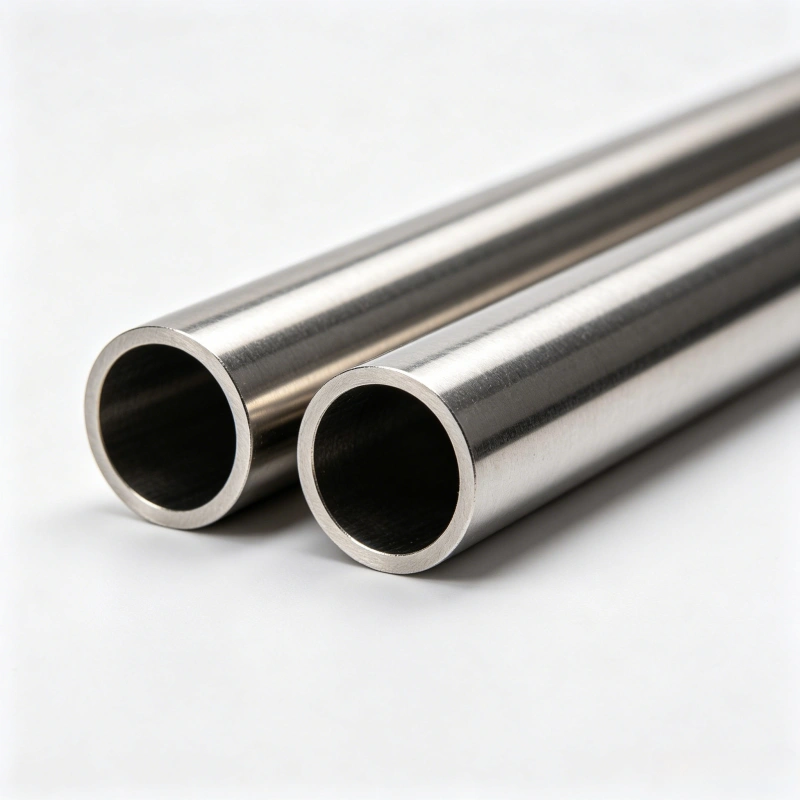
444 — UNS S44400, EN 1.4521 — is a ferritic stainless steel with 18% chromium and about 2% molybdenum, stabilised with titanium and niobium so it can be welded without intergranular corrosion. It sits in the gap between 316L and the duplex grades: pitting resistance equivalent around 26, which matches or slightly beats 316L, but with a ferritic structure that resists chloride stress corrosion cracking in the temperature range where 316L cracks. It is not a duplex and it is not a 2205 substitute. What it is good at is hot water, heat exchanger tube, solar circuits and food equipment — welded, formed and put into chloride-bearing water without the SCC risk of an austenitic grade.
Chemistry
Table 1 — Chemical composition, EN 10088-2 / ASTM A268 (%, limits)
| Element | Requirement | Function |
|---|---|---|
| Carbon | 0.025 max | Very low; keeps intergranular corrosion risk down |
| Chromium | 17.5 – 19.5 | Passive film and pitting resistance |
| Molybdenum | 1.75 – 2.50 | The 2% Mo that separates 444 from 430 |
| Titanium + niobium | 0.20 + 4(C+N) min | Stabilisation; lets the grade be welded |
| Nitrogen | 0.035 max | Restricted; too much nitrogen hurts ferritic toughness |
| Manganese | 1.00 max | Residual |
| Silicon | 1.00 max | Deoxidation |
| Phosphorus / sulphur | 0.040 / 0.030 max | Residual control |
Mechanical properties
Table 2 — Room-temperature requirements, annealed
| Property | Requirement | Note |
|---|---|---|
| Yield, 0.2% | 275 MPa min | Higher than 430 and 304 |
| Tensile | 415 MPa min | — |
| Elongation in 50 mm | 20% min | Lower than austenitic; bend radii must allow for it |
| Hardness | ≤ 90 HRB typical | — |
| Impact at 0 °C | 27 J typical | Ferritic transition; not a cryogenic grade |
| Annealing | 800 – 850 °C, air cool | Do not exceed 900 °C; grain growth is irreversible |
Corrosion: better than 316L where it matters
Table 3 — Service limits
| Duty | 444 performance | Comment |
|---|---|---|
| Chloride pitting, ambient | Good to about 300 ppm Cl | Similar to 316L, slightly better with the 2% Mo |
| Chloride SCC | Resistant to about 90 °C | Ferritic structure; this is the main reason to choose 444 over 316L |
| Hot water and steam | Good | Hot water tanks and solar circuits are the classic uses |
| Seawater immersion | Not recommended | Crevice corrosion under deposits; use 2205 or F55 |
| Nitric acid | Moderate | 304L is often better and cheaper |
| Organic acids | Good | Acetic, citric and lactic at moderate temperature |
| Low temperature | Not below −20 °C | Ferritic ductile-brittle transition |
444 and 316L have similar PREN, so the pitting resistance is not the reason to pay for 444. The reason is SCC: an austenitic 316L tube in 60 °C water with 200 ppm chloride will eventually crack; a ferritic 444 tube will not. If the duty is pitting rather than SCC, 316L is usually cheaper.
444 against 316L, 430 and 2205
Table 4 — Grade selection
| 430 | 444 | 316L | 2205 | |
|---|---|---|---|---|
| Chromium | 16 – 18 | 17.5 – 19.5 | 16 – 18 | 22 – 23 |
| Molybdenum | — | 1.75 – 2.5 | 2.0 – 3.0 | 3.0 – 3.5 |
| Structure | Ferritic | Ferritic | Austenitic | Duplex |
| PREN | ≈ 17 | ≈ 26 | ≈ 25 | ≈ 35 |
| Yield | 205 MPa | 275 MPa | 170 MPa | 450 MPa |
| SCC resistance | Good | Good to 90 °C | Poor above 60 °C | Good to 100 °C |
| Weldability | Limited in thick sections | Good, stabilised | Excellent | Requires control |
Sizes and forms
Table 5 — Product range
| Form | Range | Tolerance |
|---|---|---|
| Seamless tube | OD 6 – 219 mm, WT 1 – 12 mm | OD ±0.15 mm, WT ±10% |
| Welded tube | OD 12 – 508 mm, WT 0.8 – 6 mm | OD ±0.20 mm |
| Length | 3 – 12 m | +20 / 0 mm |
| Surface | Pickled, bright annealed, or 2B | Ra ≤ 1.6 µm pickled |
| Standards | ASTM A268, A240; EN 10088-2, EN 10216-5 on request | — |
Welding
Table 6 — Fabrication parameters
| Parameter | Recommendation |
|---|---|
| Filler | ER444 or ER430; ER309L for dissimilar joints |
| Heat input | Low to moderate; 0.5 – 1.5 kJ/mm |
| Interpass | ≤ 200 °C |
| Preheat | None; the grade does not harden |
| PWHT | Not required; avoid 400–550 °C (475 °C embrittlement) |
| Post-weld | Pickle and passivate the weld zone |
Where 444 tube is used
Hot water tanks
Inner tanks and heating coils, where 316L suffers SCC in chlorinated mains water above 60 °C.
Solar water heating
Absorber tubes and manifolds that stagnate at high temperature with chloride-bearing water.
Heat exchanger tube
Water-to-water and food exchangers with moderate chloride, where duplex is not justified.
Food processing
Brine and sauce lines where 430 pits and 316L cracks under stress.
District heating
Service pipe and heat interface units with chlorinated make-up water.
Automotive exhaust
Hot-end components where 409L oxidises too fast and 304 is over-specified on cost.
Frequently asked questions
Is 444 a duplex stainless steel?
No. 444 is ferritic, with a body-centred cubic structure. It contains 2% molybdenum for pitting resistance, which makes it look similar to a duplex on a chemistry sheet, but the structure and the mechanical properties are different.
Can 444 replace 316L?
In chloride-bearing hot water where SCC is the failure mode, yes, and it is often the better choice. In strong reducing acids or where high toughness is needed, 316L or a duplex is better. Check the temperature and the chloride level before substituting.
Is 444 suitable for seawater?
No. At PREN 26 it pits and crevices in seawater, particularly under deposits. Use 2205 for moderate seawater and F55 or 6Mo for continuous or hot seawater.
Why is 444 stabilised with titanium and niobium?
To prevent chromium carbide precipitation at the grain boundaries during welding. The stabilising elements combine with carbon at high temperature, leaving the chromium in solution and preserving corrosion resistance in the heat-affected zone.
What is 475 °C embrittlement?
Ferritic stainless steels become brittle when held between about 400 and 550 °C for long periods, because chromium-rich phases precipitate. It is why 444 is not used for service in that temperature band and why PWHT is avoided.
Is 444 magnetic?
Yes, strongly magnetic, like all ferritic grades. That is often an advantage in sensor and solenoid parts.
What is the difference between 444 and 430?
Molybdenum and stabilisation. 430 has 17% chromium and no molybdenum, PREN about 17; 444 has 18% chromium, 2% molybdenum and titanium-niobium stabilisation, PREN about 26. 444 costs more and resists chlorides and welding much better.
What is the minimum order and lead time?
500 kg per size for seamless tube. Lead time is 20–30 days; welded large diameter and bright annealed finishes run longer. Third-party inspection adds about a week.
Request a quote
Related products
SUH409L (1.4512) TubeTi-stabilised 11% Cr for exhaust
405 (1.4002) Pipe12% Cr ferritic that will not harden
410 / 410S TubeMartensitic 12% Cr
ASTM A312 TP316LThe austenitic grade 444 replaces in hot water
2304 Duplex TubeWhen 444 is not enough for chlorides
All stainless steel tube · Guide: ferritic stainless steels — 409L, 430, 444 and where each one stops
Also in this range: 10Cr17 / 430 ferritic tube · SUH409L (1.4512) exhaust tube · 410 / 410L / 410S martensitic tube · 405 (1.4002) ferritic pipe.
Request a quotation
Give us the form, size, wall, quantity, chloride level, temperature and whether the part is welded. The welding route decides whether the stabilised grade is required.