
Project Description
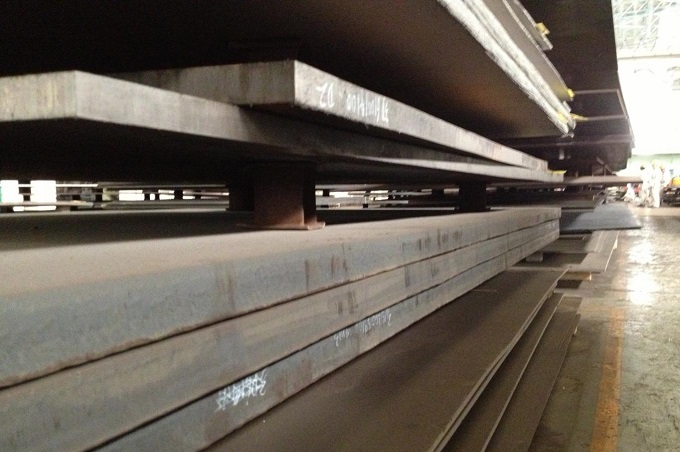
Lead time 25–35 days
Cut to size flame or plasma
Quote within 24 hours
UT on request
ASTM A537 is the heat treated carbon-manganese-silicon plate specification: three classes of increasing strength, all with mandatory impact testing, used where a pressure vessel shell is thick enough — or cold enough — that toughness is a design requirement rather than a formality. Class 1 is normalized, Class 2 and Class 3 are quenched and tempered. Compared with A516, the same thickness carries roughly 50 to 70 MPa more yield, which is what allows a heavy wall to be thinner. It is the grade to specify when A285 or A516 would need a plate too thick to weld comfortably, or when the vessel has to demonstrate fracture toughness at low ambient temperature.
The three classes
Table 1 — Mechanical properties and condition
| Class | Heat treatment | Tensile Rm | Yield ReH min | Elongation |
|---|---|---|---|---|
| Class 1 | Normalized | 485 – 620 MPa | 345 MPa | 22% |
| Class 2 | Quenched and tempered | 550 – 690 MPa | 415 MPa | 22% |
| Class 3 | Quenched and tempered | 550 – 690 MPa | 380 MPa | 22% |
Class 3 carries the same tensile as Class 2 with a lower guaranteed yield — it is the tougher of the two, and it is specified where impact performance governs. If a drawing quotes Class 2 and the fabricator proposes Class 3 “because it is better”, the design review has to accept the lower yield.
Table 2 — Chemistry (%)
| Element | Requirement | Element | Requirement |
|---|---|---|---|
| C max | 0.24 | P max | 0.035 |
| Mn | 0.70 – 1.60 | S max | 0.035 |
| Si | 0.15 – 0.50 | Cu max | 0.35 |
| Ni max | 0.25 | Cr max | 0.25 |
| Mo max | 0.08 | — | — |
Manganese at 0.70–1.60% is what gives A537 its strength over A516 without alloy additions, and the residual caps on Ni, Cr and Mo keep it a plain carbon-manganese steel for welding and PWHT purposes.
Which plate specification
Table 3 — A285, A516 and A537 side by side
| A285 | A516 | A537 | |
|---|---|---|---|
| Yield range | 165 – 205 MPa | 260 – 345 MPa | 345 – 415 MPa |
| Impact testing | Not standard | Optional by grade | Required for all classes |
| Heat treatment | As-rolled or normalized | Normalized | Normalized or Q&T |
| Thickness | to about 50 mm | to about 200 mm | 6 – 150 mm |
| Use it when | Wall set by corrosion allowance | General vessel plate, impact optional | Thick wall or low temperature, toughness required |
Where A537 is used
Thick wall pressure vessels
Where an A516 shell would need a plate too heavy to handle and weld, and the extra 70 MPa of yield pays for itself in thickness.
Cold climate installation
Vessels erected and hydrotested in winter at high latitude, where fracture toughness at ambient is a construction requirement.
Gas storage spheres and bullets
Pressurised gas storage where the wall is thick and the vessel may sit outdoors for decades.
Hydroelectric and dam structures
Penstock and gate plate, where strength plus toughness at low temperature governs.
Heavy lift and mining equipment
Structural plate on equipment that operates below freezing and must not brittle fracture.
Not for sour service
Carbon-manganese plate is not a NACE grade. Sour duty needs hardness control and usually a stainless or clad option.
Frequently asked questions
What is the difference between A537 Class 1 and Class 2?
Heat treatment and strength. Class 1 is normalized at 345 MPa yield; Class 2 is quenched and tempered at 415 MPa. Class 2 costs more because of the quench and temper cycle.
Is A537 impact tested?
Yes, for all three classes — it is a requirement of the specification, not an option. That is the main difference from A516, where impact testing is a supplementary requirement.
Can A537 replace A516?
Normally yes as an upgrade, and it is the usual answer when the A516 wall gets too thick. It needs a design review for the higher allowable stress and a welding procedure review, because the Q&T classes are more sensitive to heat input.
What is the maximum thickness?
About 150 mm. Above that the properties through the section become difficult to guarantee and a different specification — often a normalized fine grain plate — should be considered.
Does it need post-weld heat treatment?
Per code and thickness, not per grade. Note that PWHT above the original tempering temperature will reduce the strength of a Class 2 or 3 plate — the fabricator must keep the PWHT below the tempering temperature used by the mill.
Can you supply cut profiles?
Yes — CAD-controlled flame or plasma cutting to drawing, with edges ground for welding. UT and edge preparation are available on request.
Is it suitable for sour service?
No. A537 is a carbon-manganese plate with no hardness control for H₂S service. Sour duty needs NACE-compliant material, usually stainless or a clad plate.
What is the minimum order and lead time?
One tonne. Lead time is 25–35 days; Q&T classes and UT run towards the longer end.
Request a quote
Related products
ASTM A516 PlateGr 60 / 65 / 70, the general vessel plate
16Mo3 Plate0.3% Mo for elevated temperature
EN 10028-2 PlateEuropean elevated temperature plate
ASTM A553 Plate7 / 8 / 9% nickel for cryogenic service
DIN 17155 PlateCreep resistant plate and strip
All boiler and pressure vessel plate — carbon, alloy and nickel steel · Guide: ASTM vs ASME, and which one governs your order
Request a quotation
Tell us class, thickness, plate size, quantity and the minimum design metal temperature. We reply within 24 hours with price, lead time and impact test scope.