
Project Description
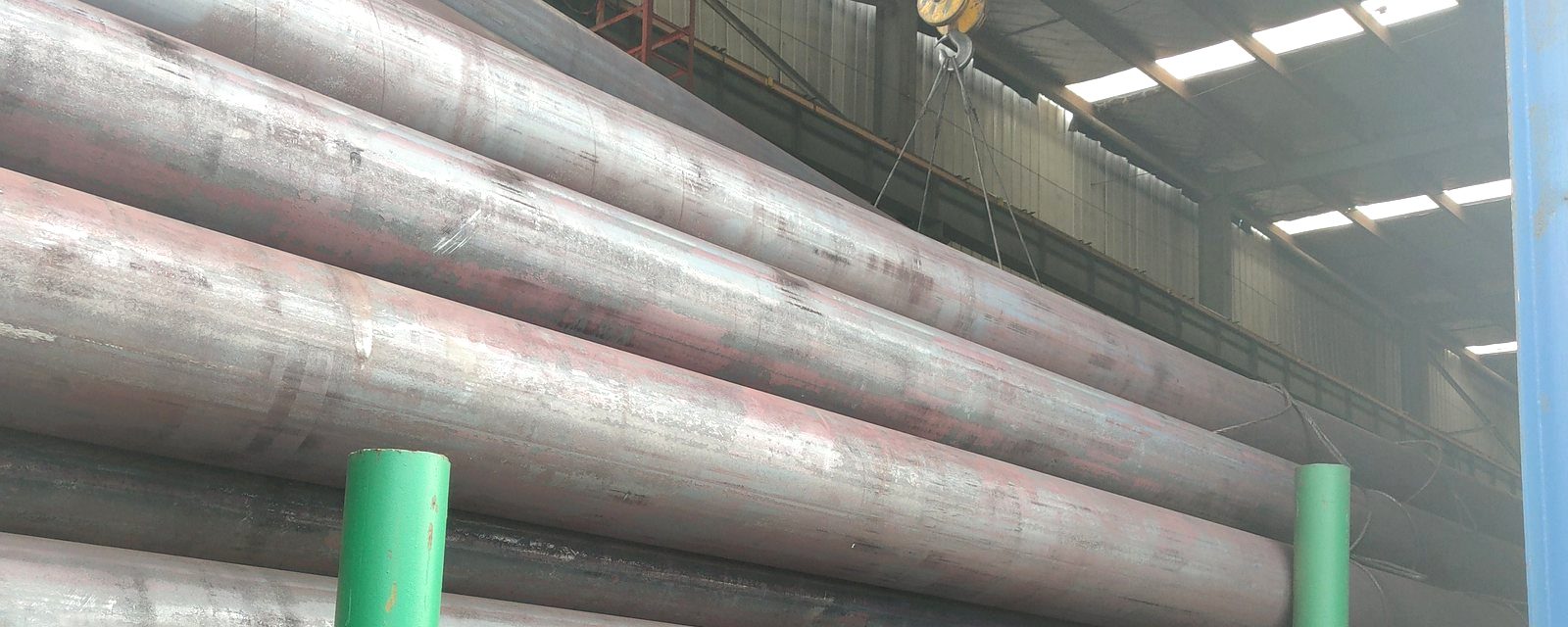
Lead time 20–35 days
Third party SGS / BV / TUV
Quote within 24 hours
Ends plain or bevelled
At 219 to 508 mm outside diameter with a wall under about 20 mm, most of what moves in the market is welded: ERW, LSAW or spiral. It is cheaper per tonne, it comes in longer lengths, and for a static structure it is usually the correct answer. So this page is not going to pretend that every large thin wall job needs seamless tube.
Seamless earns its price in three situations. Where the tube is machined into a ring or a roller and a weld seam would show up as a hardness and structure discontinuity. Where the load is dynamic — crane booms, excavator arms, idler shells — and the seam becomes a fatigue initiation site. And where pressure or vacuum has to be held without a weld qualification per batch. Outside those three, welded is the better buy and we will say so.
What makes thin wall difficult is not strength, it is geometry. A wall of 8 mm on a 355 mm tube has very little resistance to ovalisation during handling, quenching and straightening, and very little stiffness when it is chucked in a lathe. So the tolerances below are the real specification — not the grade. If you are buying for a machining operation, tell us the allowance you need before we quote.
Size matrix
Wall range is set by the D/S limit, not by a fixed table: at 508 mm OD the wall cannot go below about 10 mm without the ovality becoming unmanageable, while at 219.1 mm a 6 mm wall is routine. Weights are calculated at the minimum and maximum wall in each row.
| OD (mm) | Wall (mm) | D/S at min wall | Weight (kg/m) | Route | Typical use |
|---|---|---|---|---|---|
| 219.1 | 6–8 | 27–37 | 31.5–41.6 | Hot rolled | Roller shell, water main |
| 273.0 | 6–10 | 27–46 | 39.5–64.9 | Hot rolled | Conveyor, structural |
| 323.9 | 6–12 | 27–54 | 47.0–92.3 | Hot rolled | Crane boom |
| 355.6 | 7–14 | 25–51 | 60.2–118.0 | Hot rolled; Q&T on request | Boom, idler |
| 406.4 | 8–16 | 25–51 | 78.6–154.1 | Hot rolled | Pile casing, structure |
| 457.0 | 9–18 | 25–51 | 99.4–194.9 | Hot rolled | Structural, machinery frame |
| 508.0 | 10–20 | 25–51 | 122.7–240.7 | Hot rolled | Structural, project work |
| Project sizes | 508–720 OD · wall per enquiry | — | — | Project schedule | Mill allocation required |
Sizes above 508 mm are produced to project schedule; confirm mill allocation before quoting.
What “thin wall” means in engineering
Thin wall is a ratio, not a millimetre figure. The industry convention is D/S — outside diameter divided by wall thickness — and anything above 25 is treated as thin wall. In absolute terms that is a wall below 4% of the diameter.
| D/S | Class | Behaviour | Where it appears |
|---|---|---|---|
| 5–10 | Heavy wall | Bore and wall carry load; quench through is the limit | Cylinder barrels, drill collars |
| 10–25 | Standard wall | Normal rolling and heat treatment | Line pipe, general mechanical |
| > 25 | Thin wall | Ovality, straightness and handling dominate | Booms, rollers, structural |
| > 50 | Extra thin | Distortion on quenching is the main risk, not strength | Lightweight booms, shells |
Seamless or welded: where the boundary sits
This is the table to read before sending an enquiry. If the application sits in the right-hand column, welded tube will do the job at a lower cost and we will point you there rather than sell you seamless.
| Factor | Seamless (this page) | Welded ERW / LSAW |
|---|---|---|
| Cost index | 130–160 | 100 |
| Seam | None | Longitudinal weld and HAZ |
| Length | Up to 12 m | 12–18 m, longer on spiral |
| Wall tolerance | ±10% | ±5% from coil |
| OD tolerance | ±1% | ±0.5% for ERW |
| Dynamic load | Preferred — no seam to initiate fatigue | Seam is the initiation site |
| Machined ring or roller | Preferred — uniform structure through the wall | Seam shows as hardness step |
| Static structure | Over-specified in most cases | Better buy |
| NDT | Full body UT | Weld seam UT or ET |
| Minimum order | 1 tonne per size | Set by coil, often 5–20 t |
What thin wall does to heat treatment
Quenching a thin wall is not the same problem as quenching a thick one. A thick wall fails in the middle because the core cools too slowly. A thin wall fails at the surface because the section has almost no stiffness: it ovalises, it bows, and the hardness scatters as the section moves through the quench.
| Issue | What happens | How it is controlled |
|---|---|---|
| Ovality after quench | Section collapses under its own quench stress | Fixture quench with internal support |
| Bow | 0.3–0.8% of length after quenching | Rotary straightening, then stress relief |
| Hardness scatter | Thin section cools faster than the test block | Temper setpoint taken from a section test |
| Decarburisation | Both surfaces exposed at temperature | Controlled atmosphere, machining allowance |
| Thread or groove cutting | Wall may be too thin after machining | Declare the final wall at enquiry, not the ordered wall |
Practical consequence: in this size band we normally supply hot rolled or normalised. Quenched and tempered thin wall is available on request, with fixture quenching and a section test — it is not a stock item and the lead time reflects that.
Tolerances you can actually hold
| Item | Standard | Tighter, on request |
|---|---|---|
| Outside diameter | ±1% | ±0.75% for machined rings |
| Wall thickness | ±10% | ±7.5% on selected sizes |
| Ovality | ≤1% of OD, hot rolled | ≤1.5% after Q&T, re-rounded at ends |
| Straightness | 1.5 mm/m | 1.0 mm/m on request |
| Length | 6–12 m | Fixed length ±10 mm |
| Ends | Plain, square cut | Bevelled 30° for welding |
Inspection and documents
| Test | Reference | Frequency |
|---|---|---|
| Chemical composition | Product analysis, per heat | Every heat |
| Tensile | GB/T 8162 or EN 10297-1 | Per lot |
| Ultrasonic | GB/T 5777 L2.5, or SEP 1921 group 3 | Full body, on request |
| Hydrostatic | EN 10216-2 or agreed pressure | Per tube when specified |
| Dimensional | OD, wall, ovality, straightness | 100% |
| Certificate | EN 10204 Type 3.1 | Every shipment |
Where thin wall large diameter is used
Crane booms and excavator arms
Q460C/D/E or E355, chosen because the wall can be thin and the weight still carried. The boom is a fatigue structure, so no weld seam is wanted in the chord.
Conveyor and idler shells
Roundness and straightness matter more than grade; the shell is machined after delivery, so a uniform wall and a clean bore save machining time.
Pile casing and temporary works
Often the case for welded tube. Specify seamless only where the casing is extracted and reused, or where the wall will be machined.
Frequently asked questions
What counts as thin wall?
A D/S ratio above 25, which means a wall thinner than 4% of the outside diameter. At 508 mm OD that is 20 mm or less; at 219.1 mm it is 8.8 mm or less.
Why not just use welded tube?
Often you should. Seamless is worth the premium when the part is machined from the wall, when the load is dynamic, or when pressure has to be held without a per-batch weld qualification. For a static structure, ERW or LSAW is the cheaper and equally correct answer.
Can you hold ovality on a thin wall?
Hot rolled is held to 1% of OD. After quenching it moves to about 1.5%, which is why Q&T thin wall is rotary straightened and the ends are re-rounded before despatch. If the tube will be chucked in a lathe, tell us the clamping position — it changes the allowance.
What is the longest length available?
12 m on the standard route, limited by the heat treatment furnace and by road transport. Welded tube can go longer, up to 18 m on LSAW, which is one of the reasons it wins on long structural runs.
Can you supply 508 × 8 mm?
Not on a standard route. D/S would be 63, and at that ratio ovality and wall scatter make it a special project rather than a stock item. The practical minimum at 508 mm is 10 mm; below that we would quote it as a development order with a section trial.
Does quenching and tempering distort the tube?
Yes, and that is the main reason Q&T is not the default in this size band. It is controlled by fixture quenching with internal support, followed by rotary straightening and stress relief. Expect 1.5% ovality and plan a machining allowance if the OD is a functional surface.
What is the lead time and minimum order?
20–35 days and one tonne per size on the standard range. Project sizes are tied to a full heat, so both the minimum and the schedule are set by mill allocation.
Can you supply above 508 mm?
On a project basis, up to 720 mm OD, with the wall confirmed per enquiry. These are produced against mill allocation rather than from stock, so the minimum is a full heat and the schedule is agreed case by case.
Request a quotation
WhatsApp +86 178 7358 1838
Large OD Thick WallWhen the wall, not the diameter, is the problem.
Engineering MachineryBoom, arm and cylinder stock in one place.
Cold Drawn + Q&TThe small diameter route with tight tolerance.
Small OD Thick WallDrill pipe bodies and core barrels.
Welded AlternativeLSAW pipe when the budget decides.
Request a quotation