
Project Description
Lead time 30–45 days
Threads EUE, NUE, BTC, premium
Quote within 24 hours
SSC test NACE TM0177 on request
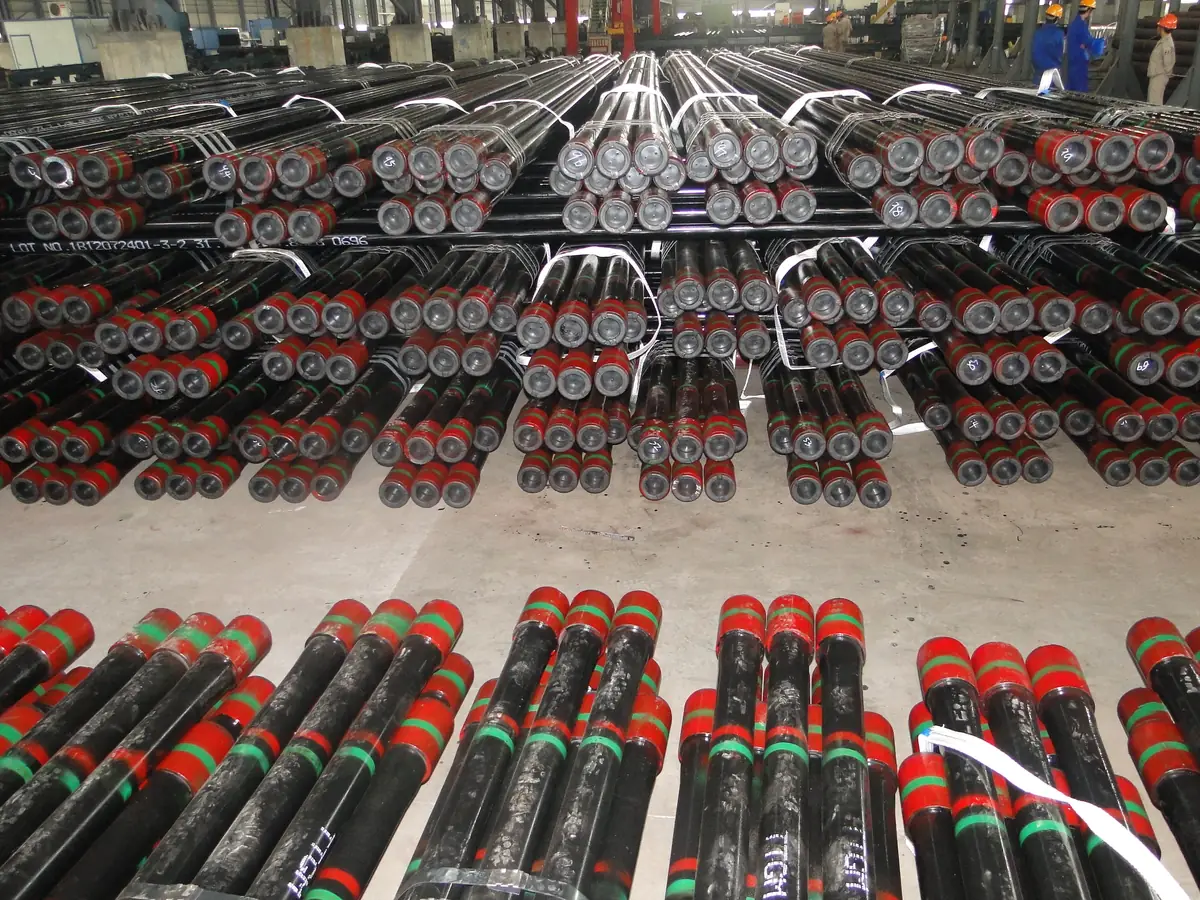
13Cr OCTG exists for one reason: carbon steel dissolves in wet CO₂. Where a well produces CO₂ partial pressure above roughly 0.2 bar with water present, plain L80 or P110 corrodes at a rate that makes inhibitor programmes uneconomic, and the industry answer is a martensitic 13% chromium tubular. L80-13Cr is the base grade — 552 to 655 MPa yield, 23 HRC maximum, specified in API 5CT. Super 13Cr adds nickel and molybdenum and drops the carbon below 0.05%, which raises the yield into the C95 and P110 bands and extends the working envelope towards higher temperature, higher chloride and mildly sour service. We supply both as seamless tubing and casing, 2-7/8 to 10-3/4 inch, with EUE, NUE, BTC or premium connections and the full API 5CT test schedule.
L80-13Cr against Super 13Cr — which one your well needs
Table 1 — The 13Cr family by strength grade
| Grade | Yield strength | Tensile min | Hardness max | Where it sits |
|---|---|---|---|---|
| L80-13Cr | 552 – 655 MPa (80–95 ksi) | 655 MPa | 23 HRC | The standard CO₂ grade; API 5CT listed, most widely stocked |
| C95-SP13Cr | 655 – 758 MPa (95–110 ksi) | 724 MPa (105 ksi) | 27 – 28 HRC | Higher pressure or deeper wells, mild sour |
| P110-SP13Cr | 758 – 896 MPa (110–130 ksi) | 827 MPa (120 ksi) | 32 HRC | HPHT completions; highest strength in the family |
Hardness is the number to watch, not yield. Every step up in strength buys pressure capacity and gives away sulphide stress cracking resistance — P110-SP13Cr is not a sour-service material, whatever the CO₂ rating suggests.
Chemical composition
Table 2 — Super 13Cr analysis (%)
| Element | Range | Element | Range |
|---|---|---|---|
| C | 0.05 max | Mo | 1.50 – 2.00 |
| Si | 0.50 max | Cu | 0.30 max |
| Mn | 0.50 – 1.00 | N | 0.06 – 0.12 |
| P | 0.020 max | S | 0.005 max |
| Cr | 12.00 – 15.00 | Ni | 4.00 – 7.00 |
The carbon limit is what separates Super 13Cr from the older modified grades: below 0.05% C the martensite is tough enough to survive the higher strength levels, and the 4–7% nickel keeps the ferrite phase out. Nitrogen at 0.06–0.12% is deliberate — it substitutes for carbon in solid solution without the loss of corrosion resistance.
Table 3 — L80 Type 13Cr analysis per API 5CT (%)
| Element | Requirement | Element | Requirement |
|---|---|---|---|
| C | 0.15 – 0.22 | Cr | 12.0 – 14.0 |
| Si | 1.00 max | Ni | 0.50 max |
| Mn | 0.25 – 1.00 | Mo | 0.50 max |
| P | 0.020 max | Cu | 0.25 max |
| S | 0.010 max | — | — |
L80-13Cr is a higher-carbon martensitic grade, which is why it is quenched and tempered to a 23 HRC ceiling rather than alloyed for toughness. The certificate should carry the actual heat treatment temperatures, not just the resulting hardness.
Where the envelope actually ends
No supplier can tell you from a grade name whether 13Cr will survive your well. The limits are set by CO₂ partial pressure, H₂S partial pressure, chloride concentration, pH and temperature acting together, and the governing document is NACE MR0175 / ISO 15156 plus the operator’s own corrosion assessment.
Table 4 — Working guidance by environment (assessment required, not a specification)
| Environment | L80-13Cr | Super 13Cr (C95 / P110) | Comment |
|---|---|---|---|
| Wet CO₂, no H₂S, low chloride | Suitable | Suitable | The original application for both |
| CO₂ with chlorides above about 1,000 mg/L | Pitting risk; assess | Preferred | Molybdenum is what resists chloride pitting |
| Temperature above about 150 °C | Not recommended | Assess to about 175 °C | Corrosion rate rises sharply with temperature |
| Mild sour, H₂S below about 0.01 bar | Outside the envelope | Possible within ISO 15156 limits | Hardness grade governs; P110-SP13Cr normally excluded |
| H₂S above about 0.01 bar | No | No | Move to duplex, 17-4PH or a nickel alloy |
The numbers above are the commonly used screening bands, not acceptance criteria. Every well requires a corrosion assessment against ISO 15156 with actual partial pressures. If a supplier quotes 13Cr for a sour well without asking for the H₂S figure, the quote is not finished.
Size, weight and range
Table 5 — Availability
| Parameter | Range | Note |
|---|---|---|
| Outside diameter | 2-7/8" to 10-3/4" | Standard API sizes plus non-standard on request |
| Wall / weight | Per API 5CT table for the size | Non-standard weights quoted against drawing |
| Range 1 (R1) | 6.10 – 7.32 m (20 – 24 ft) | Shortest; used where handling height is limited |
| Range 2 (R2) | 8.53 – 9.75 m (28 – 32 ft) | The common completion length |
| Range 3 (R3) | 10.97 – 12.80 m (36 – 42 ft) | Fewer connections per string |
| Product form | Tubing and casing | Coupling stock and accessory material on request |
Connections
Table 6 — Thread options we supply
| Connection | Type | Typical use |
|---|---|---|
| NUE | Non-upset, API 5B | Small tubing where clearance is critical |
| EUE | External upset, API 5B | The default tubing connection; stronger than NUE at the same size |
| STC / LTC | Short / long round thread casing | Standard casing strings |
| BTC | Buttress casing | Heavier walls and higher tension loads |
| Premium (integral or coupled) | Metal-to-metal seal | Gas-tight service, HPHT; brand specified by the operator |
Premium connections are licensed products — the operator specifies the brand and we machine against their drawing under the mill’s licence. We will not offer a “premium equivalent”; if the well needs a gas-tight seal, it needs the qualified product.
Standards
Table 7 — Specifications that govern 13Cr OCTG
| Standard | Scope | Relevance |
|---|---|---|
| API 5CT / ISO 11960 | Casing and tubing | The base product specification; PSL1, PSL2 and PSL3 differ in test scope |
| API 5CRA / ISO 13680 | Corrosion-resistant alloy seamless tubes | The CRA route; governs the Super 13Cr grades |
| API 5B | Threading, gauging and thread inspection | Thread geometry and gauge requirements |
| NACE MR0175 / ISO 15156 | Sour service material qualification | Decides whether the grade can be used, and at what hardness |
| NACE TM0177 | Laboratory testing for SSC and SCC | The test method behind the sour-service claim |
Inspection and testing
Table 8 — Test scope by PSL
| Test | PSL1 | PSL2 | PSL3 |
|---|---|---|---|
| Tensile, yield, elongation | Required | Required | Required |
| Hardness, full body | Required | Required | Required |
| Hydrostatic test | Required | Required | Required |
| Non-destructive examination | — | Required | Required |
| Impact test | — | On order | Required |
| Metallographic / grain size | — | — | Required |
| SSC test to NACE TM0177 | On request | On request | On request |
Where 13Cr tubulars are used
CO₂-rich gas wells
The defining application. Wet CO₂ above about 0.2 bar partial pressure rules out carbon steel and makes 13Cr the economic answer before a duplex or nickel alloy is needed.
CO₂ injection and EOR
Injection and production wells in miscible gas floods, where the produced fluid is wet and CO₂ partial pressure stays high through the life of the well.
Geothermal wells
CO₂ and chloride-bearing brines at moderate temperature. 13Cr handles many geothermal completions where carbon steel fails within a couple of years.
HPHT completions
P110-SP13Cr where high pressure and moderate CO₂ coincide and the strength requirement rules out L80-13Cr.
Downhole accessories
Packers, mandrels and subsurface safety valve bodies machined from the same grade, so the completion is metallurgically consistent.
Well intervention and workstrings
Short strings and handling equipment where the working environment is the same produced fluid as the completion.
Frequently asked questions
What is the difference between L80-13Cr and Super 13Cr?
L80-13Cr is the API 5CT grade: about 0.2% carbon, 12–14% chromium, limited to 23 HRC, and a yield of 552–655 MPa. Super 13Cr drops carbon below 0.05% and adds 4–7% nickel and 1.5–2% molybdenum, which allows C95 and P110 strength levels and gives better chloride and temperature resistance.
Can 13Cr be used in sour service?
L80-13Cr is not a sour-service material. Super 13Cr can be used in mildly sour conditions within ISO 15156 limits, but only after a corrosion assessment with the actual H₂S partial pressure. Above roughly 0.01 bar H₂S the answer is normally duplex or a nickel alloy.
Why is hardness limited to 23 HRC on L80-13Cr?
Because sulphide stress cracking resistance falls as hardness rises. The 23 HRC ceiling is the compromise that keeps the grade usable in CO₂ service with trace H₂S; push the hardness up and the grade stops being qualifiable.
Which PSL should I order?
PSL2 for almost all completion work — it adds non-destructive examination of the body, which is what catches the manufacturing defects that fail in service. PSL3 adds impact and metallography and is specified on HPHT and critical wells.
Do you supply couplings and accessory material?
Yes, coupling stock in the matching grade, and accessory material for float equipment and hangers. Couplings are marked and certified separately from the pipe, as API 5CT requires.
Can you supply premium connections?
We machine premium connections under the mill’s licence for the brand the operator specifies. We do not offer generic “premium equivalents” — a gas-tight seal is a qualified product, not a thread form.
What does the certificate include?
API 5CT 3.1 certificate with heat number, chemistry, tensile and yield, elongation, hardness survey, hydrostatic test pressure, NDE method and result, and the thread inspection record. SSC test results are added when ordered.
What is the minimum order and lead time?
20 tonnes for standard sizes and grades. Lead time is 30–45 days; premium connections and non-standard weights run longer, and SSC testing adds two to three weeks.
Request a quote
Related products
ASTM A269 Stainless TubeTP304 / TP316L general service
2205 Duplex TubeFor sour service beyond 13Cr
ASTM A333 Low Temp PipeCarbon steel for cold service
ASTM A106 Seamless PipeThe carbon steel baseline
AISI 4140 Alloy TubeDownhole tool and accessory stock
All pressure tube · Guide: NACE MR0175 sour service, what the standard actually requires
Request a quotation
Give us OD, weight, grade, range, thread and quantity, plus the CO₂ / H₂S figures if the well is sour. We reply within 24 hours with price, lead time and test scope.