
Project Description
Introduction
The 3-Spline Internal Profile Seamless Steel Tube occupies a highly specialized position within the broader spline transmission family. With only three evenly distributed internal teeth, this geometry represents the most extreme loading concentration of any multi-tooth configuration in common industrial use. Each tooth flank carries approximately 33.3% of the total transmitted torque, roughly double the per-tooth share of a 6-spline at equivalent bore diameter and applied load.
This extreme per-tooth loading demands correspondingly massive tooth cross-sections, wide root fillet radii, and deep effective tooth heights. The resulting profile prioritizes absolute bending strength and shock resistance above all other performance criteria. Engineers select this configuration when the drivetrain requires maximum tooth root robustness in a minimum tooth count, typically under conditions of very high peak torque, severe shock loading, or constrained radial envelopes.
The 120° angular tooth pitch results in a symmetrical three-lobe geometry that can be efficiently cold-drawn over a purpose-built mandrel. However, the wide individual tooth sections generate elevated drawing forces compared to higher tooth-count profiles. This demands carefully controlled multi-pass reduction strategies, premium lubricant systems, and robust draw bench capacity. For complementary heavy-wall precision components, explore our cold drawn steel tube manufacturing capabilities.
Fushun Steel Tube produces 3-spline precision seamless tubes in carbon, alloy, and bearing steel grades to client-supplied drawings. All orders include full EN 10204 3.1 certification and complete heat traceability. Our engineering team is available for a free feasibility review from initial concept through to volume production.
Product Overview & Geometry
The even angular distribution of the three teeth facilitates straightforward concentricity verification using three-point CMM probing. Because only three teeth are formed simultaneously, any mandrel wear or asymmetry is immediately reflected in the finished bore. This makes mandrel condition monitoring and scheduled re-grinding particularly critical for maintaining dimensional consistency across production lots.
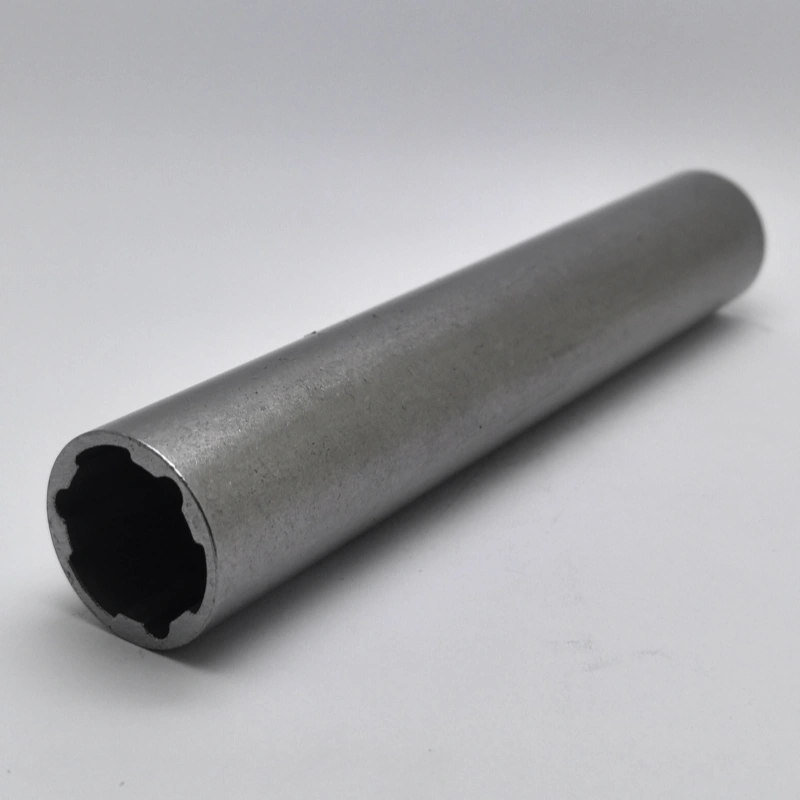
Finished tubes are typically stress-relief annealed to stabilize the three-tooth profile geometry and relieve drawing-induced residual stresses before final inspection. Contact our application engineers to validate your 3-spline design parameters.
Engineering a drivetrain for extreme shock loads or high peak torque?
Explore Cold Rolled Steel Tube OptionsApplications
The 3-spline configuration is chosen specifically when maximum tooth root bending strength and shock resistance take precedence over fine engagement refinement. Rotational backlash and index error have less impact at the low operating speeds typical of these service environments. The wide tooth flanks provide ample surface area for boundary lubrication film formation, even in inadequately lubricated or contaminated conditions.
Primary Tubular Applications
- Heavy-duty agricultural implement input shaft coupling sleeves for large tillage equipment, subsoilers, and post-hole diggers where severe soil-rock impact loading creates extreme bending moments.
- Industrial speed reducer output coupling sleeves and heavy torque transfer adapters for crushers, shredders, log splitters, and compactors operating under irregular load engagement.
- Off-highway vehicle final drive adapter sleeves and wheel hub coupling tubes for construction, mining, and forestry machinery requiring maximum root robustness.
- Hydraulic motor drive coupling sleeves for high-torque, low-speed motors in mobile machinery where maximum torque density per bore diameter is required.
- Specialized winch, capstan, and hoist drive coupling tubes where infrequent heavy-load engagement governs the design parameters.
- Custom heavy industrial press and forging machine coupling sleeves specified for cyclic peak torque loading by original equipment designers.
Specifications & Standards
The 3-spline profile is a specialized configuration that does not feature in major agricultural PTO standardization frameworks. In industrial practice, these tubes are almost exclusively produced to client-supplied engineering drawings. Geometry definition references general involute or straight-sided spline standards, with tooth count, module, pressure angle, fit class, and dimensions specified per design requirements.
Applicable Spline Geometry Standards
- DIN 5480: Involute splines based on reference diameters — the most commonly referenced European standard for 3-tooth profiles; module, pressure angle, and fit class are fully specifiable.
- ANSI B92.1 / SAE J498: Inch and metric involute spline standards applicable to 3-tooth profiles; widely referenced for North American industrial and off-highway equipment.
- ISO 4156: Straight-sided and involute splines — applicable for 3-tooth profile geometry definition in metric industrial applications.
- GB/T 3478 & GB/T 1144: Chinese national standards for cylindrical involute and straight-sided splines; 3-tooth profiles are producible to any module and pressure angle.
Seamless Tube Production Standards
- ASTM A519 Seamless carbon and alloy steel mechanical tubing
- EN 10305-1: Steel tubes for precision applications — seamless cold-drawn tubes
- DIN 2391 Seamless precision steel tubes (cold drawn)
- GB/T 3639 & GB/T 8162: Precision and structural seamless steel tubes for mechanical applications.
Available Sizes & Delivery
Because the 3-spline profile is produced exclusively to client drawings rather than a universal dimensional standard, our manufacturing range is defined by the geometric envelope of our cold-drawing and hot-rolling equipment. All dimensional parameters are produced to your engineering drawing or referenced standard specification.
| Parameter | Range | Notes |
|---|---|---|
| Outer Diameter | 30 mm – 200 mm | Cold-drawn precision range; larger OD for base tube |
| Wall Thickness | 5 mm – 35 mm | Minimum WT governed by tooth height and remaining wall section |
| Module Range | 2.0 – 10.0 | Coarser modules typical for heavy-torque applications |
| Splined Length | Per drawing | Full-length or partial spline bore available |
| Tolerance Class | IT6 – IT9 | Fit class per DIN 5480; confirmed per drawing review |
| Length | 500 – 6,000 mm | Cut-to-length available |
Delivery Terms
3-spline tubes are non-stock items manufactured exclusively to order. Standard lead time is 30–40 days from receipt of confirmed drawing, material specification, and purchase order. Small prototype batches for engineering fit-and-function evaluation are accepted prior to volume production. Minimum order quantities are negotiable based on OD, module, and material grade.
Chemical Composition
Grade selection is driven by the severe per-tooth loading that results from only three teeth sharing the total transmitted torque. With each tooth root carrying one-third of the full applied torque moment, bending fatigue resistance is the primary failure-limiting factor. Deep-hardening, high-toughness alloy steels with proven fatigue performance under shock loading are universally preferred over plain carbon grades.
| Grade | C | Si | Mn | Cr | Mo | Other |
|---|---|---|---|---|---|---|
| 42CrMo4 / 4140 | 0.38–0.45 | 0.17–0.37 | 0.60–0.90 | 0.90–1.20 | 0.15–0.30 | Primary Q+T grade |
| 20CrMnTi / 8620 | 0.17–0.23 | 0.17–0.37 | 0.80–1.10 | 0.40–0.70 | 0.15–0.25 | Ti 0.04–0.10; carburizing |
| 35CrMo / 4135 | 0.32–0.40 | 0.17–0.37 | 0.40–0.70 | 0.80–1.10 | 0.15–0.25 | Medium-carbon Cr-Mo |
| GCr15 / 52100 | 0.95–1.05 | 0.15–0.35 | 0.25–0.45 | 1.40–1.65 | ≤0.10 | Max contact fatigue resistance |
Manufacturing Process
The manufacturing challenge unique to 3-spline precision tubing is the combination of extremely wide individual tooth sections, deep root profiles, and high drawing forces. Coarse module values typically specified for these designs mean the tooth height represents a significant proportion of the tube wall section. Proper lubricant penetration into the three tooth roots during cold drawing is critical to achieving complete bore-to-mandrel contact without surface tearing.
Production begins with hot piercing and rolling of a seamless shell, followed by spheroidizing or normalizing annealing, acid pickling, and application of phosphate-soap or polymer drawing lubricant. The 3-tooth mandrel is precision ground in carbide or high-speed steel to the exact involute or straight-sided form. Successive cold-drawing passes with mandatory inter-pass annealing cycles prevent work-hardening accumulation that could cause cracking in the wide root fillet zone. Finished tubes are stress-relief annealed at 550–620 °C to stabilize geometry before final inspection.
Mechanical Properties
Given the 33.3% per-tooth torque share, minimum core impact toughness values are particularly important specification parameters. For tubes intended for cold-climate or polar-region service, low-temperature Charpy impact testing at −20 °C or −40 °C is strongly recommended and available as a certifiable test parameter on the Mill Test Certificate.
| Grade / Condition | Tensile (MPa) | Yield (MPa) | Elongation (%) | Hardness | Impact (J) |
|---|---|---|---|---|---|
| 42CrMo4 / Q+T | ≥ 1000 | ≥ 800 | ≥ 11 | 285–321 HBW | ≥ 50 |
| 35CrMo / Q+T | ≥ 930 | ≥ 780 | ≥ 12 | 265–310 HBW | ≥ 45 |
| 20CrMnTi / Core | ≥ 850 | ≥ 600 | ≥ 10 | 180–220 HBW | ≥ 40 |
| 20CrMnTi / Case | — | — | — | 58–62 HRC | — |
| GCr15 / Q+T | ≥ 1600 | ≥ 1400 | ≥ 5 | 60–64 HRC | ≥ 15 |
Heat Treatment
The deep root geometry characteristic of coarse-module 3-spline tubes requires careful furnace atmosphere control during carburizing. This prevents decarburization of the root fillet zones, where the stress concentration factor is highest and fatigue crack initiation is most likely to occur.
| Treatment | Temperature | Cooling | Application |
|---|---|---|---|
| Stress-Relief Anneal | 550–620 °C | Air cool | Stabilizes profile after drawing; mandatory before inspection |
| Normalizing | 850–900 °C | Air cool | Grain refinement prior to Q+T or carburizing |
| Quench & Temper | 830–860 °C / 500–650 °C | Oil quench | Primary for 42CrMo4/35CrMo; high core strength + toughness |
| Carburize & Harden | 900–930 °C / 820–850 °C | Oil quench | For 20CrMnTi; case 1.5–2.5 mm; 58–62 HRC + tough core |
| Induction Hardening | Per geometry | Water/polymer | Selective flank hardening for large-diameter sleeves |
Quality Assurance
The three-tooth geometry simplifies CMM probing: three diametrically related measurement positions at 120° intervals allow precise pitch circle diameter definition and symmetric flank verification with minimal fixturing complexity. Fushun Steel Tube applies a rigorous inspection protocol to all 3-spline tube production.
- Raw Material: Optical emission spectrometry (OES) for chemical analysis; non-metallic inclusion rating per ASTM E45 for critical fatigue applications.
- In-Process: Dimensional checks at each drawing pass confirm OD, WT, and mandrel engagement quality.
- Finished Tube NDT: Ultrasonic testing for subsurface flaws; eddy current or magnetic particle testing for surface defects on the three tooth flanks.
- Mechanical & Metrology: Full tensile and hardness testing per heat. CMM profile measurement confirms tooth thickness, root/tip diameters, pitch circle concentricity, and flank position accuracy.
- Case Verification: Vickers microhardness traverse on cross-section samples for carburized and induction-hardened lots.
All shipments include EN 10204 Type 3.1 Mill Test Certificates. Third-party witnessed inspection by SGS, TÜV, BV, or client-appointed agencies is fully supported.
Packing & Shipping
Finished tubes are fitted with custom plastic bore caps profiled to the three-tooth internal geometry, protecting wide tooth flanks and root fillets from contamination and mechanical damage during transit. Each tube is individually wrapped in VCI anti-rust film and packed in fumigated wooden cases or steel crates appropriate to the OD and length.
Package labels carry full identification including grade, heat number, dimensions, module, tooth count, pressure angle, fit class, and standard reference. Custom cold-stamp or laser-etched heat marking is available for full production traceability. We support global ocean freight, expedited airfreight for urgent prototypes, and complete commercial documentation packages for all major import markets.
Frequently Asked Questions
- What applications actually require a 3-spline rather than a 6-spline configuration?
- The 3-spline is selected when maximum tooth root bending strength in a minimum tooth count is critical. It excels in slow-speed, high-peak-torque, or extreme shock-load environments like large subsoilers, industrial shredders, log splitters, and heavy winches. The wide-root robustness survives extreme engagement events where finer splines would fail.
- Is there a recognized international standard specifically for 3-spline geometry?
- The 3-spline is not codified as a standalone standard in major catalogs. Instead, it is defined by referencing general involute standards like DIN 5480, ANSI B92.1, or GB/T 3478, specifying z=3 alongside module, pressure angle, and fit class. We manufacture to any fully defined client drawing referencing these frameworks.
- What is the minimum wall thickness for a 3-spline tube at a given module?
- The remaining wall from the root circle to the OD must resist the 33.3% per-tooth bending moment. As a guideline, minimum remaining wall should be ≥1.5× full tooth depth for 42CrMo4 Q+T grades, and ≥2.0× for carburized grades. Our engineers perform section strength checks for specific OD/module/torque combinations before order acceptance.
Ready to validate your heavy-duty 3-spline coupling design?
Request a Quote for 3-Spline Steel Tubes