
Project Description
12Cr13 / 410 Martensitic Stainless Steel Seamless Tube
12Cr13 (also known as 1Cr13, S41000/410, SUS410, X12Cr13, Werkstoff 1.4006, and 12X13 under GOST) is a martensitic stainless steel containing approximately 11.5–13.5% chromium. Its defining characteristic is the ability to be hardened by heat treatment — quenching and tempering — delivering tensile strength exceeding 540 MPa while retaining useful corrosion resistance in mildly aggressive environments. When supplied as seamless tube, this combination of strength and surface integrity makes 12Cr13 an economical choice for mechanical components that must withstand wear, moderate temperature, and atmospheric or low-concentration chemical exposure.
At Fushun Steel Tube, we produce 12Cr13 seamless tubes through hot-rolling followed by cold-drawing or cold-rolling for precision applications. Our integrated steelmaking route — EAF + LF + VD — ensures clean steel with tight control over sulfur and phosphorus. For the most demanding applications, we offer ESR and VIM+VAR upgrade routes for superior cleanliness and homogeneity. Whether your project calls for standard stock sizes or custom dimensions with non-standard tolerances, tell us your specifications and we will prepare a competitive quotation.
Product Appearance
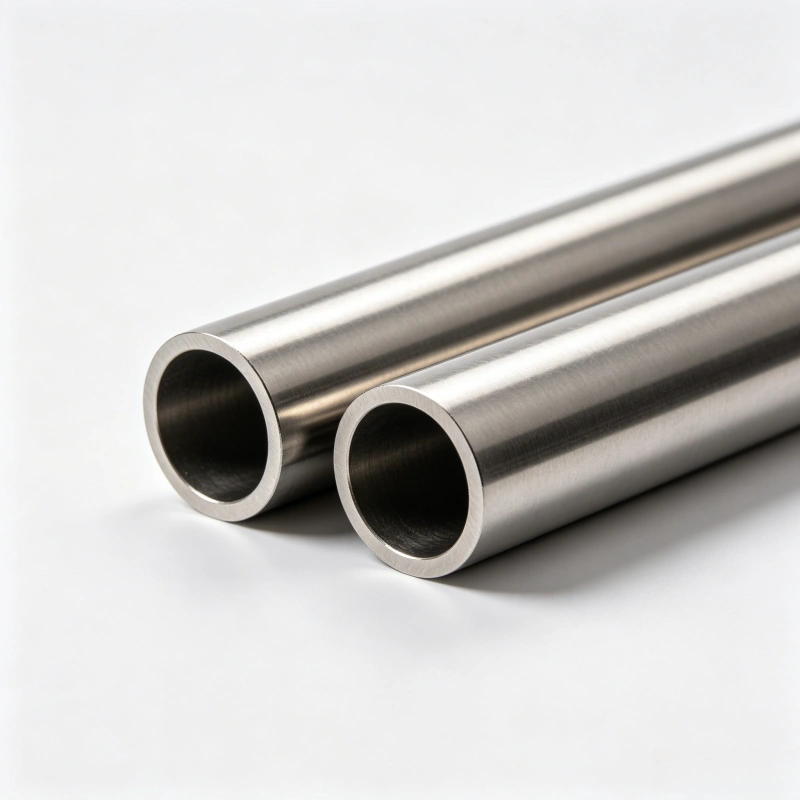
Typical Applications
Thanks to its hardenability and moderate corrosion resistance, 12Cr13 seamless tubes are widely specified for mechanical components that need higher strength than austenitic grades can offer:
- Steam and gas turbine blades, buckets, and nozzle partitions
- Valve stems, seats, and bodies for petrochemical and power generation service
- Pump shafts, sleeves, and impeller components for water and chemical pumps
- High-strength bolts, studs, and fasteners for moderately corrosive environments
- Compressor blades and rotary shafts for turbochargers and centrifugal compressors
- Hydraulic cylinder rods and piston components requiring wear resistance
- Cutlery, surgical instruments, and food-processing blades
- Automotive exhaust valve components and thermal management tubing
Our cold-drawn precision tubes in 12Cr13 deliver the tight OD and WT tolerances these applications demand. Contact us for a free quote with your required dimensions and heat treatment condition.
Specifications & Standards
12Cr13 seamless tubes are supplied under the following national and international standards. The table below emphasizes tube- and pipe-specific standards, distinguishing between seamless, welded, and precision tubing grades.
| Standard | Description | Tube Type |
|---|---|---|
| ASTM A519 | Seamless carbon and alloy steel mechanical tubing | Seamless (mechanical) |
| ASTM A268/A268M | Seamless and welded ferritic and martensitic stainless steel tubing for general service | Seamless & welded |
| GB/T 14976 | Seamless stainless steel pipes for fluid transport | Seamless (fluid) |
| GB/T 14975 | Seamless stainless steel pipes for structural use | Seamless (structural) |
| EN 10216-5 | Seamless stainless steel tubes for pressure purposes | Seamless (pressure) |
| EN 10297-1 | Seamless circular steel tubes for mechanical and general engineering | Seamless (mechanical) |
| JIS G3463 | Stainless steel boiler and heat exchanger tubes | Seamless & welded |
| DIN 2391-1 / DIN 2391-2 | Seamless precision steel tubes — dimensions and technical delivery conditions | Seamless (precision) |
| EN 10305-4 | Seamless cold-drawn tubes for hydraulic and pneumatic power systems | Seamless (precision, hydraulic) |
Material certification to EN 10204 3.1 or 3.2 is standard on all shipments. Equivalent grade designations — 1Cr13 (GB legacy), S41000/410 (UNS/ASTM), SUS410 (JIS), X12Cr13 (EN), 1.4006 (Werkstoff), and 12X13 (GOST) — ensure global specification compatibility. Request a sample or ask our engineering team about certifying to additional standards.
Available Sizes & Delivery
Fushun Steel Tube supplies 12Cr13 seamless tubes across a broad dimensional range, covering both standard stock sizes and custom requirements:
- Hot-Rolled Seamless Tubes
- Outer diameter 32–630 mm × wall thickness 2.5–60 mm × length 4,000–12,000 mm
- Cold-Drawn / Cold-Rolled Precision Tubes
- Outer diameter 6–120 mm × wall thickness 0.5–12 mm × length up to 18,000 mm (straightened and cut to exact length)
- Ready stock for common diameters and wall thicknesses: ships within approximately 7 days
- Custom / non-standard dimensions: minimum order quantity 2–3 tons, delivery approximately 25–35 days
- Small trial orders accepted for special grades and first-article qualification
- Volume orders: negotiable pricing and delivery schedule
We also supply matching 12Cr13 round bars and forgings produced from the same heat of steel for complete material traceability.
Chemical Composition
| Element | GB/T 14976 (12Cr13) | ASTM A268 (410) | EN 10216-5 (X12Cr13 / 1.4006) | JIS G3463 (SUS410) | GOST (12X13) |
|---|---|---|---|---|---|
| Carbon (C) | 0.08–0.15 | ≤0.15 | 0.08–0.15 | ≤0.15 | 0.08–0.15 |
| Silicon (Si) | ≤1.00 | ≤1.00 | ≤1.00 | ≤1.00 | ≤0.80 |
| Manganese (Mn) | ≤1.00 | ≤1.00 | ≤1.50 | ≤1.00 | ≤0.80 |
| Phosphorus (P) | ≤0.040 | ≤0.040 | ≤0.040 | ≤0.040 | ≤0.030 |
| Sulfur (S) | ≤0.030 | ≤0.030 | ≤0.015 | ≤0.030 | ≤0.025 |
| Chromium (Cr) | 11.50–13.50 | 11.50–13.50 | 11.50–13.50 | 11.50–13.50 | 12.00–14.00 |
| Nickel (Ni) | ≤0.60 | ≤0.75 | ≤0.75 | ≤0.60 | ≤0.60 |
Under the ASTM A519 specification for mechanical tubing, the 410 grade chemistry aligns closely with the ASTM A268 limits above. Fushun Steel Tube routinely controls sulfur to 0.010% or lower through VD treatment for enhanced cleanliness in fatigue-critical applications.
Manufacturing Process
Fushun Steel Tube produces 12Cr13 seamless tubes through an integrated manufacturing chain that begins with in-house steelmaking. The base route uses EAF melting followed by ladle furnace refining and vacuum degassing, achieving clean steel with sulfur typically below 0.010% and hydrogen below 2 ppm. For applications requiring the highest cleanliness levels — such as turbine blades operating at elevated stress — ESR and VIM+VAR upgrade routes are available.
The solidified ingot or continuous-cast round billet is heated and pierced into a hollow shell, then hot-rolled on a retained-mandrel mill to form the rough tube. For precision applications, the hot-rolled tube undergoes subsequent cold-drawing through carbide dies or cold-rolling on a Pilger mill. These cold-working processes refine the grain structure, tighten dimensional tolerances, and improve surface finish. The final heat treatment — annealing, or quenching and tempering — is applied according to the customer's specified mechanical property requirements.
Mechanical Properties
| Condition | Standard | Tensile Strength (MPa) | Yield Strength (MPa) | Elongation (%) | Hardness |
|---|---|---|---|---|---|
| Annealed | GB/T 14976 | ≥440 | ≥205 | ≥20 | ≤200 HBW |
| Quenched & Tempered | GB/T 14976 | ≥540 | ≥345 | ≥22 | ≤201 HBW |
| Annealed | ASTM A268 | ≥415 | ≥205 | ≥20 | ≤89 HRBW |
| Quenched & Tempered (+QT) | EN 10216-5 | 500–700 | ≥350 | ≥16 | — |
| Annealed | JIS G3463 (SUS410) | ≥410 | ≥205 | ≥20 | — |
The quenched-and-tempered condition maximizes tensile and yield strength for 12Cr13 tubes, making it the preferred delivery state for turbine blades, valve components, and high-strength fasteners. For applications that will undergo subsequent machining or cold-forming by the customer, the annealed condition provides a softer, more workable starting material. Contact us for a free quote and specify your required heat treatment condition.
Heat Treatment
| Treatment | Temperature (°C) | Holding Time | Cooling Method |
|---|---|---|---|
| Annealing | 800–900 | 1–2 h, furnace cool to ~600 °C | Slow furnace cooling or air cool |
| Isothermal Annealing | 830–880, hold then transfer to 700–720 | 2 h at each stage | Air cool after isothermal hold |
| Quenching (Hardening) | 950–1,000 | 30–60 min per 25 mm section | Oil quench (fast) |
| Tempering | 650–750 | 1–2 h | Air cool |
| Stress Relieving | 300–400 | 1–2 h | Air cool |
For the quenched-and-tempered delivery condition, Fushun Steel Tube typically applies quenching from 980–1,000 °C in oil, followed by double tempering at 700–750 °C to minimize retained austenite and residual stress. Tubes above 25 mm wall thickness receive extended soaking times for through-thickness uniformity. Tempering temperatures below 450 °C should be avoided due to risk of tempered martensite embrittlement in 12Cr13.
Surface Finish & Tolerances
12Cr13 seamless tubes are available in multiple surface finishes to match downstream processing requirements. The standard as-supplied condition for hot-rolled tubes is pickled and passivated, removing mill scale and restoring a uniform matte metallic surface. Cold-drawn and cold-rolled tubes are supplied bright-annealed in a protective atmosphere, delivering a clean, oxide-free surface suitable for direct machining or further finishing. For the tightest dimensional control, our cold-rolled precision tubes achieve outer diameter tolerances of ±0.05 mm and wall thickness tolerances of ±5%, meeting DIN 2391-2 and EN 10305-4 requirements.
Honed internal surfaces with roughness Ra ≤ 0.4 μm are available for hydraulic cylinder and piston rod applications. Standard commercial straightness is 0.0015 × length; tighter straightness can be specified.
Quality Assurance & Testing
Each heat of 12Cr13 is subjected to a comprehensive quality control workflow:
- Raw material inspection: Optical emission spectrometry for full chemistry verification on every heat; inclusion rating per ASTM E45 or ISO 4967
- In-process checks: Dimensional monitoring during hot-rolling and cold-drawing; surface inspection after pickling and annealing
- Non-destructive testing: 100% ultrasonic testing (UT) per EN ISO 10893-10 or eddy-current testing (ET) per EN ISO 10893-2 for longitudinal and transverse defects
- Hydrostatic testing: Performed per applicable standard for pressure-rated tubes
- Mechanical testing: Room-temperature tensile test per ASTM E8 / ISO 6892-1; hardness testing per ASTM E18 or ISO 6506
- Dimensional inspection: OD, WT, straightness, ovality, and end-squareness checked on statistically representative samples from each batch
- Metallographic examination: Grain size, microstructure, and delta-ferrite content where required; intergranular corrosion testing per ASTM A262 Practice E for sensitization-sensitive applications
All test results are documented on EN 10204 type 3.1 inspection certificates. Type 3.2 certificates witnessed by a third-party inspection agency are available on request.
Packing & Shipping
12Cr13 seamless tubes are packed according to product size and surface finish to prevent mechanical damage, corrosion, and contamination during transit. Precision cold-drawn tubes with bright surface finishes are individually wrapped in corrosion-inhibiting paper and packed into wooden crates or plywood cases lined with VCI film. Hot-rolled tubes are bundled with steel straps, with plastic end caps fitted on both tube ends. Loose or bundled loading into 20-foot or 40-foot containers is the standard shipping method; break-bulk and flat-rack options are available for oversized lengths. All shipments include the material test certificate, packing list, and commercial invoice.
Frequently Asked Questions
What are the typical applications for 12Cr13 / 410 seamless tubes?
12Cr13 tubes are widely used in turbine blades and buckets, valve stems and seats, pump shafts, high-strength bolts and fasteners, compressor blades, and hydraulic cylinder components. The grade's hardenability makes it suitable wherever moderate corrosion resistance must be combined with strength and wear resistance.
Can 12Cr13 tubes be welded?
Yes, 12Cr13 can be welded, but precautions are required due to its martensitic microstructure and air-hardening tendency. Preheating to 200–300 °C and post-weld heat treatment (tempering at 650–750 °C) are strongly recommended to prevent cold cracking in the heat-affected zone. Austenitic stainless steel filler metals (e.g., E309 or ER309) are commonly used for dissimilar or repair welding.
What is the difference between 12Cr13 / 410 and 20Cr13 / 420?
The key difference is carbon content: 12Cr13 (410) contains 0.08–0.15% carbon, while 20Cr13 (420) contains 0.16–0.25%. The higher carbon in 420 allows it to achieve greater hardness after quenching (up to ~50 HRC versus ~40 HRC for 410), but with slightly reduced toughness and weldability. Choose 12Cr13 for components requiring a balance of strength and ductility; choose 20Cr13 when maximum hardness is the priority.
Do you keep 12Cr13 tubes in stock?
We maintain ready stock of common 12Cr13 seamless tube sizes — particularly OD 10–89 mm in medium wall thicknesses — for immediate shipment within approximately 7 days. Non-standard dimensions are produced to order with a typical lead time of 25–35 days and a minimum order quantity of 2–3 tons.
What certificates do you provide with 12Cr13 tubes?
All shipments include an EN 10204 type 3.1 material test certificate documenting chemical composition, mechanical properties, dimensional results, and NDT outcomes for the specific heat and batch. EN 10204 type 3.2 certificates witnessed by third-party inspection agencies such as Lloyd's Register, Bureau Veritas, TÜV, or SGS are available on request.