
Project Description
SUH409L (X2CrTi12 / 1.4512) Low-Carbon Stainless Steel Seamless Tube
SUH409L is the ultra-low-carbon variant of the widely used 409-series ferritic stainless steel, designated as X2CrTi12 (material number 1.4512) under the EN system. With carbon restricted to a maximum of 0.03%—less than half the limit of standard SUH409—this titanium-stabilized grade delivers measurably superior as-welded ductility, virtual elimination of martensite formation in the HAZ, and the freedom to omit post-weld heat treatment in most fabrication sequences.
The metallurgical logic is straightforward: by holding carbon to an ultra-low level, the titanium addition (6×C minimum) ties up all available carbon as stable TiC particles, leaving chromium fully available for oxidation and corrosion resistance at every point in the microstructure. For stainless steel tube buyers in the automotive, industrial heating, and general engineering sectors, SUH409L represents the premium choice within the 409 family—delivering the same cost advantage over austenitic grades while adding the process reliability that complex welded assemblies demand. Contact us for a free quote on your SUH409L tube requirements.
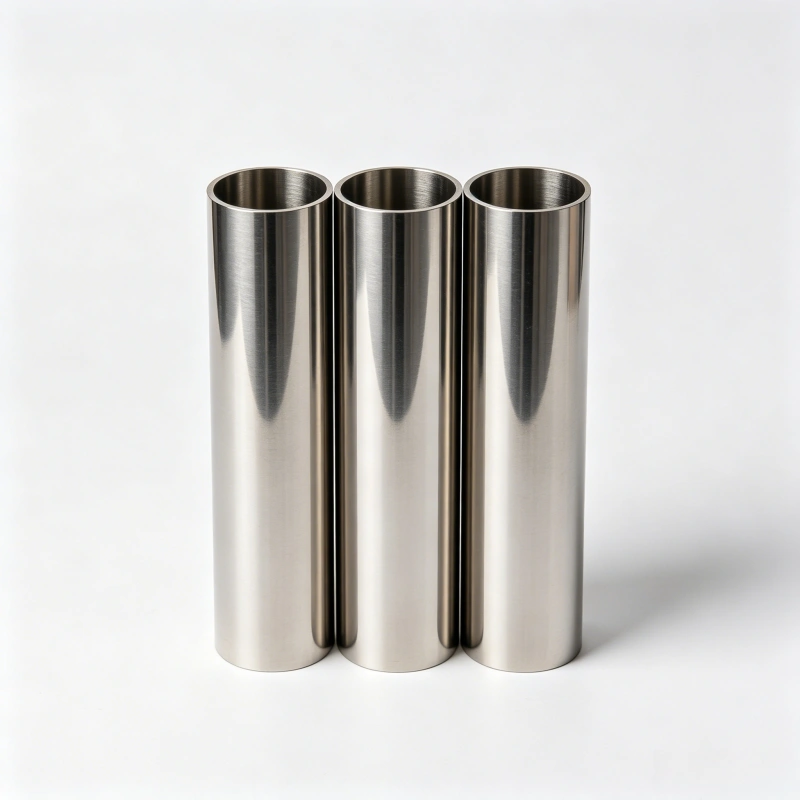
SUH409L / X2CrTi12 Stainless Steel Seamless Tube — Product View
Below is a representative batch of SUH409L (1.4512) low-carbon ferritic stainless steel seamless tubes in the bright-annealed surface finish. These precision tubes are manufactured to JIS G3463, EN 10216-5, and EN 10297-2, with full NDT and dimensional verification completed before release.
Applications
SUH409L is specified wherever standard 409's corrosion and oxidation resistance is sufficient, but the fabrication process demands superior weld integrity, higher as-welded ductility, or freedom from post-weld annealing. Typical downstream applications include:
- Complex welded exhaust manifolds — Multi-pass welded fabrications where standard 409 may develop brittle martensite in the HAZ; 409L's ultra-low carbon eliminates this risk.
- Flexible exhaust couplings and bellows — Components formed and welded from thin-wall tube where as-welded ductility directly determines fatigue life under thermal cycling.
- Catalytic converter shells with fillet-welded flanges — Weld zones maintain full corrosion resistance without post-weld solution treatment, reducing manufacturing cost.
- EGR cooler tube bundles — Tube-to-tubesheet welds in EGR coolers benefit from 409L's resistance to sensitization in the as-welded condition.
- Exhaust gas aftertreatment tubing — SCR and DPF system tubing with multiple welded joints, where the cumulative benefit of low-carbon material becomes significant.
- Heat exchanger tubes — Moderate-temperature shell-and-tube exchangers in boiler tube and process heating applications where 409L's combination of thermal conductivity and cost efficiency is valued.
- Industrial oven and furnace components — Tubular supports and radiant tube assemblies operating at temperatures up to 675°C intermittent / 815°C continuous.
Specifications & Standards
SUH409L / X2CrTi12 is governed by multiple international standards. The table below identifies the key tube and product-form specifications applicable to this grade. Fushun Steel Tube manufactures to any of these standards.
| Standard | Title / Scope | Tube Type | Grade Designation |
|---|---|---|---|
| JIS G4312 | Heat-Resisting Steel Plate, Sheet and Strip | — | SUH409L |
| JIS G3463 | Stainless Steel Boiler and Heat Exchanger Tubes | Seamless & Welded | SUH409L |
| EN 10216-5 | Seamless Steel Tubes for Pressure Purposes — Stainless Steel Tubes | Seamless | X2CrTi12 / 1.4512 |
| EN 10297-2 | Seamless Circular Steel Tubes for Mechanical and General Engineering Purposes — Stainless Steel | Seamless | X2CrTi12 / 1.4512 |
| EN 10088-2 | Stainless Steels — Technical Delivery Conditions for Sheet/Plate and Strip | — | X2CrTi12 / 1.4512 |
| BS 6323-1 | Seamless and Welded Steel Tubes for Automobile, Mechanical and General Engineering Purposes | Seamless & Welded | 409S19 / 1.4512 |
For precision tube requirements, SUH409L can also be supplied to EN 10305-4 tolerances. All tubes ship with EN 10204 3.1 certificates; 3.2 with third-party inspection is available on request.
Available Sizes & Delivery
| Route | OD Range (mm) | WT Range (mm) | Length (m) |
|---|---|---|---|
| Hot-Rolled Seamless | 32–426 | 2.5–40 | Up to 12 |
| Cold-Drawn Seamless | 6–219 | 0.8–25 | Up to 12 |
| Cold-Rolled Seamless | 6–114 | 0.5–12 | Up to 12 |
Common SUH409L sizes in ready stock ship within approximately 7 days. For non-standard dimensions or custom specifications, MOQ is typically 2–3 tons with a delivery lead time of 25–35 days. Small trial orders are welcome for initial evaluation. Volume buyers benefit from negotiable pricing and coordinated production scheduling. Tell us your specifications for a detailed delivery estimate.
Chemical Composition
The ultra-low carbon content is the defining characteristic of SUH409L. The table below compares the composition requirements under JIS G4312 and EN 10088-2:
| Element | JIS G4312 SUH409L | EN 10088-2 X2CrTi12 / 1.4512 |
|---|---|---|
| Carbon (C) | ≤ 0.03% | ≤ 0.03% |
| Silicon (Si) | ≤ 1.00% | ≤ 1.00% |
| Manganese (Mn) | ≤ 1.00% | ≤ 1.00% |
| Phosphorus (P) | ≤ 0.040% | ≤ 0.040% |
| Sulfur (S) | ≤ 0.030% | ≤ 0.015% |
| Chromium (Cr) | 10.50–11.75% | 10.50–12.50% |
| Nickel (Ni) | ≤ 0.60% | ≤ 0.50% |
| Titanium (Ti) | 6×C min, 0.75% max | 6×(C+N) min, 0.65% max |
The titanium stabilization mechanism is identical to standard 409: by maintaining a Ti-to-(C+N) ratio of at least 6:1, all free interstitial carbon and nitrogen are bound as stable titanium carbonitrides. This prevents chromium depletion at grain boundaries during welding or elevated-temperature exposure, ensuring consistent intergranular corrosion resistance. The key difference is that with carbon starting at ≤0.03% instead of ≤0.08%, the required titanium addition is proportionally smaller, and the safety margin against sensitization is substantially larger.
Manufacturing Process
Fushun Steel Tube produces SUH409L seamless tube through an integrated manufacturing route with full process control from melt to finished product:
- Steelmaking: EAF melting with precise ferroalloy additions, LF refining for tight composition control (particularly carbon at ≤0.03% and Ti at 6×C), VD treatment for gas removal. For critical applications, ESR or VIM+VAR secondary melting is available for enhanced cleanliness.
- Continuous Casting: Round billets are continuously cast, surface-conditioned, and cut to pipe-mill charging length.
- Hot Piercing & Rolling: Billets heated to 1150–1250°C are rotary-pierced and rolled on pilger or plug mills to hot-rolled dimensions.
- Cold Drawing / Cold Rolling: For precision tubes under cold-drawn steel tube tolerances, hot-rolled hollows are cold-drawn through dies or cold-rolled on pilger mills to achieve tight dimensional control and improved surface finish.
- Annealing: All tubes are annealed at 780–850°C with controlled cooling to restore the equilibrium ferritic microstructure with fine grain size.
- Finishing: Straightening, cut-to-length, end preparation, and surface treatment (pickled-and-passivated or bright-annealed) per order requirements.
Mechanical Properties
SUH409L / X2CrTi12 mechanical properties in the annealed condition, as specified by the applicable standards:
| Property | JIS G4312 SUH409L (Plate/Sheet) |
EN 10088-2 1.4512 (Strip, +A Condition) |
EN 10216-5 1.4512 (Seamless Tube) |
|---|---|---|---|
| Tensile Strength | ≥ 360 MPa | 380–560 MPa | 390–560 MPa |
| Yield Strength (0.2%) | ≥ 175 MPa | ≥ 210 MPa (long.) ≥ 220 MPa (trans.) |
≥ 200 MPa |
| Elongation | ≥ 25% | ≥ 25% | ≥ 20% |
| Hardness, max | 162 HBW / 80 HRB | — | 180 HB |
| Density | 7.75 g/cm³ (0.280 lb/in³) | ||
| Melting Range | ~1480–1530°C (2696–2786°F) | ||
| Modulus of Elasticity | ~200 GPa at 20°C | ||
| Thermal Conductivity | ~25 W/m·K at 20°C | ||
| Mean Thermal Expansion (20–500°C) | ~11.5 × 10⁻⁶ /K | ||
The low thermal expansion coefficient—roughly 30% lower than austenitic grades like 304—is one of SUH409L's principal engineering advantages. In exhaust system applications where components undergo rapid temperature cycling from ambient to 600°C and back, lower expansion translates directly to lower thermal stress, reduced distortion, and longer fatigue life.
Heat Treatment
| Treatment | Temperature | Holding Time | Cooling | Purpose |
|---|---|---|---|---|
| Full Annealing | 780–850°C (1436–1562°F) | 30–90 min | Air cool or water quench | Recrystallize cold-worked structure; restore ductility and formability |
| Stress Relieving | 650–760°C (1202–1400°F) | 60–120 min | Air cool | Relieve residual stresses from forming or welding without grain growth |
A key practical advantage of SUH409L over standard 409 is that post-weld annealing can often be omitted. The ultra-low carbon content means that even without a post-weld solution treatment, the heat-affected zone remains ductile and resistant to intergranular attack. For most automotive exhaust applications, as-welded 409L is used directly. Stress relieving at 650–760°C is recommended only for heavily cold-formed or multi-pass welded components where dimensional stability or residual stress reduction is required.
Surface Finish & Tolerances
- Bright Annealed (Cold-Drawn/Cold-Rolled)
- Standard finish for cold-worked precision tubes. Annealing in a controlled-atmosphere furnace produces a clean, oxide-free surface that requires no post-fabrication pickling. Preferred for automotive exhaust and stainless steel tube applications where internal surface cleanliness is critical.
- Hot-Rolled & Pickled
- Standard finish for hot-rolled seamless tubes. The dark scale from hot forming is removed by acid pickling and passivation, producing a matte gray surface suitable for general industrial use.
- Polished
- OD mechanical polishing to 180#–600# grit is available for architectural, food equipment, or aesthetic applications.
Standard dimensional tolerances follow the applicable ASTM, EN, or JIS specification. For cold-drawn precision tubes, OD tolerance of ±0.10 mm and WT tolerance of ±10% of nominal are routinely achieved. Tighter tolerances are available—specify at inquiry.
Quality Assurance & Testing
- Raw Material Verification: Incoming billets verified by OES for full chemistry including carbon at ≤0.03% and Ti:C ratio confirmation. Every heat is tagged and traceable through production.
- In-Process Controls: Real-time monitoring of hot-rolling and cold-drawing parameters. Dimensional checks at each process stage.
- NDT: 100% of tubes receive eddy current or ultrasonic testing per the applicable standard.
- Hydrostatic Testing: Performed to specification requirements, typically at 1.5× design pressure with prescribed hold times.
- Mechanical Testing: Tensile tests at room temperature on sample coupons from each heat treatment lot. Hardness verification.
- Metallographic Examination: Microstructure verification—fully ferritic, fine-grained, free of martensite. Intergranular corrosion testing per ASTM A763 Practice X available on request.
- Dimensional Final Inspection: 100% check on OD, WT, length, straightness, and end condition before packing.
Our quality system is ISO 9001 certified. EN 10204 3.1 certificates are standard; 3.2 with third-party witness inspection by SGS, BV, LR, or your nominated agency is available. Request a sample or certificate template for your review.
Packing & Shipping
- Cold-drawn precision tubes: Anti-rust paper wrap, steel-strapped bundles, seaworthy plywood cases with end protectors.
- Hot-rolled tubes: Bare bundles with steel straps, plastic end caps. Water-resistant fabric wrap for export orders.
- Small-diameter tubes (OD ≤ 25 mm): Wooden crates with inter-layer separators to prevent fretting.
Shipping by sea freight (FCL/LCL), air freight, rail, or express courier. Custom labeling and bar-coding available for volume buyers. Our logistics team handles documentation and customs clearance for all major ports worldwide.
Frequently Asked Questions
- What is the difference between SUH409L and standard 409 / SUH409?
- SUH409L has a maximum carbon content of 0.03%, compared to 0.08% for standard SUH409. This 2.7× reduction in carbon virtually eliminates martensite formation during welding, significantly improves as-welded ductility, and generally removes the need for post-weld heat treatment. Elongation is also higher at ≥25% versus ≥22%. The chromium range is nearly identical. For applications involving complex welded assemblies or where post-weld annealing is impractical, 409L is the strongly preferred choice.
- Why is low carbon important for automotive exhaust tubing?
- Modern exhaust systems contain multiple welded joints—manifold-to-flange, tube-to-tube, and bracket attachments—often fabricated by robotic MIG or TIG welding at high speed. In standard 409, carbon levels of 0.05–0.08% can produce small amounts of brittle martensite in the weld HAZ during rapid cooling. SUH409L's C ≤ 0.03% eliminates this risk, ensuring every weld zone retains ductility and corrosion resistance without requiring post-weld annealing—a significant manufacturing cost saving. Contact us for a free quote on your SUH409L exhaust tubing requirements.
- Can SUH409L replace 304 in exhaust system applications?
- For the majority of automotive exhaust applications—manifolds, downpipes, catalytic converter bodies, mufflers, and tailpipes—SUH409L is not only a suitable replacement but often the better engineering choice. Its thermal expansion coefficient (~11.5 × 10⁻⁶/K) is approximately 30% lower than 304 (~17.0 × 10⁻⁶/K), meaning lower thermal stress during heat cycling and better dimensional stability. Combined with a cost saving of 30–40%, this makes 409L the standard material for mass-produced exhaust systems. 304 should be retained for applications involving chloride exposure (coastal environments, road de-icing salt) or where the cosmetic bright finish of 304 is specifically required.
- What sizes and delivery times are available for SUH409L tube?
- We supply SUH409L seamless tube in OD 6–426 mm, WT 0.8–40 mm, in lengths up to 12 meters. Common sizes in stock ship in approximately 7 days. Custom sizes require MOQ 2–3 tons with 25–35 day delivery. Small trial orders are welcome for first-article qualification.
- Do you supply SUH409L tubes with EN 10204 3.2 certification?
- Yes. Every shipment includes an EN 10204 3.1 mill test certificate documenting full chemical analysis, mechanical properties, NDT results, hydrostatic test data, and dimensional verification. EN 10204 3.2 certificates with third-party witness inspection by SGS, Bureau Veritas, Lloyd's Register, or your nominated agency are available on request. Our facility is ISO 9001 certified.