
Project Description
Corrugated Special-Shaped Steel Tube — Product Overview
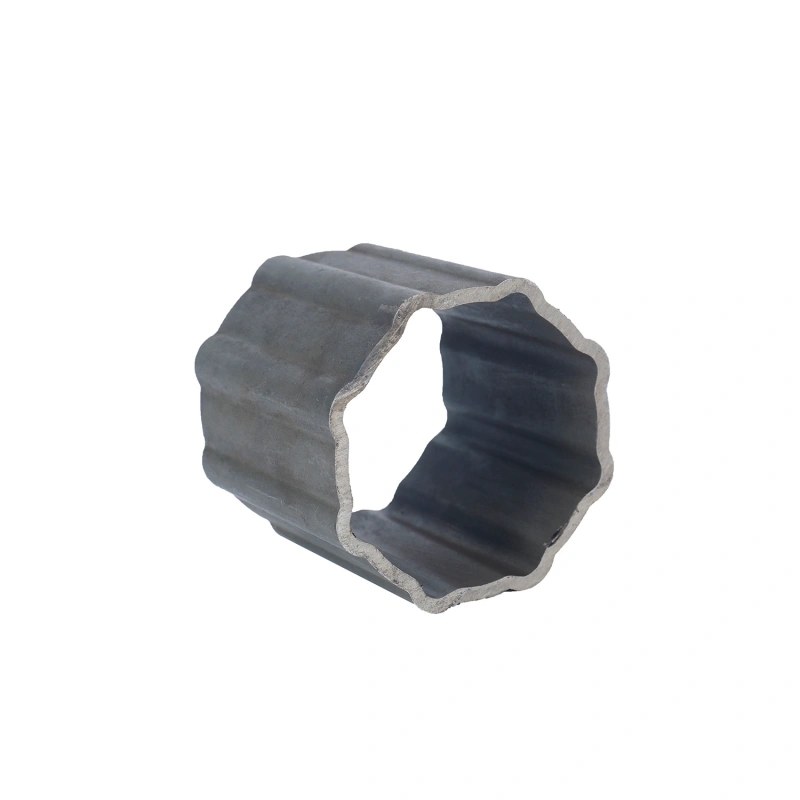
The corrugated special-shaped steel tube—also referred to as a multi-lobe tube or corrugated profile tube—is an advanced tubular product engineered for applications demanding superior heat transfer and structural performance. Unlike conventional round tubes whose inner and outer walls present smooth, uniform cylindrical surfaces, this tube features a distinctive circumferential wave profile: a continuous alternation of raised convex ridges and recessed concave grooves that together form a corrugated annular cross‑section.
This undulating geometry is far from cosmetic. Every ridge and every groove contributes directly to the tube's functional behavior. The corrugated profile multiplies the effective surface area compared with a smooth-walled tube of the same nominal diameter—typically yielding a 25 % to 45 % gain in wetted area. For industries such as automotive manufacturing, agricultural machinery production, and general mechanical engineering, that translates into measurable improvements in thermal efficiency, structural rigidity, and material economy.
Fushun Steel Tube manufactures these tubes to exacting dimensional tolerances under ASTM, EN, and DIN specifications. Each tube is produced through precision cold-drawn seamless steel tube processes that ensure consistent ridge geometry, uniform wall thickness distribution, and repeatable mechanical properties across production batches. Whether your project calls for cost-effective carbon steel or high-temperature alloy steel, our corrugated special-shaped tubes deliver dependable, long-service‑life performance.
Product Image
Distinctive Profile Geometry
Corrugated Wave Contour
The defining characteristic of this tube is its wave-like profile when viewed in cross-section. Instead of tracing a perfect circle, the tube wall follows a continuous sinusoidal or multi-lobe path around the circumference. Raised convex ridges project outward at regular angular intervals, separated by concave grooves that dip inward. This pattern repeats symmetrically along the entire length of the tube, creating a consistent corrugated geometry from end to end.
The number of lobes—typically ranging from 4 to 12 depending on the outer diameter—determines the pitch and amplitude of the wave pattern. A higher lobe count produces finer corrugations with greater total surface area gain; fewer but deeper lobes prioritize structural rigidity. Our engineering team works closely with customers to select the optimal lobe configuration for their specific thermal and mechanical requirements.
Radial Wall Thickness Variation
A direct consequence of the corrugated forming process is a deliberate, controlled variation in wall thickness around the tube circumference. At the crest of each ridge the wall measures slightly thinner than at the trough of each adjacent groove. This thickness gradation—typically maintained within a tolerance band of ±8 % of nominal—is not a defect but an intentional design feature. The thicker material concentrated at the groove bases reinforces the tube against radial compression, while the thinner ridge crests reduce overall weight without compromising axial load-bearing capacity. The result is a tube that resists denting and ovalization far more effectively than a smooth-walled equivalent of the same nominal gauge.
Uniform Gear-Like Surface Texture
Viewed end-on or in section, the corrugated special-shaped tube presents a gear-like or star-shaped profile. Both the external surface and the internal bore exhibit the same rhythmic undulation, visible as a consistent pattern of alternating peaks and valleys. This uniform texture is achieved through precision tooling and tightly controlled drawing parameters, ensuring that every millimeter of tube length maintains the specified profile.
The gear-like contour also provides natural keying surfaces for mechanical bonding in composite assemblies—a valuable property in over-molded and encapsulated components. Additionally, the textured profile disrupts laminar boundary layer formation on both the inner and outer walls, enhancing convective heat transfer by promoting localized turbulence at lower flow velocities than smooth-bore tubes can achieve.
Performance Advantages
Maximized Thermal Transfer Surface
The single most significant performance advantage of the corrugated profile is the substantial increase in effective heat transfer area. For a tube of given nominal diameter and length, the corrugated geometry can increase the wetted surface area by 25 % to 45 % compared with an equivalent smooth-bore tube. This directly improves heat exchange rates in applications such as engine cooling radiators, oil coolers, intercoolers, charge air coolers, and HVAC condensers. In boiler tube and heat recovery steam generator systems, the enhanced surface area enables more compact heat exchanger designs without sacrificing thermal output.
The corrugations also promote turbulent flow at lower Reynolds numbers than smooth tubes, further boosting the convective heat transfer coefficient. Effective thermal performance is maintained even at reduced flow velocities, contributing to overall system energy efficiency—a critical consideration in modern vehicle thermal management and industrial process heating.
Elevated Structural Rigidity
The corrugated geometry imparts significantly higher bending stiffness and radial crush resistance compared with smooth-walled tubes of equivalent material grade and nominal wall thickness. The alternating ridge-and-groove structure functions analogously to corrugated sheet metal or I-beam flanges: the raised ridges act as longitudinal stiffening ribs that resist flexural deformation. In agricultural machinery applications where tubes serve as structural supports, protective sleeves, or spacer elements, this added rigidity reduces the risk of denting and buckling under rough field conditions.
For manufacturers seeking to balance strength with weight, the corrugated tube often allows a down-gauging strategy—replacing a heavier-gauge smooth tube while delivering equivalent or superior mechanical performance. To discuss how corrugated special-shaped tubes can optimize your next project, contact our engineering team for a technical consultation.
Weight-Optimized Design
By concentrating material where it contributes most to structural integrity—at the groove bases and ridge transition zones—the corrugated tube achieves an efficient strength-to-weight ratio. This is particularly valuable in automotive and mobile machinery applications where every kilogram saved contributes directly to fuel economy and emissions compliance. The tube's intrinsic geometric stiffening means that designers can often specify a thinner starting gauge than would be required for a conventional round tube, yielding weight savings of 10 % to 20 % without compromising durability.
Material Grades & Manufacturing Standards
Fushun Steel Tube supplies corrugated special-shaped tubes in a range of carbon and alloy steel grades conforming to internationally recognized standards. American specifications are covered by ASTM A519 seamless carbon and alloy steel mechanical tubing, available in grades 1010, 1020, 1026, 4130, and 4140. European specifications include EN 10297 seamless circular steel tubes for mechanical and general engineering purposes in grades E235 and E355, alongside DIN 2391 seamless precision steel tubes in St35, St45, and St52.
For applications demanding enhanced corrosion resistance, stainless steel tube variants in grades 304, 304L, 316, and 316L are also available upon request. All products are accompanied by mill test certificates compliant with EN 10204 Type 3.1, providing full traceability from heat number to finished tube.
Industrial Applications
Automotive Industry
Corrugated special-shaped tubes are widely specified in automotive thermal management systems. They serve as core tubing in engine radiators, heater cores, oil coolers, and charge air coolers where their enhanced surface area maximizes heat rejection within tight under‑hood packaging constraints. The tubes' vibration-damping characteristics—a natural consequence of their non-uniform cross-section—also make them well suited for exhaust gas recirculation (EGR) cooler applications, where thermal cycling and mechanical vibration are persistent operational challenges.
Agricultural Machinery
In agricultural equipment these tubes perform dual roles—functioning simultaneously as structural components and fluid conduits. Their high bending stiffness makes them ideal for hydraulic line protection sleeves, power take-off shaft guards, and implement frame reinforcements. The corrugated surface texture provides natural mechanical adhesion for powder coating and paint finishes, improving long-term corrosion protection for equipment routinely exposed to fertilizers, moisture, and abrasive field debris.
Mechanical Engineering & General Industry
Beyond automotive and agricultural sectors, corrugated special-shaped tubes are specified for industrial shell-and-tube heat exchangers, compressor intercoolers and aftercoolers, hydraulic system oil coolers, and pneumatic air dryers. Their versatility extends to architectural and furniture applications where the distinctive gear-like profile serves an aesthetic as well as structural function—featured in exposed tubular frameworks, handrail systems, and decorative structural elements that demand visual impact alongside engineering integrity.
Technical Specifications
| Parameter | Specification Range |
|---|---|
| Outer Diameter | 15 mm – 120 mm |
| Wall Thickness | 0.8 mm – 6.0 mm |
| Length | Up to 12,000 mm (custom cut lengths available) |
| Lobe Count | 4 – 12 (application-optimized) |
| ASTM Grades | 1010, 1020, 1026, 4130, 4140 |
| EN / DIN Grades | E235, E355 / St35, St45, St52 |
| Applicable Standards | ASTM A519, EN 10297, DIN 2391, BS 6323 |
| Surface Treatment (Optional) | Oil-dipped, phosphated, galvanized |
| End Finish | Plain end, deburred, chamfered |
Quality Assurance & Testing
Every production batch of corrugated special-shaped tubes undergoes a comprehensive inspection regimen before release. Our standard testing protocol includes:
- Eddy Current Testing (ECT) — 100 % inspection for surface and near-surface discontinuities
- Hydrostatic Pressure Testing — verification of leak-tight integrity at 1.5× design pressure
- Dimensional Metrology — laser micrometer and coordinate measuring system verification of OD, wall thickness, lobe geometry, and straightness
- Visual Inspection — controlled-lighting surface examination for finish quality and geometric consistency
For critical applications, supplementary non-destructive testing methods—including ultrasonic testing (UT) and dye penetrant inspection (DPI)—are performed upon customer specification. Mill test certificates compliant with EN 10204 Type 3.1 are supplied as standard documentation with every shipment. Our quality management system is certified to ISO 9001:2015, ensuring consistent process control from raw material sourcing through final packaging and dispatch.
Request a Quote
Whether you need standard-sized corrugated special-shaped tubes from production inventory or custom-engineered profiles for a specific application, Fushun Steel Tube is ready to support your project. Contact our sales team with your dimensional requirements, preferred material grade, lobe configuration, and target quantity—we will provide a competitive quotation within 24 hours. We welcome inquiries for both prototype quantities and full-scale production volumes, and our engineering staff is available to assist with material selection and profile optimization for your unique operating conditions.
For urgent requirements or technical questions, reach us directly at [email protected]. Comprehensive product datasheets and material test reports are available upon request.